The reorganization of administrative units creates opportunities to restructure development spaces, concentrate resources and strengthen linkages among localities. However, larger administrative scales can only be transformed into growth drivers when accompanied by governance capacity, effective resource allocation, integrated infrastructure and the ability to leverage the strengths of each area.
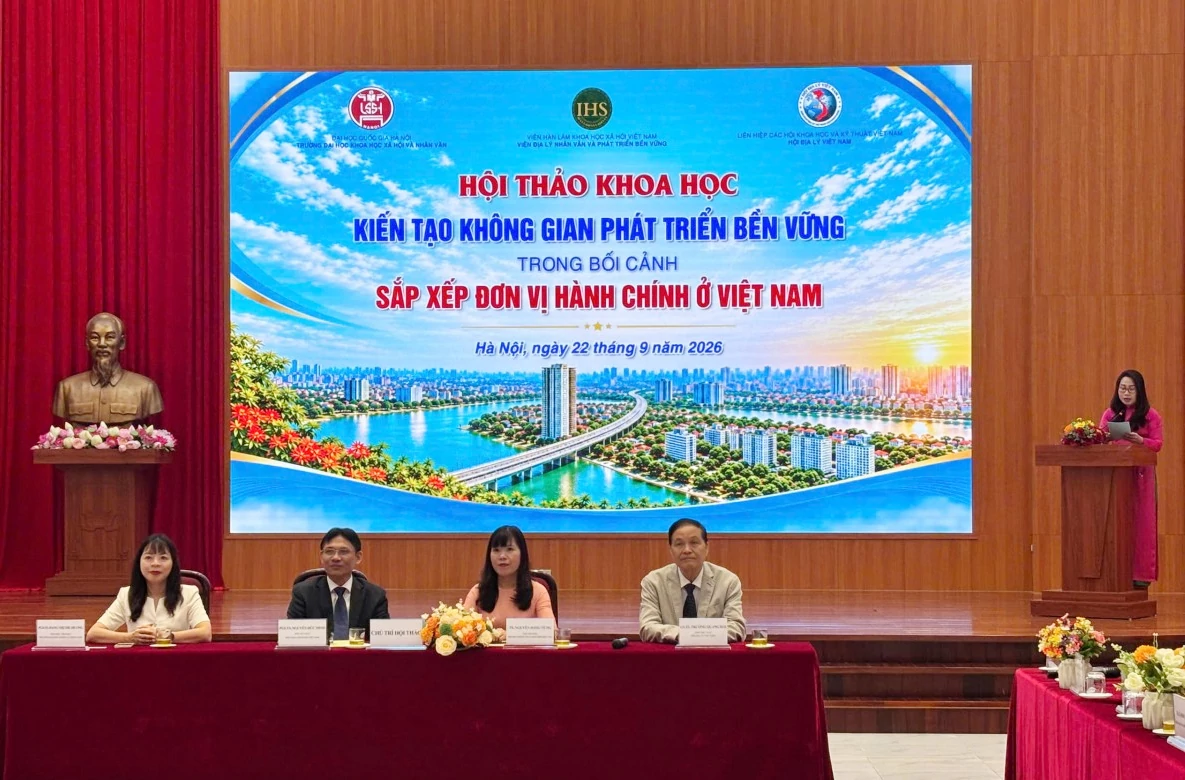
Scientific workshop on creating sustainable development spaces in the context of administrative unit reorganization.
Turning the New Scale into a Resource for Growth
The restructuring of administrative boundaries is bringing about major changes in population size, geographical area, resources and the scope of governance. Following the reorganization, the country has 34 provincial-level administrative units and 3,321 commune-level administrative units. Behind these figures lies a process of restructuring development spaces, creating new potential that needs to be effectively leveraged.
The question is how the new scale can create additional value for the economy. Broader administrative boundaries can form larger markets, facilitate resource concentration, strengthen linkages among regions and support infrastructure restructuring. However, these advantages need to be translated into implementation capacity, investment efficiency and improved quality of public services.
Speaking at the scientific workshop titled “Creating Sustainable Development Spaces in the Context of Administrative Unit Reorganization” on September 22, Associate Professor and PhD Nguyen Anh Cuong of the University of Social Sciences and Humanities under Vietnam National University, Hanoi, said that the reorganization of administrative units creates opportunities to reduce administrative focal points, concentrate resources and expand the scale of governance. This provides an important basis for reorganizing development resources across a larger space with stronger potential for connectivity.
However, an expanded scale does not automatically create corresponding development capacity. According to Associate Professor and PhD Nguyen Anh Cuong, opportunities arising from the new scale can only be transformed into implementation capacity when supported by institutional design, resources, data, channels of representation and accountability mechanisms. These are also decisive factors in determining the quality of governance following the reorganization.
When information is interconnected, planning, investment and service delivery can better reflect the characteristics of each locality. This provides a foundation for more efficient use of public resources while facilitating production and business activities. In this way, digital transformation becomes part of the capacity to create growth within the new administrative space.
From a growth perspective, this requirement is particularly important. When resources are concentrated, authorities are better positioned to identify priority areas, allocate investment according to actual needs and leverage complementary advantages among localities. A larger development space also provides a basis for reducing fragmented investment and increasing the potential for projects of greater scale and wider spillover effects.
Associate Professor and PhD Nguyen Anh Cuong proposed assessing implementation capacity after the reorganization across five dimensions: territorial coverage; resource allocation; service delivery; data and digitalization; and accountability. Accordingly, assigned responsibilities should be accompanied by corresponding authority, budgets, human resources, data and accountability to ensure that decentralization can operate effectively.
Data has become an important component of the new governance model. Authorities need to have access to information on population, infrastructure, land, public services and vulnerable groups in order to allocate resources based on the needs of each area. Population, civil status, land, social security, enterprise and administrative procedure data should also be interconnected.
Another requirement is to avoid excessive concentration of development resources in the new administrative center. Areas following reorganization often encompass localities with different economic conditions, infrastructure and access to services. Without appropriate coordination mechanisms, the benefits of scale may be accompanied by widening development gaps between the center and more remote areas.
Creating a Polycentric Development Network and Leveraging the Strengths of Each Area
In response to these requirements, Associate Professor and PhD Nguyen Anh Cuong proposed developing the spatial structure toward a coordinated polycentric model. The new administrative center would serve a coordinating role, while former centers could be repurposed as public service points, community spaces, educational and healthcare facilities, or digital support centers, thereby continuing to utilize previously invested resources.
For areas located far from the center, authorities could increase infrastructure investment, organize mobile public services and maintain rotating channels for voter engagement. This approach would strengthen the coordinating role of the new center while making use of existing facilities and capabilities in areas prior to the reorganization, thereby limiting resource waste.
The conversion of former administrative offices to other uses could also generate additional resources for development. Associate Professor and PhD Nguyen Anh Cuong cited a case in Dong Anh, Hanoi, where a facility originally built for the district-level People's Committee was converted into a school in Nam Hong Commune after its function was changed. This approach created additional educational facilities to serve local residents.
According to the expert, the effectiveness of the reform should also be evaluated periodically after 6 months, 12 months and 36 months. Local authorities could publicly disclose the number of applications processed, levels of citizen satisfaction, transition costs, results of handling surplus administrative facilities and investment allocation, allowing issues requiring adjustment to be identified in a timely manner.
From a broader perspective, Professor and PhD Nguyen Cao Huan, Chairman of the Vietnam Geographical Association, said that creating development spaces needs to be closely linked with spatial governance. Reorganizing administrative boundaries establishes the initial framework, while development effectiveness depends on how resources within the new space are connected, managed and mobilized.
Associate Professor and PhD Nguyen Ngoc Khanh, a member of the Vietnam Geographical Association, proposed a network-based governance model operating in two directions: from higher levels to grassroots levels and from grassroots levels upward. OCOP products demonstrate that when community resources are connected with distribution systems and markets, local value can become part of a broader development network.
The network-based approach also allows each locality to be viewed as a link with its own specific function. Administrative centers can undertake coordination functions; production areas can leverage their industrial or agricultural strengths; while localities with distinctive cultural identities can develop cultural, tourism and related economic activities. When effectively connected, these individual strengths can complement one another and expand the space for growth.