In the first eight months of 2026, Customs authorities detected 29 tobacco smuggling cases, seizing more than 132,000 packs of cigarettes and 135,000 electronic cigarette products. The cases show that smuggled goods are being transported and concealed through increasingly diverse methods, highlighting the need to strengthen risk identification at an early stage...
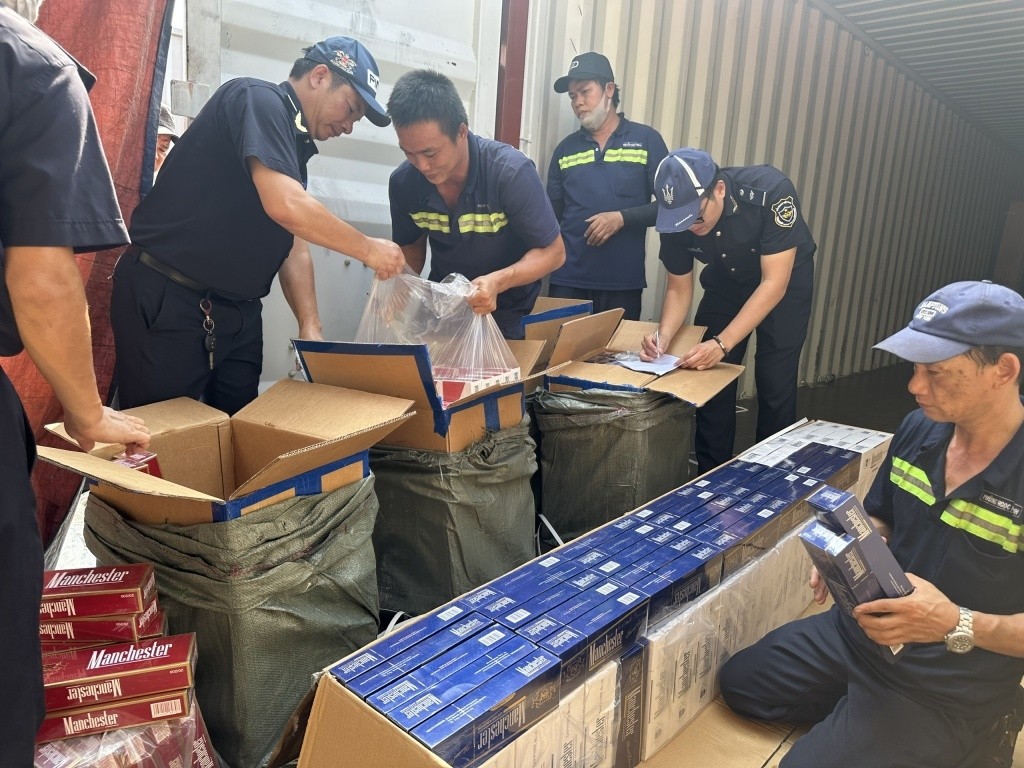
Smuggled tobacco disguised by offenders and detected and seized by Customs authorities. Photo: Thu Hoa.
Tobacco smuggling is shifting toward increasingly sophisticated transportation and concealment methods, with illicit products being not only mixed into import and export shipments but also introduced into e-commerce activities and cyberspace.
Implementing the directions of the Government, the National Steering Committee 389, and the Ministry of Finance, the Customs Department has instructed regional Customs branches to strengthen controls, proactively collect information, and identify at an early stage suspected smuggling rings and organized groups showing signs of violations.
According to a report by the Customs Department, during the first eight months of 2026, the sector detected, apprehended, and handled 29 tobacco-related cases involving 28 individuals. Seized exhibits included 132,650 packs of smuggled cigarettes, 135,206 electronic cigarette products, and 9,343 kg of tobacco leaves.
The scale of seized goods in some cases shows that smuggled products are not transported solely through small-scale methods. In June 2026, Regional Customs Branch II detected more than 83,000 packs of cigarettes concealed in a container carrying exported food products. The goods had not been declared to the Customs authorities and were immediately detained at the border gate.
Another larger-scale case was detected at Lao Bao International Border Gate.
In August 2026, Customs authorities at Lao Bao International Border Gate under Regional Customs Branch IX, in coordination with the relevant authorities, conducted enforcement measures and compelled the destruction of nearly 325,000 packs of counterfeit Esse Change 4mg cigarettes. The total value of the violating goods was estimated at approximately VND 6.44 billion.


Law enforcement forces detected and temporarily seized large quantities of smuggled tobacco products. Source: Customs Department.
These cases show that controlling smuggled tobacco is becoming increasingly difficult if efforts focus solely on direct inspections at border gates. When illicit goods can be disguised within other shipments or traded through online channels, detection needs to begin with information on transportation routes, types of goods, enterprises, and unusual signs arising during customs clearance procedures.
According to the Customs Department’s direction, relevant units are required to strengthen information collection and analysis, focusing on unusual signs during customs clearance, transportation routes, and types of goods that may be exploited to conceal or illegally transport tobacco products.
The scope of control covers not only smuggled cigarettes but also counterfeit tobacco products, tobacco materials, electronic cigarettes, and heated tobacco products. The expansion of the scope reflects changes in the illicit tobacco market, as violating goods are no longer concentrated in a single traditional product category.
At the same time, control efforts are being expanded from border areas and border gates to inland areas and cyberspace, accompanied by requirements for information sharing among relevant authorities.
This is one of the issues addressed in the implementation of Directive No. 25/CT-TTg dated June 9, 2026 of the Prime Minister on strengthening efforts to combat the smuggling, illegal transportation, production, trading, storage, and use of tobacco in the new situation.
Accordingly, the Ministry of Public Security, Ministry of National Defence, Ministry of Finance, Ministry of Industry and Trade, and local authorities are required to direct relevant forces to strengthen situation monitoring, inspection, and control in their respective areas and coordinate in handling violations.
Implementing Directive No. 25/CT-TTg, the Customs Department has requested regional Customs branches to proactively develop operational plans and measures to promptly detect and handle acts of smuggling and illegal transportation of tobacco, electronic cigarettes, and heated tobacco products within their areas of management, while complying with periodic and expedited reporting requirements.
Alongside professional enforcement measures, competent authorities are required to raise public awareness of new methods and tactics so that people can recognize them and reduce the risk of purchasing, transporting, or facilitating the distribution of violating goods.
In the coming period, the Customs Department said it would continue to strengthen control measures, focusing on types of activities and methods that may be exploited for violations, including transit shipments and cross-border e-commerce. Coordination with the police, Border Guard, and Market Surveillance forces will also be strengthened to detect and handle large-scale smuggling rings and organized groups.