To realize its strategy of developing an integrated, modern, and sustainable bauxite–alumina–aluminum industry, Lam Dong Province is coordinating with Vietnam National Coal and Mineral Industries Group (TKV) to implement projects aimed at expanding production capacity.
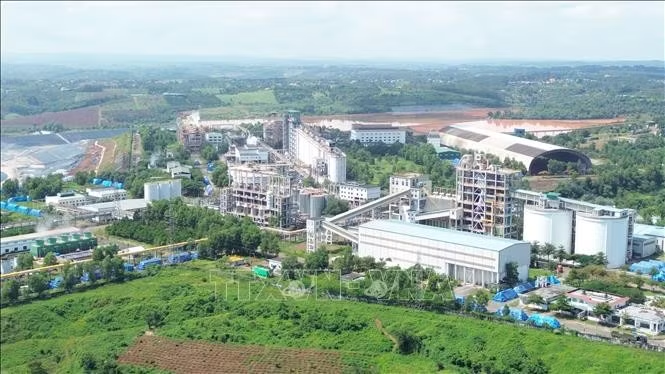
Dak Nong Aluminum Company – TKV, located in Nhan Co Commune, Lam Dong Province, engages in mining and alumina processing, providing an important raw material for the aluminum industry.
According to assessments by relevant authorities, Vietnam currently possesses approximately 5.8 billion tons of bauxite resources, concentrated mainly in the Central Highlands, including Lam Dong Province. These resources provide a vital foundation for developing the alumina and aluminum industries, as well as high-value-added downstream processing products. Establishing aluminum smelting facilities close to raw material sources will not only improve resource extraction efficiency but also create favorable conditions for developing domestic aluminum-consuming industries.
According to Vietnam National Coal and Mineral Industries Group (TKV), years of implementing the pilot projects for the Tan Rai and Nhan Co bauxite mining and alumina production complexes in Lam Dong have demonstrated the soundness of the policies adopted by the Party and the State. These projects have delivered tangible socio-economic benefits while helping ensure national defense and security in the Central Highlands.
Statistics show that, cumulatively from the commencement of operations through the end of June 2026, the complexes had produced nearly 15 million tons of alumina equivalent. Their products have met quality standards and been exported to markets such as the Middle East, India, South Korea, and Japan. The projects have contributed an estimated VND 13.85 trillion to the state budget, created direct employment for more than 2,500 workers, primarily local residents, and provided over VND 550 billion in social welfare support.
A significant step toward completing Vietnam’s deep-processing value chain from bauxite to alumina and aluminum is the commissioning of the Dak Nong Aluminum Electrolysis Plant. On July 26, 2026, in Nhan Co Industrial Park, Nhan Co Commune, the Lam Dong Provincial People's Committee, in coordination with Tran Hong Quan Metallurgy Company Limited, held a ceremony to announce Vietnam’s first aluminum ingot product. The project, invested in by Tran Hong Quan Metallurgy Company Limited, has a total investment of nearly VND 28 trillion and covers an area of 128 hectares. Phase 1 has been completed and entered production, with a capacity of 150,000 tons of aluminum per year. Phase 2, with a planned total capacity of 300,000 tons per year, is expected to commence operations in the fourth quarter of 2026, while Phase 3, bringing the total capacity to 450,000 tons per year, is scheduled for completion in the first quarter of 2027.
According to Tran Hong Quan, Director of Tran Hong Quan Metallurgy Company Limited, the Dak Nong aluminum electrolysis project plays a crucial role in the socio-economic development of Lam Dong Province and the Central Highlands. The project will contribute to the province's target of achieving double-digit economic growth, make significant contributions to the state budget, and create jobs for approximately 3,500 local workers. It will also enhance the economy's ability to meet domestic demand for primary aluminum, improve the trade balance by reducing average annual aluminum imports by approximately USD 1.5 billion, attract further investment, promote the development of downstream aluminum supporting industries, and accelerate Lam Dong's economic restructuring toward industrialization and modernization.
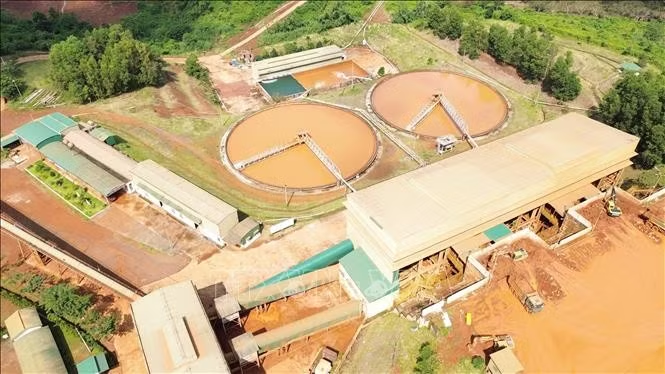
The bauxite ore beneficiation plant supplying alumina production at Dak Nong Aluminum Company – TKV, located in Nhan Co Commune, Lam Dong Province.
Under TKV's development strategy for the bauxite–alumina–aluminum sector in the Central Highlands through 2030, with a vision to 2045, the Group plans to expand the Tan Rai and Nhan Co bauxite mining and alumina production complexes to approximately 2.0 million tons of alumina per year each; invest in the Dak Nong 2 bauxite–alumina complex with a capacity of approximately 2.0 million tons of alumina per year; and invest in an aluminum electrolysis plant in Lam Dong with an annual capacity of 0.5–1.0 million tons of aluminum. The aim is to produce the first aluminum ingot by 2030, helping establish Lam Dong as a national aluminum industry hub.
To realize this goal, Lam Dong Province is gradually expanding its industrial development space by integrating alumina processing and aluminum smelting projects with industrial park planning, energy supply, and transportation infrastructure. The Lam Dong Provincial People's Committee has approved the investment policy and investor for TKV's projects to expand and increase the capacity of the Nhan Co Alumina Plant and the Lam Dong Bauxite–Aluminum Complex, each with a capacity of 1.2 million tons of alumina per year. Both projects aim to commence operations in 2030.
Alongside expanding production capacity, the province is focusing on allocating land for industrial development and ensuring sufficient electricity supplies for aluminum smelting complexes. Under Decision No. 2786/QD-UBND dated June 6, 2026, the Provincial People's Committee approved adjustments to the Lam Dong Provincial Plan for the 2021–2030 period, with a vision to 2050, adding two industrial parks planned to accommodate aluminum electrolysis complexes: Vinh Hao Industrial Park and Vinh Hao 2 Industrial Park. The province has also requested that the Ministry of Industry and Trade include a 1,980 MW coal-fired thermal power project in Vinh Hao Commune in the revised Power Development Plan VIII to ensure a stable electricity supply for aluminum production.
However, to ensure that key projects proceed on schedule and enhance their competitiveness, relevant stakeholders are calling on competent authorities to promptly address outstanding issues. These include financial and land-use mechanisms following mining operations, such as land reclamation, the early handover of land to local authorities, and reimbursement of land clearance compensation costs; energy policies and electricity pricing for aluminum production; coordinated investment in logistics infrastructure, seaports, and railways; and policies to secure long-term investment capital. Resolving these bottlenecks in a coordinated manner will provide strong momentum for Lam Dong to successfully develop into a national aluminum industry hub, contributing to economic growth in the Central Highlands and across the country.
According to leaders of the Lam Dong Provincial People's Committee, the province will continue to accelerate administrative reforms and work closely with central government agencies to resolve difficulties promptly. It will prioritize the completion of connected transport infrastructure and logistics systems while ensuring a safe and stable electricity supply. At the same time, the province will strengthen cooperation with research institutes and universities to train highly skilled technical personnel and create the most favorable conditions for attracting supporting investors to establish a downstream aluminum industrial ecosystem locally.
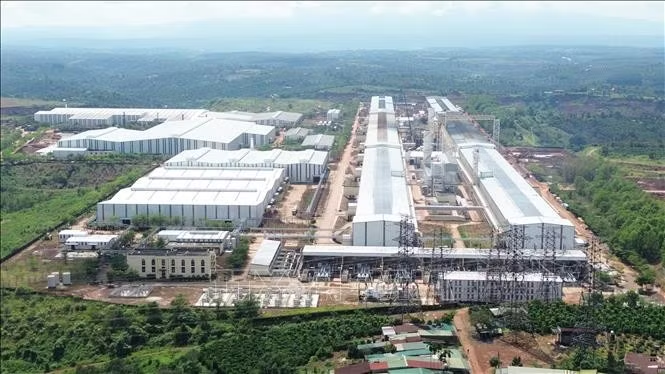
The Dak Nong Aluminum Electrolysis Plant in Nhan Co Industrial Park, Nhan Co Commune, Lam Dong Province, contributing to the completion of Vietnam's deep-processing value chain from bauxite to alumina and aluminum.
With its abundant bauxite resources and strategic focus on integrating mining, processing, primary aluminum production, and downstream aluminum manufacturing, Lam Dong is laying the groundwork for a large-scale aluminum industry hub. Addressing bottlenecks related to energy, capital, and infrastructure will be critical to keeping projects on schedule, increasing the value derived from natural resources, creating employment, and promoting rapid and sustainable local economic development.