Vietnam’s fruit and vegetable exports are showing positive momentum, with export turnover exceeding USD 5.8 billion in the first eight months of the year, bringing the country closer to its target of USD 10 billion in 2026. To accelerate growth in the final months of the year, alongside ensuring supply, quality, and market access, meeting export requirements and procedures will play a decisive role.
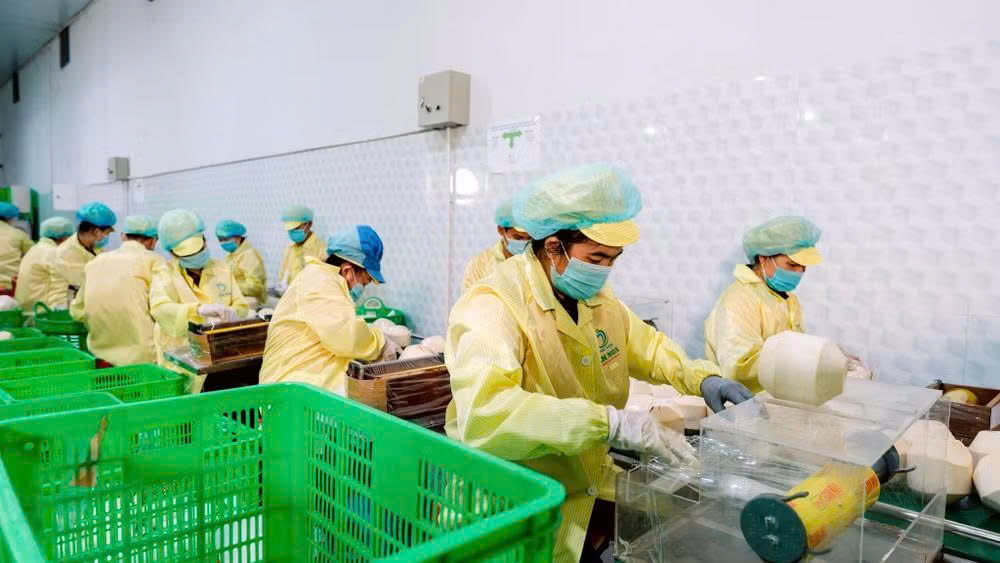
Packaging coconuts for export at an enterprise in Vinh Long Province. (Photo: Minh Anh)
Exceeding USD 1 Billion for Two Consecutive Months
Mr. Dang Phuc Nguyen, Secretary General of the Vietnam Fruit and Vegetable Association, said that Vietnam’s fruit and vegetable exports have made significant progress, reaching export turnover of more than USD 1 billion for the first time in two consecutive months.
Specifically, export turnover in August reached approximately USD 1.09 billion, up 14.6% year on year, while July recorded approximately USD 1.07 billion. Durian continued to make a major contribution to overall export growth.
According to the Customs Department, durian exports in July reached approximately USD 681.2 million, up 81% year on year, bringing total durian export turnover in the first seven months of the year to approximately USD 1.77 billion, an increase of 47.1%.
This result coincided with the beginning of the harvest season in durian-growing areas across the Central Highlands.
Meanwhile, coconuts have emerged as a new bright spot. In the first seven months of 2026, coconut export turnover reached USD 367.446 million, up approximately 20% year on year, surpassing dragon fruit and mangoes to become the second-largest fruit and vegetable export product after durian.
According to Ms. Nguyen Thi Kim Thanh, Chairwoman of the Vietnam Coconut Association, coconuts still have significant growth potential in the remaining months of the year as markets continue to expand and businesses increasingly improve the value-added potential of coconut products.
Accelerating in the Final Stretch
According to the Vietnam Fruit and Vegetable Association, September and October remain peak harvest periods for many fruits, while import demand in China, other Asian markets, and the EU typically increases in the fourth quarter to meet demand during holidays and the Lunar New Year.
According to Mr. Le Anh Dung, General Director of Vietnam National Vegetable, Fruit and Agricultural Products Corporation (Vegetexco Vietnam), the company’s fruit and vegetable products are currently available in approximately 60 countries, including demanding markets such as the United States, the European Union (EU), and Japan.
To proactively secure supply, quality, and delivery schedules, Vegetexco Vietnam has linked raw material production areas with its preliminary processing and processing systems.
Through its network of strategic partners and affiliated farms nationwide, the company is capable of supplying large orders across a diverse range of products.
Beyond supply capacity, requirements for goods to be accepted in import markets are also becoming increasingly detailed.
For markets with strict management of growing areas and packing facilities, such as China, identification codes are an important component of export capacity. This requires accelerating the issuance and approval of such codes to expand formal export capacity.
In the United States, the EU, and Japan, businesses need to effectively control issues related to food safety and plant quarantine. Another challenge facing fresh fruit and vegetable exports is the need to shorten transportation times in order to maintain stable product quality and enhance competitiveness.
For the major Chinese market, exporting countries are continuously seeking ways to deliver their products to consumers as quickly as possible.
According to information from the Import-Export Department under the Ministry of Industry and Trade, Cambodia’s fruit exports to China have increased sharply following the launch of a cross-border agricultural transport corridor through Laos in late June 2026.
This intermodal model allows goods to be transported by road to Laos and then connected to the China-Laos railway, reducing delivery times to approximately one week instead of the 15–20 days required by sea.
As a result, Cambodia’s durian exports to China reached a record 5,738 tons in the first seven months of 2026, nearly 40 times higher than the total volume recorded in all of 2025.
Under these circumstances, efforts to facilitate customs clearance for Vietnamese fruit and vegetable exports are also being accelerated to enhance competitiveness.
In practice, since July 2026, the Customs Department has instructed relevant units to provide maximum facilitation and complete customs clearance for exported agricultural products within the same day, as well as to process customs procedures and supervise exported goods outside regular working hours, on weekends, and during public holidays.
Together with a reliable supply of high-quality products, these measures are expected to provide an important impetus for Vietnam’s fruit and vegetable exports to reach the USD 10 billion target soon.