Artificial intelligence (AI) can solve mathematical problems, write code and process enormous volumes of data. However, selecting the right model, validating results and taking responsibility for decisions still require human judgment. This shift is placing new demands on Economics and Mathematics education, linking mathematical foundations with data, technology and real-world financial applications.

The scientific seminar themed “From Fundamental Mathematics to Models in Economics and Finance.”
Developing the Ability to Master Models in the AI Era
As software can solve most problems in the curriculum and AI is becoming increasingly proficient at writing code, the question for mathematics education is no longer simply how many exercises students can solve. More importantly, do learners understand the nature of a problem, select an appropriate model and recognize the limitations of technology-generated results?
This question was raised at the scientific seminar themed “From Fundamental Mathematics to Models in Economics and Finance,” organized by the Academy of Finance on September 24, 2026. The seminar attracted more than 100 lecturers, scientists and students attending in person, along with nearly 300 students following the event online from the Academy’s campuses and branches.
In his opening remarks and orientation for the seminar, Assoc. Prof. Dr. Nguyen Manh Thieu, Deputy Director of the Academy of Finance, highlighted a notable paradox. Technology can effectively solve many problems posed by humans and may even replace part of the work involved in teaching mathematics. However, AI cannot replace humans in determining whether an economic problem has been properly formulated in the first place.
In economics and finance, this is precisely the part that determines the value of a model. Which model is appropriate for a given problem, which assumptions are satisfied, and whether the analytical results are sufficiently reliable all require human professional expertise. In particular, when an incorrect result leads to a wrong decision, AI is not the party that bears responsibility.
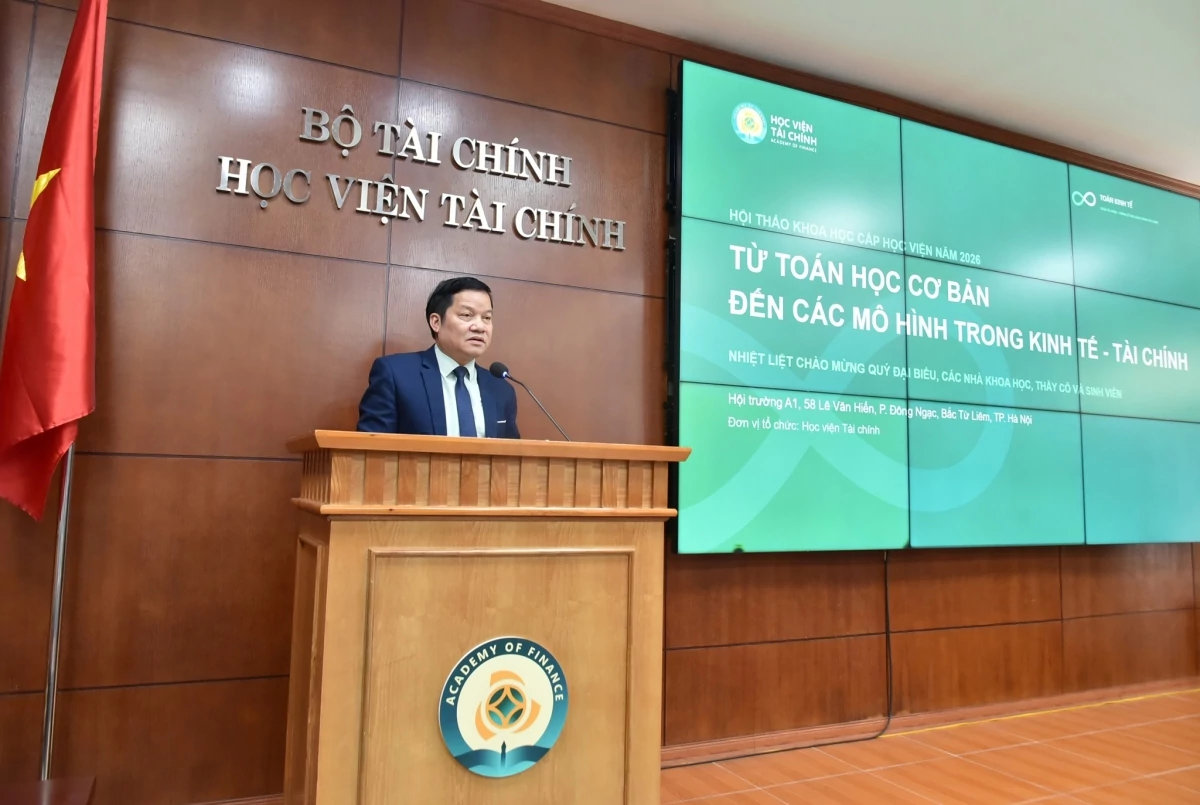
Assoc. Prof. Dr. Nguyen Manh Thieu, Deputy Director of the Academy of Finance, speaks at the seminar.
This context calls for major changes in the teaching, research and application of mathematics in economics and finance. Rather than competing with AI in computational capabilities, learners need to know how to harness technological power on the foundation of solid knowledge. Understanding mathematics, models and data has become essential to using technology proactively rather than depending on results generated by machines.
According to the seminar’s orientation, this process needs to establish a continuous pathway from fundamental mathematics to applied models; develop the ability to master technology and models; and strengthen connections between research and education and actual business practices. These three directions converge on one requirement: bringing mathematical knowledge beyond the scope of purely academic exercises in the classroom.
From a business perspective, the Chief Technology Officer of AIZ Joint Stock Company said that many Vietnamese businesses are currently applying AI in a fragmented manner. Data is stored across multiple systems, departments use separate tools with limited connectivity, while many applications remain at the experimental stage and have yet to be deeply integrated into business operations and management.
To address this challenge, AIZ has developed AIZ BrainOS under an AI enterprise operating system model. BrainZ serves as the “digital brain,” integrating data and knowledge; AgentZ functions as a digital workforce working alongside humans; while ColabZ organizes processes and digital departments, gradually establishing a unified operating system built on data.
Underlying this system is still a mathematical foundation. Data integration requires standardization and linkage; assigning tasks to digital workers requires criteria and constraints; and performance evaluation requires appropriate measurements. These requirements are all closely connected to linear algebra, probability and statistics, and optimization, demonstrating that as AI advances, the ability to understand and master models becomes increasingly important.
Mathematical Foundations Open the Way to Finance and Data
Another perspective comes from the banking sector. Dr. Nguyen Thanh Hao, Head of the Data Science Department at Vietnam Prosperity Joint Stock Commercial Bank (VPBank), presented a report titled “From Mathematics to Data Science and AI: Practical Applications in Finance and Banking,” using his own career journey to demonstrate the value of a mathematical foundation.
From years of working with theorems and proofs to taking charge of data science at a commercial bank, this journey was not a departure from mathematics in favor of technology. Credit scoring, fraud detection, demand forecasting and customer segmentation models are still built on probability, statistics, optimization and quantitative thinking.
What has changed is the type of data and the problems that need to be solved. Mathematics graduates entering finance and banking do not have to start from scratch. The foundation developed through their studies becomes a tool for working with real-world data, building models, evaluating results and addressing problems directly related to business operations.
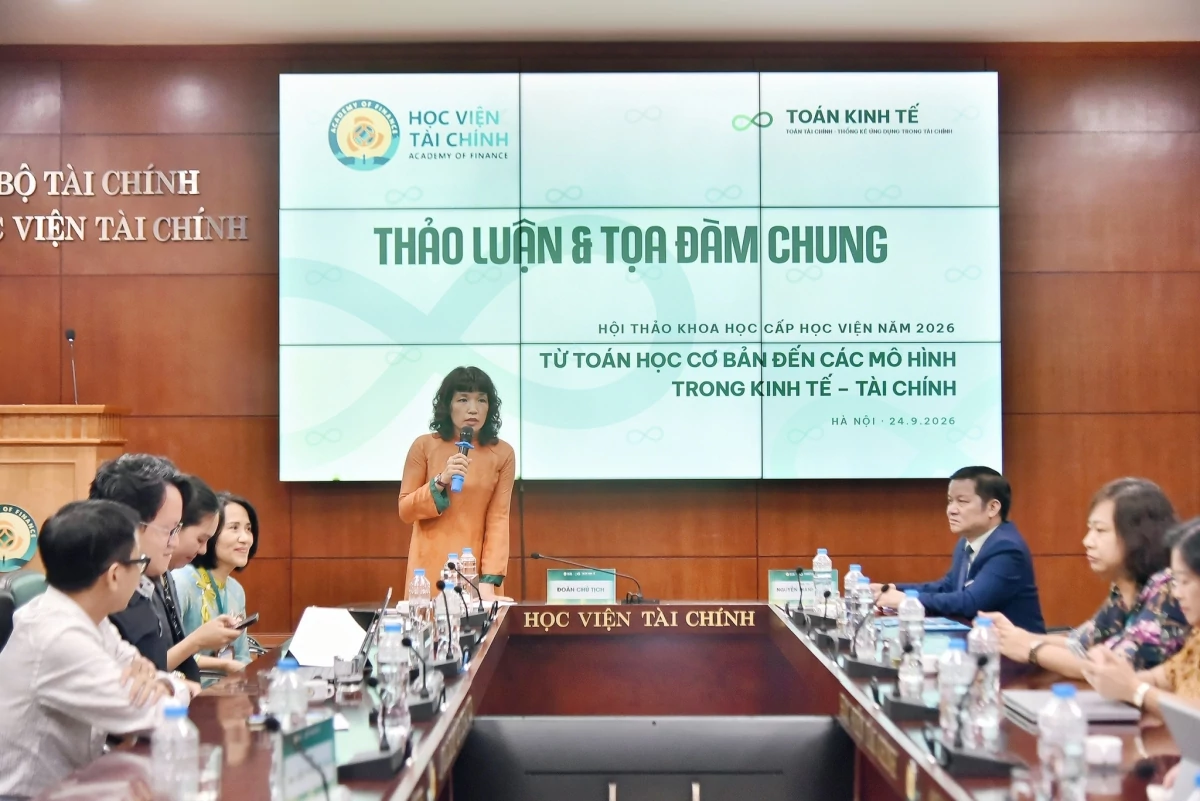
Experts present their papers at the seminar.
The development of Data Science and AI is also changing workforce requirements. The market is no longer focused solely on people who can feed data into an algorithm and obtain a result. Increasingly, value lies in those who understand why a model produces a particular result, can validate its assumptions, identify when the model begins to deviate, and explain the results to management teams.
This is precisely the advantage of personnel with rigorous mathematical training. A forecasting model may run extremely quickly, but determining variables, selecting methods, evaluating errors and understanding the limitations of the results still require quantitative thinking. As AI reduces the time needed for technical tasks, humans gain more room to focus on higher-value questions.
From an educational perspective, Dr. Nguyen Thi Thuy Quynh, Head of the Faculty of Fundamental Sciences at the Academy of Finance, emphasized the need to develop an Economics and Mathematics education ecosystem in the context of AI. Knowledge only truly becomes competence when learners follow a continuous journey from foundational classrooms and computational laboratories to businesses and academic networks.
This approach also opens up another perspective on the future of Economics and Mathematics. Linear algebra, calculus, probability and statistics, and optimization do not exist as isolated subjects. Together, they form the foundation for asset pricing, portfolio management, credit risk measurement, volatility forecasting, policy analysis and a wide range of emerging data applications.
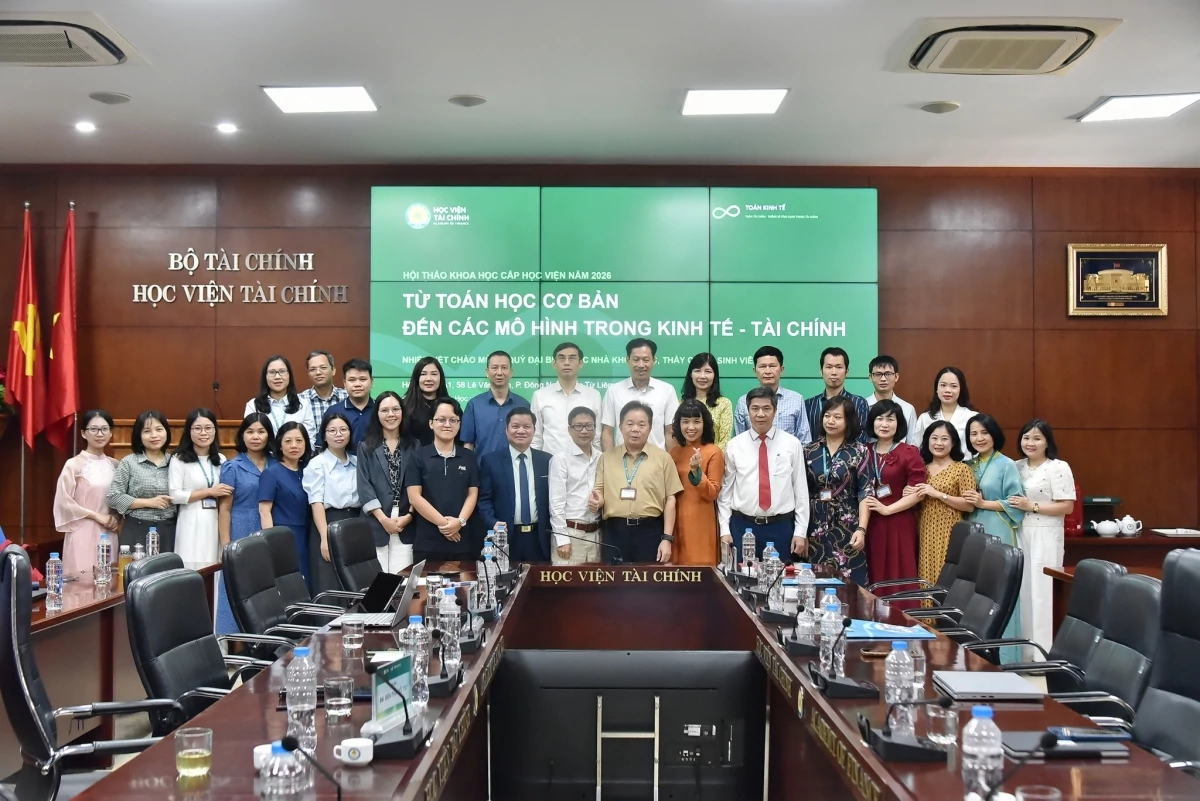
Delegates attend the seminar.
As Vietnam develops and operates an international financial center while promoting science, technology, innovation and digital transformation, the demand for personnel with quantitative thinking is becoming increasingly concrete. Modern financial markets need people who understand the underlying principles of models while also being able to use data, programming and technology to turn knowledge into tools that support decision-making.
This is also the direction pursued by the Economics and Mathematics programs at the Academy of Finance, with two programs in Financial Mathematics and Applied Statistics in Finance. The curricula are built around three pillars: Applied Mathematics; Technology – Data – Programming; and Economics – Finance – Banking, with the aim of connecting quantitative foundations with real-world problems.
AI may continue to become more powerful, computational tools will become increasingly accessible, and many technical tasks may be automated. This very development further highlights the value of people who understand the nature of a problem, control models and take responsibility for the results. For Economics and Mathematics, this is also the path from being a user of technology to becoming capable of mastering it.