The demand for infrastructure capital is growing, while the market is not short of financial resources. The bottleneck lies in the fact that many projects have yet to generate sufficiently clear cash flows, risk allocation mechanisms remain inappropriate, and capital mobilization instruments are not well aligned with asset lifecycles. To attract 15–20-year capital into billion-dollar projects, the challenge is not simply to “find the money” but also to design projects that the market can properly assess and accept the associated risks.
Infrastructure development investment has been identified as one of Vietnam’s three strategic breakthroughs. From transport, energy and logistics to digital transformation and climate change adaptation, these sectors all require substantial capital and involve long investment periods. Under the medium-term public investment plan for 2026–2030, the National Assembly approved a total capital allocation of VND 8.22 quadrillion, with the expectation of laying the foundation for completing the infrastructure system. However, the increasingly large scale of projects is creating a growing need for medium- and long-term capital to finance projects with lifecycles spanning decades.
Capital Is Available, but There Is a Lack of Projects Capable of Absorbing It
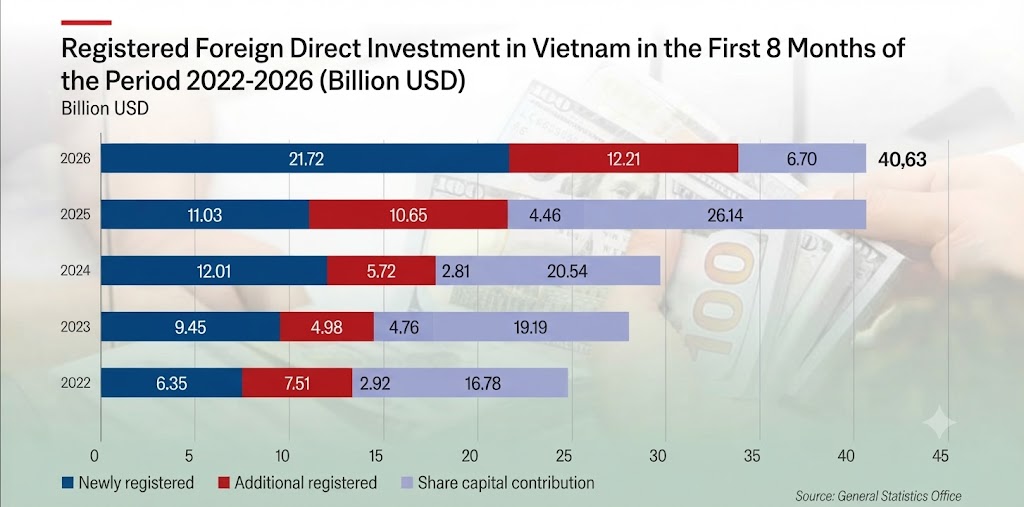
From the supply side, capital flows into Vietnam remain substantial. According to newly released data from the National Statistics Office under the Ministry of Finance, as of the end of August 2026, total registered FDI into Vietnam, including newly registered capital, additional capital and capital contributions and share purchases, reached USD 40.63 billion, up 55.4% year on year. Of this amount, newly registered capital reached USD 21.72 billion across 2,771 newly licensed projects. Notably, while the number of projects increased by only 9.4%, newly registered capital surged by 96.8% compared with the same period last year. This indicates a significant increase in the average capital size of new projects and further reinforces Vietnam’s attractiveness to investors.
However, turning investor interest in a project into actual capital mobilization remains a considerable challenge. The issue is not simply how much funding a project requires, but whether the project has a sufficiently clear structure for banks, investors and long-term financial institutions to assess risks, price them and make financing decisions.
Bank credit continues to play a central role in supplying capital to the economy. According to data from the State Bank of Vietnam, as of August 22, 2026, credit growth reached 9.71% compared with the end of 2025, with outstanding credit reaching VND 20.4 quadrillion, up 14.7% year on year, while the State Bank of Vietnam’s target for credit growth in 2026 is around 15%.
This heavy reliance also creates limitations for projects with long lifecycles such as infrastructure. A large proportion of banks’ funding comes from short-term deposits of less than one year, while infrastructure projects typically require financing with maturities of 15–20 years or even longer. The mismatch between funding and lending maturities makes it difficult for banks alone to meet the long-term capital requirements of these projects.
According to calculations by the BIDV Institute for Economic Research, during 2026–2030, the economy’s total capital requirements are expected to increase by an average of approximately 13% per year, while an annual growth rate of around 10% will need to be maintained during 2031–2045. In terms of the capital structure financing the economy, credit currently accounts for approximately 50–51%; the stock market, 6.4%; corporate bonds, 7.0%; public investment, 12–15%; and FDI, around 12%. This structure highlights the growing need to diversify capital channels.
For infrastructure investment, the issue is not merely about having more money, but about securing capital with the right maturity, appropriate risk profile and alignment with the project’s cash flows. The reality among infrastructure and energy companies demonstrates this gap quite clearly. Based on a survey of 19 listed companies monitored by FiinRatings, total assets increased from VND 120 trillion in 2017 to VND 364 trillion in 2024. While bank credit remained at 33–36% of total assets, the share of bonds increased from approximately 1% to 7%.
Notably, during 2022–2024, the assets of this group of companies increased by approximately VND 50 trillion, while bond financing remained virtually unchanged in absolute terms. Most funding needs continued to be met through equity and other loans, meaning that the pace of investment expansion depended largely on the project owners’ own ability to mobilize capital. As a result, a gap remains between capital supply and capital demand, stemming from the structure of projects and the capital mobilization instruments available.
Unclear Risks Make It Difficult for Long-Term Capital to Enter
If the bottleneck does not lie entirely in the amount of money available in the market, the solution must begin with the projects themselves. To secure long-term financing, an infrastructure project must first demonstrate what cash flows will be used to repay debt, which factors could reduce those cash flows, and which party will bear responsibility when risks materialize. This is also a common weakness among many infrastructure projects in Vietnam.
International experience shows that each type of risk should be allocated to the party best able to control it or transfer it to another party. However, in Vietnam, this allocation is not always clearly defined. Certain risks remain with project owners and banks, whereas in many markets, policy-related risks or risks beyond a company’s control are subject to mechanisms under which the Government shares part of the risk.
According to Mr. Abhishek Dangra, Managing Director and Head of Infrastructure and Utilities Sector at S&P Global Ratings, risk allocation does not itself increase a project’s ability to raise capital. The first priority is to reduce the overall level of risk borne by the project, and then allocate the remaining risks to the party best equipped to assume them. For billion-dollar projects, even a major fluctuation in revenue, costs, interest rates or exchange rates can affect debt repayment capacity. Therefore, major risks must be identified and addressed from the outset; otherwise, the project may struggle to attract banks or financial institutions capable of providing or guaranteeing substantial amounts of capital.
The pressure is even greater as the cost of capital tends to rise. According to a survey by FiinRatings, approximately 60% of experts and executives at major financial institutions expect domestic funding costs to continue increasing over the next two years. Higher funding costs can quickly alter the feasibility of a project. Therefore, the more clearly a project defines its cash flows, obligations and risk-management mechanisms from the outset, the greater its ability to access long-term capital.
Vietnam’s experience shows that mobilizing international capital for large-scale projects is entirely feasible. According to Mr. Tran Tuan Phong, Senior Partner at Vietnam International Law Firm (VILAF – Hong Duc), international lenders have participated on the basis of a set of agreements with clearly defined risk allocation mechanisms and approval from competent authorities. This demonstrates that the ability to raise capital does not always depend on whether the market has more or less available funding, but largely on how the project is structured so that investors can clearly assess their prospects of recovering their capital.
This shows that a project’s ability to mobilize capital is not a fixed market factor, but can be created through project design and contractual structuring. If these requirements are identified and negotiated from the outset, together with a clear approval process, the time required to arrange project financing can be shortened.
India’s experience shows that during the previous decade, infrastructure projects in the country primarily accessed financing with maturities of 5–10 years. Today, some operationally stable renewable energy projects are able to issue bonds with maturities of up to 25 years. The transformation has resulted not only from the emergence of long-term investors but also from the stability of contractual arrangements. Prices agreed upon many years ago, even when higher than current market levels, continue to be honored under existing commitments. This consistency enables investors to price risks and gain confidence in long-term cash flows.
Long-Term Capital Requires Assets That Can Be Properly Valued
Once project risks have been identified, the next challenge is selecting appropriate capital mobilization instruments. For project bonds, the requirements are higher than those for bank loans. While banks may consider both the lending relationship and the financial health of the company, bond investors primarily focus on the project’s ability to generate cash flows for debt repayment. Therefore, cash flows must be ring-fenced, assets and contractual rights must be secured, the payment priority must be clearly defined, and the project should have a certain degree of independence from its parent company.
This remains a limitation in the current market. Many infrastructure-related bonds are still issued at the parent-company level, without credit ratings, with maturities typically limited to 2–3 years, while pricing continues to rely heavily on average 12-month deposit interest rates. Meanwhile, an infrastructure project may operate for decades. This mismatch between the maturity of funding and the lifecycle of the underlying assets creates refinancing and maturity pressures for companies, while also making it difficult to attract long-term investors.