Governor of the State Bank of Vietnam Pham Duc An emphasized that, to obtain loans based on cash flow, businesses must first ensure financial transparency and fully fulfill their tax obligations to the State. There should not be two separate sets of financial statements, with low profits reported to tax authorities while figures provided to banks for loan applications are “inflated.”
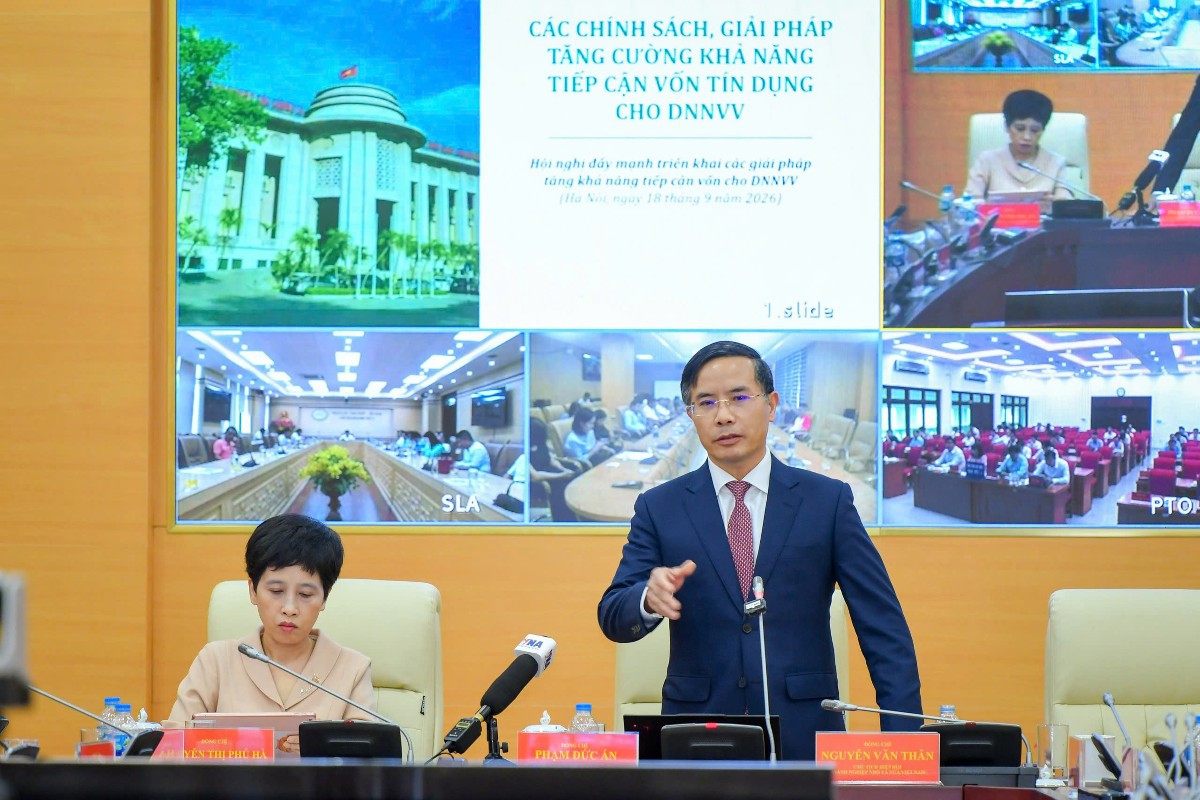
Governor of the State Bank of Vietnam Pham Duc An calls on credit institutions to gradually reduce their reliance on collateral and strengthen credit assessments based on businesses’ cash flows and value chains (Photo: PL).
On the morning of September 18, the State Bank of Vietnam, in coordination with the Vietnam Association of Small and Medium Enterprises (VinaSME), held a conference on enhancing access to credit for small and medium-sized enterprises (SMEs).
One of the key issues discussed at the conference was the use of cash flow data to assess businesses applying for loans, thereby gradually reducing reliance on collateral.
After hearing proposals from business representatives, Governor Pham Duc An instructed the Credit Information Center (CIC) to proactively study and develop a plan to connect and utilize lawful data sources for loan assessment, appraisal, and monitoring. The Governor clearly stated that the objective is to “gradually reduce reliance on collateral and strengthen assessments based on cash flows and value chains.”
At the conference, Le Anh Tuan, Deputy General Director of CIC, said that CIC is working to connect additional sources of business information to support credit institutions.
According to Mr. Tuan, CIC has recently coordinated with the unit responsible for business information under the Ministry of Finance to share databases on business registration and corporate financial statements. On September 21, CIC is expected to sign a cooperation agreement with the Tax Department to share and update business information.
CIC has also received in-principle approval from units under the Ministry of Justice, including agencies responsible for civil judgment enforcement and secured transaction registration, to exchange information relating to civil judgment enforcement and secured transaction registration.
The connection of these information sources forms part of a broader effort to strengthen CIC’s role as a central hub for connecting business data to support credit activities.
“Businesses with good creditworthiness do not necessarily need collateral to obtain loans. From my observations, businesses that participate in global value chains, for example as suppliers to major global companies, can obtain bank financing immediately. Commercial banks are highly responsive; in fact, they may even approach and invite such businesses to borrow.
That is why I have proposed allocating 20% of contracts under key national projects to small and medium-sized enterprises. This is an issue that the Ministry of Finance should take into consideration. If SMEs are allowed to participate in that 20% and are contracted by the Government, banks will be ready to lend to them.
Therefore, addressing businesses’ access to capital is not simply a matter of asking banks to simplify procedures, provide preferential treatment, or lower interest rates. Banks have funds, but they must also safeguard those funds and ensure their safety; they cannot lend at all costs. That is why this issue requires efforts from both sides.”
Nguyen Van Than, Chairman of VinaSME
According to the Deputy General Director of CIC, the center is expected to submit a proposal in the fourth quarter on developing a platform for connecting and sharing cash flow data to support credit activities. Mr. Tuan emphasized that implementing this initiative will require the consensus and cooperation of businesses and business associations. Based on international experience, cash flow data may include various transactions arising from business operations, such as payments for electricity and water, office rent, taxes, social insurance, and other payments.
Governor Pham Duc An particularly emphasized that, for banks to have confidence in lending based on cash flows rather than collateral, SMEs must provide credit institutions with complete and accurate information.
“Most importantly, businesses must ensure transparency in their financial affairs and tax obligations to the State. This will eliminate the situation in which two sets of financial statements are maintained: one reporting lower figures in connection with obligations to the State, while another is ‘inflated’ for the purpose of accessing bank financing,” the Governor said.
According to the Governor, businesses must comply with the law, make full declarations, and properly fulfill their obligations to the State budget. Businesses cannot simultaneously seek ways to reduce their obligations to the State while expecting banks to accurately assess their financial capacity and extend credit.
The Governor also stated that this is an important condition for SMEs to grow into larger enterprises.
“All large businesses today started out small. For a small business to grow, there is no other way but to operate transparently, comply with the law, and make the appropriate contributions to the State as required by regulations. If a business keeps trying to circumvent one regulation or another and is penalized before it has even grown, how can it become a large enterprise?” the Governor said.
Thus, expanding cash flow-based lending is not solely a matter of banks changing their credit assessment methods or CIC developing additional data sources. On the other hand, businesses must also establish a transparent financial profile that accurately reflects their actual business operations and cash flows. This provides a basis for credit institutions to properly assess repayment capacity and, in turn, gradually reduce reliance on collateral when extending credit to SMEs.