Rather than simply “choosing land and incentives,” FDI investors are increasingly selecting investment destinations based on the capabilities of the entire ecosystem. Synchronized infrastructure and support services not only create an advantage in attracting investment capital but also help shorten project implementation timelines, retain investors, and encourage them to expand their investments.
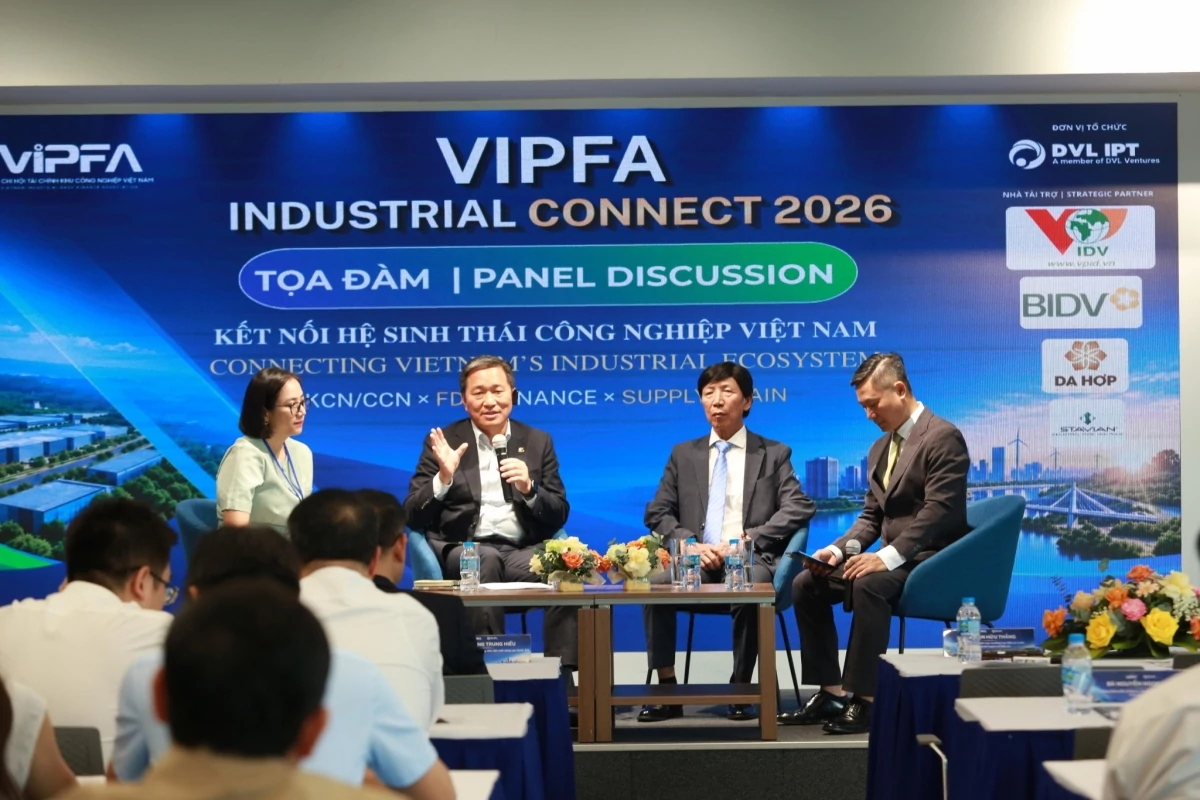
Experts discuss at the Vietnam Industrial Ecosystem Investment Connection Forum – VIPFA Industrial Connect 2026.
Investors Are No Longer Focused Solely on Costs and Incentives
Competition for FDI attraction is facing new requirements as supply chain restructuring, digital transformation, and the green transition increasingly influence investors’ decisions on where to invest. Rather than focusing solely on individual advantages, investors are placing greater emphasis on the quality of infrastructure, energy, logistics, human resources, supplier networks, as well as the ability to implement projects quickly and efficiently.
These issues were raised at the Vietnam Industrial Ecosystem Investment Connection Forum – VIPFA Industrial Connect 2026, recently organized by the Vietnam Industrial Park Finance Association (VIPFA), with nearly 150 delegates from FDI enterprises, industrial and industrial cluster developers, banks, financial institutions, and businesses across the supply chain.
Analyzing FDI trends and new requirements for Vietnam’s investment ecosystem, Mr. Truong Minh, Deputy Director General of the Foreign Investment Agency under the Ministry of Finance, said that the international investment landscape is changing rapidly. Competition for investment attraction is becoming increasingly closely associated with supply chain restructuring, digital transformation, the green transition, energy security requirements, human resources, and the resilience of production chains.
According to Mr. Minh, in this context, investors are no longer considering only costs or incentives. They are increasingly concerned with the quality of the investment environment, policy stability and transparency, infrastructure quality, energy, logistics, human resources, supplier networks, and the ability to implement projects quickly and efficiently.
The figures cited by Mr. Minh show that, in the first eight months of 2026, total registered foreign investment, including newly registered capital, adjusted capital, and capital contributions and share purchases, exceeded USD 40.6 billion, up 55.4% year on year. Disbursed FDI was estimated at USD 17.25 billion, up 12%. The processing and manufacturing sector continued to play a leading role, while investment flows also became more diversified into energy infrastructure and digital technology.
Notably, South Korea recorded more than USD 8.3 billion in registered investment during the first eight months of the year, ranking second among investors in Vietnam. According to Mr. Minh, these results indicate substantial room for cooperation between Vietnam and the Korean business community, as well as other international partners.
However, the representative of the Foreign Investment Agency emphasized that the focus should not be placed solely on the scale of investment capital. Going forward, Vietnam needs to continue improving the quality and efficiency of foreign investment; prioritize high-tech projects, innovation, research and development centers, the digital economy, the green economy, and sustainable development; while strengthening linkages between the FDI sector and domestic enterprises, promoting technology transfer, and developing high-quality human resources.
A Comprehensive Ecosystem Will Become an Advantage in Attracting FDI
Against this backdrop, Mr. Truong Minh identified three issues facing FDI attraction in the new period.
First, competition for FDI attraction is shifting from individual advantages to the capabilities of the entire ecosystem.
According to Mr. Minh, when choosing an investment location, investors do not look only at a plot of land or a particular incentive package. They simultaneously assess industrial park infrastructure, electricity and energy, logistics, human resources, administrative procedures, financial and banking services, access to suppliers, legal services, and the support provided by local authorities.
Therefore, localities or industrial parks with a comprehensive ecosystem capable of coordinating and responding quickly to investors’ needs will have an increasingly clear advantage.
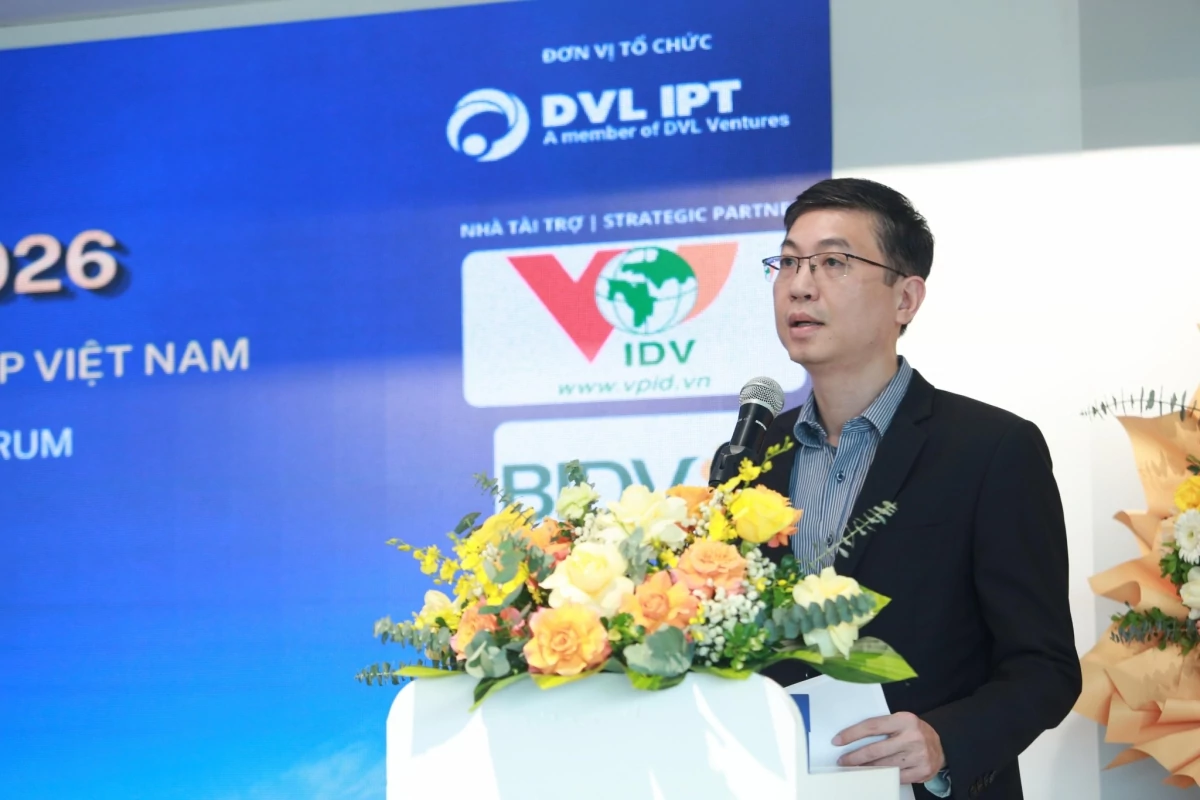
Mr. Truong Minh, Deputy Director General of the Foreign Investment Agency under the Ministry of Finance.
Second, industrial parks need to transition from simply providing infrastructure to providing an investment services platform.
Under the new model, an industrial park is not merely a place where production facilities are located but can also serve as a hub connecting investors with supporting enterprises, banks, logistics providers, human resources, technology, energy, and professional services.
“Preparing synchronized infrastructure, digital infrastructure, appropriate energy solutions, environmental standards, and support service networks will help shorten project implementation timelines, enhance investor retention, and encourage investment expansion,” Mr. Minh emphasized.
Third, stronger linkages and spillovers between the FDI sector and Vietnamese enterprises are needed.
According to Mr. Minh, attracting a new FDI project is important, but the greater value lies in how many linkages the project creates with domestic enterprises, how many Vietnamese suppliers can participate in the value chain, and how much technology and management expertise can be transferred.
To achieve this, Vietnamese enterprises need to continue improving their management capabilities, product quality, technical standards, order fulfillment capacity, and transparency. At the same time, substantive supply-demand matching mechanisms are needed to connect FDI enterprises with domestic businesses.
Industrial Parks Must Become Platforms for Building Competitiveness
The requirement to build an ecosystem rather than rely on individual investment advantages is also changing the role of industrial parks in attracting new investment flows.
Dr. Phan Huu Thang, Chairman of VIPFA, noted that nearly 40 years after Vietnam began opening its economy to FDI, foreign investment continues to play an important role in the country’s industrialization, modernization, and international integration.
However, FDI in the new period should be viewed not only in terms of capital volume but also in terms of technology, productivity, innovation, human resource training, business linkages, added value, green development, and the ability to participate in global value chains.
This also entails changes to the industrial park model to adapt to new investment flows. While industrial parks were previously viewed primarily as places providing industrial land, infrastructure, and factories, next-generation industrial parks need to focus on green infrastructure, clean energy, smart logistics, data, financial services, technology, R&D, human resources, and supplier networks.
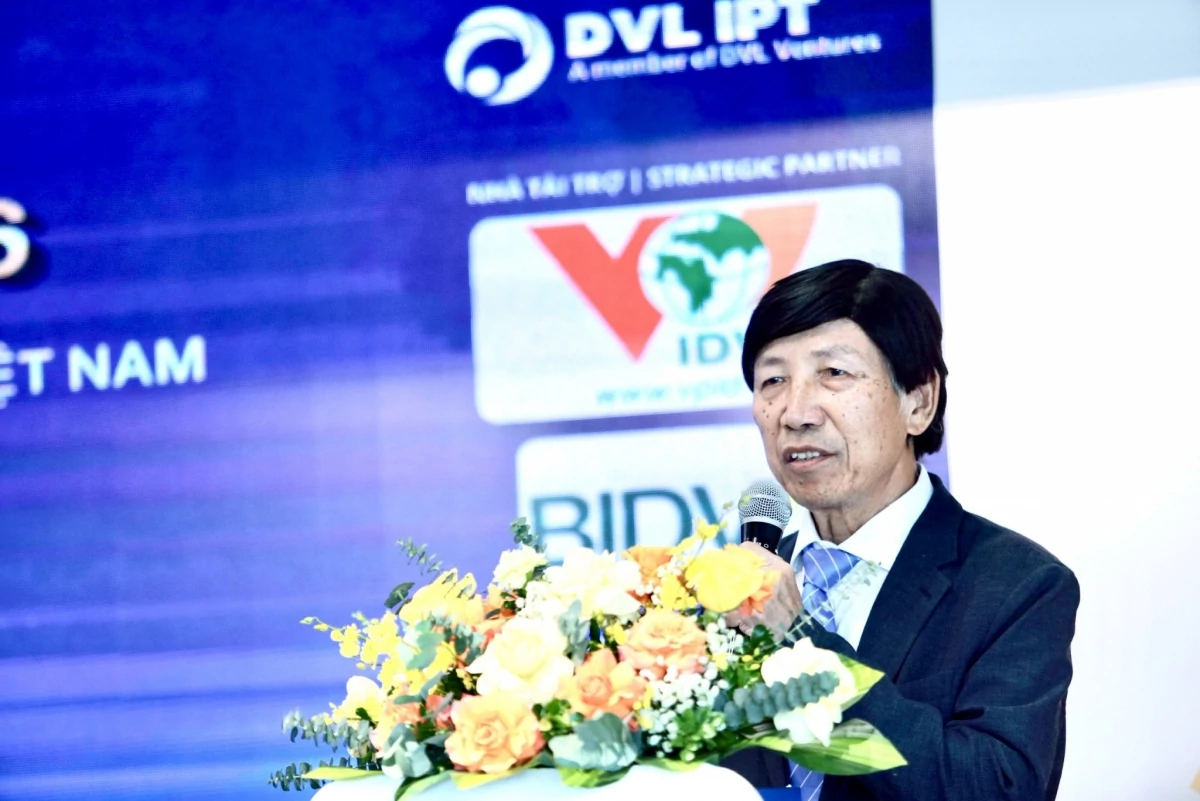
Dr. Phan Huu Thang, Chairman of VIPFA.
“In particular, for high-tech projects, semiconductors, electronics, precision engineering, AI, green industries, and emerging industries, the quality of industrial parks will increasingly become a decisive factor in investors’ location decisions,” Dr. Phan Huu Thang said.
According to Dr. Phan Huu Thang, industrial parks therefore can no longer be merely places where businesses lease land. They must become platforms that create competitive capabilities for businesses. In other words, in the coming period, investors will “not only choose land, incentives, or labor, but will choose locations with an industrial ecosystem.”
The ecosystem-based approach also requires the concept of infrastructure to be expanded beyond industrial land and conventional transportation systems.
Lawyer Nguyen Hong Chung, Chairman of the DVL IPT ecosystem, said that in addition to raw materials and land resources, attention must also be paid to infrastructure. Hard infrastructure includes road, waterway, and air transportation, while soft infrastructure includes financial solutions provided by financial institutions, the legal system, and, in particular, specialized service infrastructure.
According to Mr. Chung, an urgent requirement is to change the approach to FDI attraction. While many localities previously focused on attracting capital and providing financial solutions, the current trend is shifting toward building an industrial ecosystem. Investors do not need merely an individual industrial park but a complete ecosystem capable of creating sustainable value.
“To establish such an ecosystem, there are three key factors. First is policy, from the central to the local level, with support from local authorities in legal matters, administrative procedures, and the investment environment playing an important role. The second is industrial infrastructure, including both hard and soft infrastructure. The third is the development of supporting service providers that help investors establish and operate within the ecosystem,” Lawyer Nguyen Hong Chung shared.
Enabling Resources to “Find Each Other”
A complete industrial ecosystem is not only intended to attract FDI projects and bring them into operation. More importantly, it must be capable of connecting stakeholders and generating spillover value.
According to Mr. Le Huu Quang Huy, Vice Chairman of VIPFA, the necessary links of the ecosystem are already present. Investors are looking for investment locations and opportunities; industrial parks, high-tech parks, and industrial clusters are seeking suitable investors; banks and financial institutions are capable of providing capital and financial solutions; while Vietnamese businesses are seeking to participate more deeply in the supply chains of FDI enterprises.
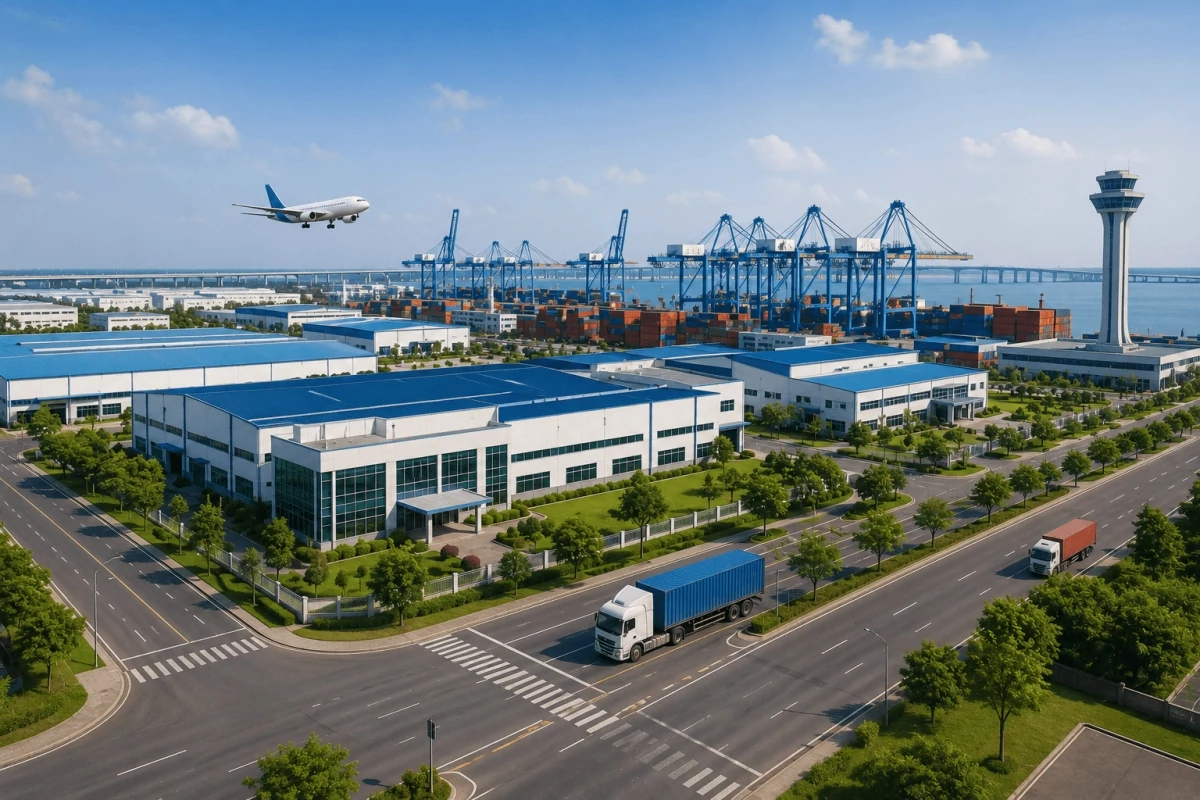
Industrial park infrastructure includes hard infrastructure, such as road, waterway, and air transportation, while soft infrastructure includes financial solutions.
Mr. Le Huu Quang Huy said that the issue is not simply “what we have,” but, more importantly, how these resources can find one another and jointly create value.
This is also why connectivity cannot end with a single forum or meetings between businesses. According to Mr. Huy, the goal is to maintain connections after the event, not merely to introduce businesses to one another but to establish connections based on actual needs; not merely to create opportunities for meetings but to turn those meetings into concrete investment and business opportunities.
According to Mr. Le Huu Quang Huy, this is the time to activate connections following the forum. VIPFA aims to develop an increasingly substantive industrial ecosystem network connecting FDI, industrial parks, finance, supply chains, and investment services.
According to experts, from requirements concerning the quality of investment flows to changes in industrial parks and the ability to establish linkages with domestic enterprises, competition for FDI attraction is therefore being placed within a broader framework.
Rather than relying on individual advantages, the ability to connect land, infrastructure, energy, finance, logistics, human resources, suppliers, and investment services into an integrated ecosystem is increasingly becoming a key consideration in attracting higher-quality investment flows and generating greater spillover value for the economy.