Vietnam’s tourism sector is accelerating toward a double-digit growth target, with 2026 serving as a foundation-building year and the 2027–2030 period marking a qualitative transformation. From expanding markets and improving product quality to digital transformation and green development, the tourism sector is aiming to enhance the value it generates and its contribution to the economy.
In 2026, the tourism sector aims to welcome 25–27 million international visitors and serve 150–153 million domestic tourists.
The Ministry of Culture, Sports and Tourism has recently issued a Tourism Development Scenario associated with the “double-digit” growth target, identifying key tasks and solutions for the remaining months of 2026 while laying the foundation for the 2027–2030 period under Decision No. 2338/QD-BVHTTDL dated September 10, 2026.
The scenario was developed to concretize the tasks set out in Government Resolutions No. 168/NQ-CP and No. 169/NQ-CP and to implement the perspectives, objectives, tasks, and solutions for tourism development under Politburo Resolution No. 26-NQ/TW dated August 22, 2026.
The tourism growth scenario is set within the broader growth objectives of the economy. Accordingly, in 2026, the tourism sector aims to welcome 25–27 million international visitors, serve 150–153 million domestic tourists, and generate approximately VND 1,125–1,230 trillion in total tourism revenue, thereby contributing to the national GDP growth target of 10% or higher.
According to the National Statistics Office under the Ministry of Finance, tourism activities maintained their growth momentum during the first eight months of 2026. The number of international visitors to Vietnam reached 15.9 million, up 14.4% compared with the same period in 2025. This was the highest number of international arrivals recorded in the first eight months of any year in recent years.
Of this total, 13.2 million visitors arrived by air, accounting for 83.1% of total international arrivals and increasing 11.6% year on year; 2.5 million arrived by land, accounting for 15.5% and increasing 32.0%; while 220,600 arrived by sea, accounting for 1.4% and increasing 17.5%.
This shows that tourism is no longer viewed simply as a service sector catering to travel and leisure needs, but is increasingly playing an important role in job creation and stimulating consumption, transportation, accommodation, trade, cuisine, culture, and entertainment. As the market expands, tourism is generating increasingly broad spillover effects across various economic sectors. However, growth in visitor numbers will only generate meaningful economic value when accompanied by qualitative growth, higher visitor spending, and longer stays.
By 2030, the scenario sets a target of welcoming 45–50 million international visitors, serving approximately 160 million domestic tourists, generating total tourism revenue of USD 80–90 billion, and contributing directly 10–12% of GDP. The focus will be on high-spending, long-stay visitors, while maintaining Vietnam’s position among the leading destinations in Southeast Asia in terms of scale and growth rate.
With this orientation, the tourism sector’s challenge in the coming period is not only to attract more visitors but also to generate greater value from each visitor. This represents a notable shift in development thinking. A market with a large number of visitors but low spending and short stays generates less value than one that attracts visitors with higher spending capacity, greater demand for services, and a higher likelihood of returning multiple times.
In the short term, the Tourism Development Scenario sets out two growth scenarios to proactively respond to fluctuations in the international environment.
Under the high-growth scenario, the tourism sector will maintain its growth momentum by focusing on attracting visitors from China, sustaining growth in the South Korean and Indian markets, strongly promoting growth in the Russian market, maintaining growth in long-haul markets such as Western Europe and North America, and leveraging the advantages of nearby Southeast Asian markets through air, land, and sea connections.
Under the low-growth scenario, Northeast Asia and Southeast Asia will be identified as key markets for further development, while China and South Korea will remain major growth drivers. Maintaining Vietnam’s image as a safe, friendly, high-quality, and competitively priced destination is considered an important solution for strengthening its appeal to source markets.
The development of different scenarios demonstrates the tourism sector’s proactive approach to risk management, which is becoming increasingly important for tourism development. The tourism sector is directly affected by economic and geopolitical fluctuations, aviation conditions, fuel prices, weather, and epidemics. Therefore, restructuring markets, avoiding dependence on individual markets, and simultaneously developing domestic tourism will strengthen the sector’s resilience to external shocks.
At the local level, 11 key tourism destinations, including Ho Chi Minh City, Hanoi, Da Nang, Khanh Hoa, Quang Ninh, Ninh Binh, Hue, An Giang, Lao Cai, Hai Phong, and Lam Dong, have been assigned targets for international visitor growth of 26.6–36.3% in 2026 compared with 2025. Other localities are required to leverage their tourism resources, infrastructure, and visitor-attraction potential to develop breakthrough growth scenarios and strive to increase international visitors, domestic tourists, and total tourism revenue by approximately 25–35% compared with 2025.
To achieve these targets, visa policies, air connectivity, and tourism promotion have been identified as areas requiring continued improvement. Proposed measures include expanding unilateral visa exemptions, studying transit visas valid for at least 72 hours, processing e-visas within 24 hours, and accelerating negotiations and the signing and expansion of “Open Skies” aviation agreements to strengthen international accessibility, support direct flight routes to key markets, and minimize the risk of disruptions to air connectivity caused by conflicts in the Middle East and fluctuations in oil prices.
Alongside international markets, domestic tourism should continue to be regarded as an important growth driver. Demand-stimulation packages featuring short-duration, reasonably priced, and flexible products can meet domestic demand while creating additional opportunities for destinations, accommodation providers, and service businesses to maintain operations during periods of weaker international demand.
In the long term, improving product quality will determine the sector’s ability to increase value. Vietnam is oriented toward developing tourism products in areas such as medical tourism, wellness, high-end resorts, MICE, culinary tourism, golf, adventure tourism, community-based tourism, and rural tourism associated with the One Commune One Product (OCOP) program and local cultural experiences. This approach will expand the tourism ecosystem, giving visitors more reasons to extend their stays and increase their spending.
Digital transformation is also becoming one of the key foundations for improving tourism management capacity. The application of artificial intelligence in tourism promotion and market analysis, the use of big data, the development of real-time market forecasting and early-warning systems, and data connectivity among regulatory authorities, localities, destinations, and businesses will enable management and administration to better align with actual market demand.
Alongside digitalization, the requirement for green tourism development is becoming increasingly clear. The tourism sector is oriented toward reducing emissions, applying technology to manage carrying capacity, regulating visitor flows, controlling localized overcrowding, and developing early-warning systems. Accordingly, tourism growth in the new period cannot be separated from the need to protect natural resources and the environment while improving the quality of visitor experiences.
Another fundamental task is to improve tourism statistics. The tourism sector, in coordination with the National Statistics Office, will improve the tourism statistical system through the application of the Tourism Satellite Account, thereby enabling a more comprehensive calculation and disclosure of tourism’s contribution to the economy. With standardized data, regulators and businesses will have a stronger basis for evaluating investment efficiency, identifying target markets, and adjusting policies.
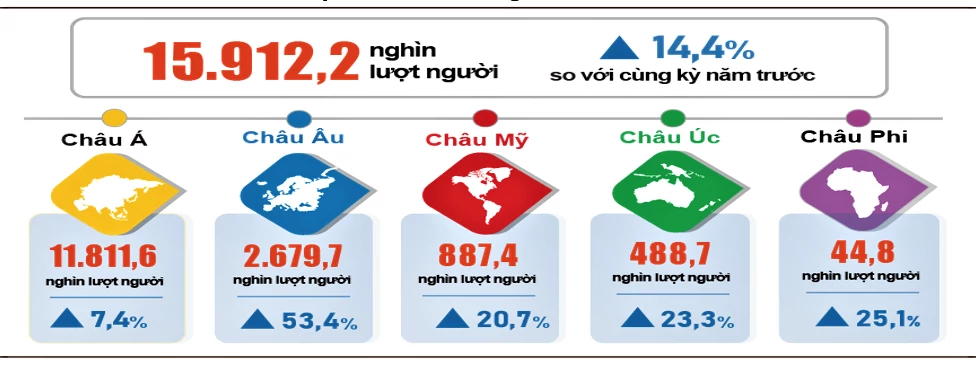
International visitors to Vietnam in the first eight months of 2026 by region and territory.
During the 2027–2030 period, the most important requirement is to shift from growth driven by expansion in scale toward growth driven by quality and value. Increasing average visitor spending, extending stays, increasing the rate of international repeat visitors, reducing seasonality, and diversifying markets will determine the sustainability of tourism growth.
At the same time, infrastructure development must be implemented in coordination with tourism products and markets. Hanoi, Da Nang, and Ho Chi Minh City are oriented toward developing into growth poles; Phu Quoc is expected to become a high-end marine tourism and resort center; while the system of tourism seaports, international gateways, inter-regional tourism corridors, tourism railway stations, and convention and exhibition centers will continue to be developed.
From 2026 to 2030, the development of Vietnam’s tourism sector will not be measured solely by the number of visitors, but also by the value each visitor segment generates for the economy. 2026 will serve as a foundation-building year, with a target of 25–27 million international visitors, while the following period aims to reach 45–50 million international visitors, approximately 160 million domestic tourists, and total tourism revenue of USD 80–90 billion. Achieving these targets will require coordinated development across institutions, infrastructure, markets, products, technology, human resources, and destination management.
Vietnam’s tourism sector is accelerating its development toward becoming a key economic sector, supported by a roadmap that connects short-term growth with long-term development. By shifting from a focus on visitor volume toward quality, value, and competitiveness, while combining digital transformation with green growth, tourism will have a stronger foundation to make a greater contribution to GDP, generate spillover effects across various economic sectors, and gradually strengthen its role as a key economic sector in the new era.