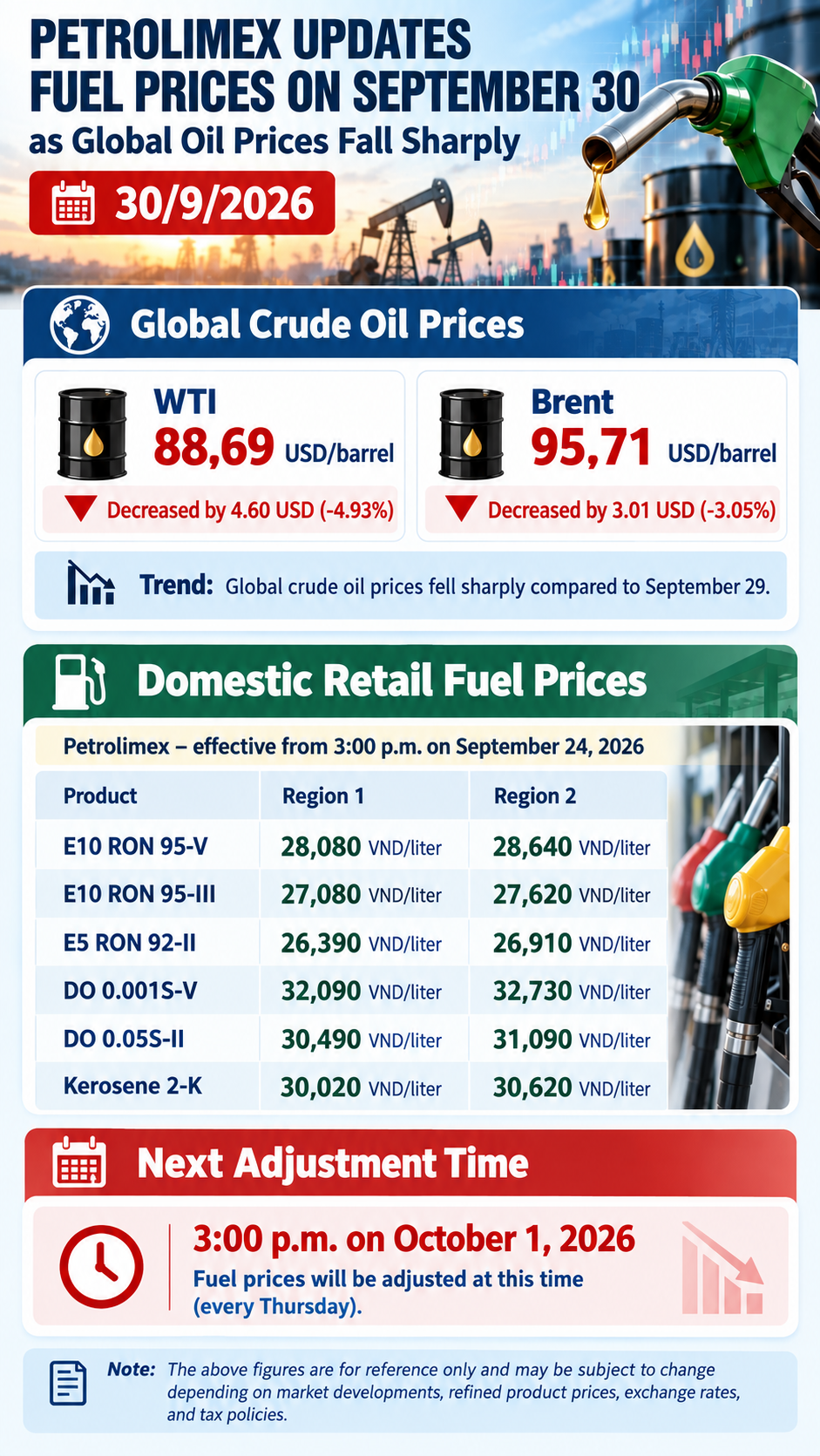
Fuel prices today, September 30, 2026: Global crude oil prices fell sharply from the previous day, while domestic retail prices remained at the levels set in the September 24 price adjustment and await the next adjustment scheduled for the afternoon of October 1.
Recent developments in the international market are adding downward pressure on fuel prices. However, the October 1 price adjustment will also be affected by refined product prices, exchange rates, and, in particular, tax policies applicable after September 30.

Illustrative image.
Global Oil Prices Fall Sharply on September 30
The global oil market entered September 30 with a clear downward trend following several sessions of significant volatility. According to data updated during the session, WTI crude was trading at around USD 88.69 per barrel, down USD 4.60 per barrel from USD 93.29 per barrel on September 29, equivalent to a decline of approximately 4.93%.
Brent crude followed the same trend, falling from USD 98.72 per barrel to USD 95.71 per barrel, down USD 3.01 per barrel, or approximately 3.05%.
| Crude Oil |
September 29, 2026 |
September 30, 2026 |
Change |
Rate |
| WTI |
USD 93.29/barrel |
USD 88.69/barrel |
-USD 4.60 |
-4.93% |
| Brent |
USD 98.72/barrel |
USD 95.71/barrel |
-USD 3.01 |
-3.05% |
During the September 30 session, WTI fluctuated between USD 88.58 and USD 89.04 per barrel, while Brent traded within a range of USD 95.61 to USD 95.96 per barrel.
It should be noted that oil prices fluctuate continuously depending on the timing and type of contract. Therefore, the figures in the table should be understood as data updated within the same monitoring system for comparison between the two days and may not exactly correspond to the closing prices of individual futures contracts on exchanges.
The current downward trend is consistent with the latest developments in the international market, as supply from the Middle East shows signs of recovery, easing concerns over potential supply shortages to some extent. The latest trading session also saw international oil prices decline by around 2.5%.
Nevertheless, oil prices remain highly volatile. The market continues to respond rapidly to changes in supply, inventories, export activities, and developments in major oil-producing regions. Therefore, the current decline does not necessarily mean that oil prices have entered a sustained downward cycle.
Domestic Fuel Prices Today, September 30, 2026
In the domestic market, as of the morning of September 30, Petrolimex retail prices remained at the levels established at 3:00 p.m. on September 24.
| Product |
Region 1 |
Region 2 |
| E10 RON 95-V Gasoline |
VND 28,080/liter |
VND 28,640/liter |
| E10 RON 95-III Gasoline |
VND 27,080/liter |
VND 27,620/liter |
| E5 RON 92-II Gasoline |
VND 26,390/liter |
VND 26,910/liter |
| DO 0.001S-V |
VND 32,090/liter |
VND 32,730/liter |
| DO 0.05S-II |
VND 30,490/liter |
VND 31,090/liter |
| Kerosene 2-K |
VND 30,020/liter |
VND 30,620/liter |
The above prices have been applicable since the September 24 price adjustment. Petrolimex's posted prices currently show E10 RON 95-V in Region 1 at VND 28,080 per liter, E10 RON 95-III at VND 27,080 per liter, E5 RON 92-II at VND 26,390 per liter, and DO 0.05S-II diesel at VND 30,490 per liter.
Compared with the September 17 price adjustment, current prices have increased significantly in the gasoline segment. E10 RON 95-III rose by approximately VND 1,450 per liter, E5 RON 92-II increased by around VND 1,260 per liter, and DO 0.05S-II rose by approximately VND 550 per liter. Meanwhile, 2-K kerosene at the Petrolimex system is around VND 1,450 per liter lower than the previous level.
Under the maximum retail prices commonly announced by the authorities on September 24, E5 RON 92 was capped at VND 26,397 per liter, up VND 1,258 per liter; E10 RON 95-III was capped at VND 27,087 per liter, up VND 1,451 per liter; and 0.05S diesel was capped at VND 30,497 per liter, up VND 552 per liter.
Fuel Price Adjustment Forecast for 3:00 p.m. on October 1
September 30, 2026 falls on a Wednesday. Under the current fuel price adjustment cycle, the next adjustment is expected to take place on Thursday, October 1, 2026. Under current regulations, fuel prices are adjusted every Thursday.
Looking solely at developments in the international oil market, the simultaneous sharp declines in WTI and Brent are creating downward pressure on domestic fuel prices. If this trend is reflected accordingly in imported refined fuel prices and other price components remain relatively stable, the possibility of lower retail prices, or at least reduced upward pressure, has become clearer compared with previous days.
However, it would be premature to estimate a specific price reduction before the official adjustment. Domestic retail fuel prices are not determined directly by WTI or Brent crude oil prices alone, but also depend on average international refined fuel prices during the period, exchange rates, costs, and tax-related factors.
Notably, the special policy on environmental protection tax and value-added tax applicable to fuel under Resolution No. 34/2026/NQ-CP is currently in effect until the end of September 30, 2026. Meanwhile, Resolution No. 109/2025/UBTVQH15 stipulates that the 2026 environmental protection tax rates under normal policy conditions are VND 2,000 per liter for gasoline, VND 1,000 per liter for diesel, and VND 600 per liter for kerosene.
Therefore, the October 1 price adjustment will involve another important variable: the actual tax policy applicable after September 30. If the support policy is extended or an equivalent measure is adopted, the decline in global oil prices would provide more favorable conditions for domestic fuel prices to fall. Conversely, if tax components change, this could partially or fully offset the impact of lower international market prices.
Overall, as of the morning of September 30, market signals are trending in a direction that could help ease domestic fuel prices. However, the official adjustment at 3:00 p.m. on October 1 will still depend on average refined fuel prices and the adjustment mechanism, particularly the tax policy taking effect from the beginning of October.