On the morning of September 25, at the headquarters of the State Audit Office of Vietnam (SAV), the SAV Steering Committee for the Development of Science, Technology, Innovation and Digital Transformation held its regular meeting under the chairmanship of Nguyen Huu Nghia, Member of the Party Central Committee, Secretary of the SAV Party Committee, State Auditor General and Head of the Steering Committee. The meeting focused on discussing and providing comments on the Draft Digital Architecture Framework of the SAV, conducting a comprehensive assessment of digital transformation implementation results in the third quarter, and reaching agreement on key tasks and directions for the fourth quarter of 2026.
The meeting was attended by members of the Standing Committee of the Steering Committee, leaders of SAV-affiliated units, and representatives of the consulting unit responsible for developing the Digital Architecture Framework (Teckad Joint Stock Company).
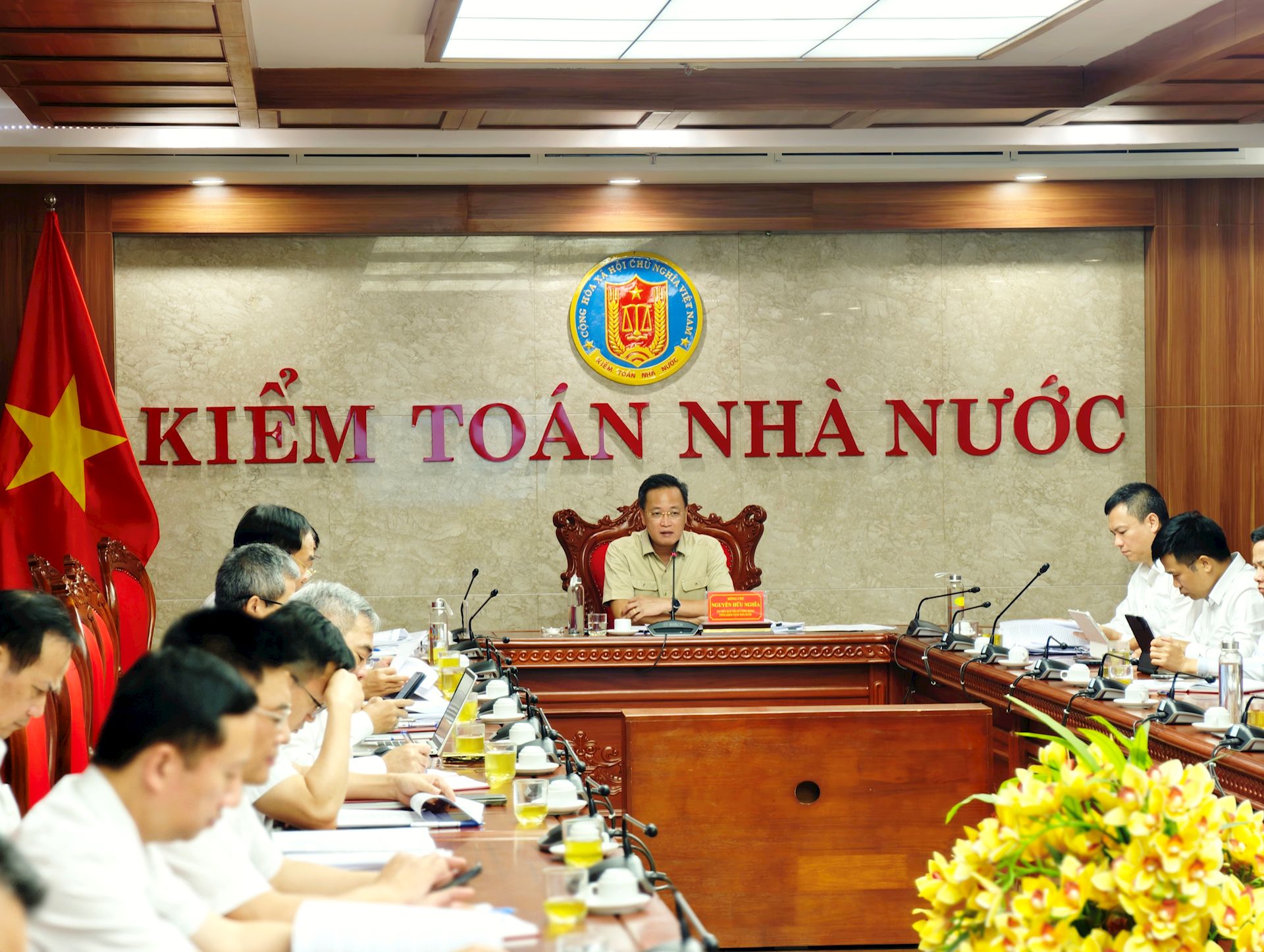
State Auditor General Nguyen Huu Nghia delivers directions at the meeting.
The Digital Architecture Framework is a “guiding compass” that must closely reflect practical realities
In a summary report presented at the meeting, Director General of the SAV Department of Information Technology Pham Huy Thong and representatives of the consulting unit said that after more than three months of urgent work and close coordination with units across the sector, the Draft Digital Architecture Framework of the SAV has basically been completed.
The Digital Architecture Framework establishes an overall model consisting of four layers: Digital Infrastructure and Cybersecurity; Data and Core Platforms; Shared Applications and Business Operations; and Interaction Channels and Performance Measurement. It is accompanied by five detailed reference models covering business operations (BRM), data (DRM), applications (ARM), technology (TRM), and information security (SRM).
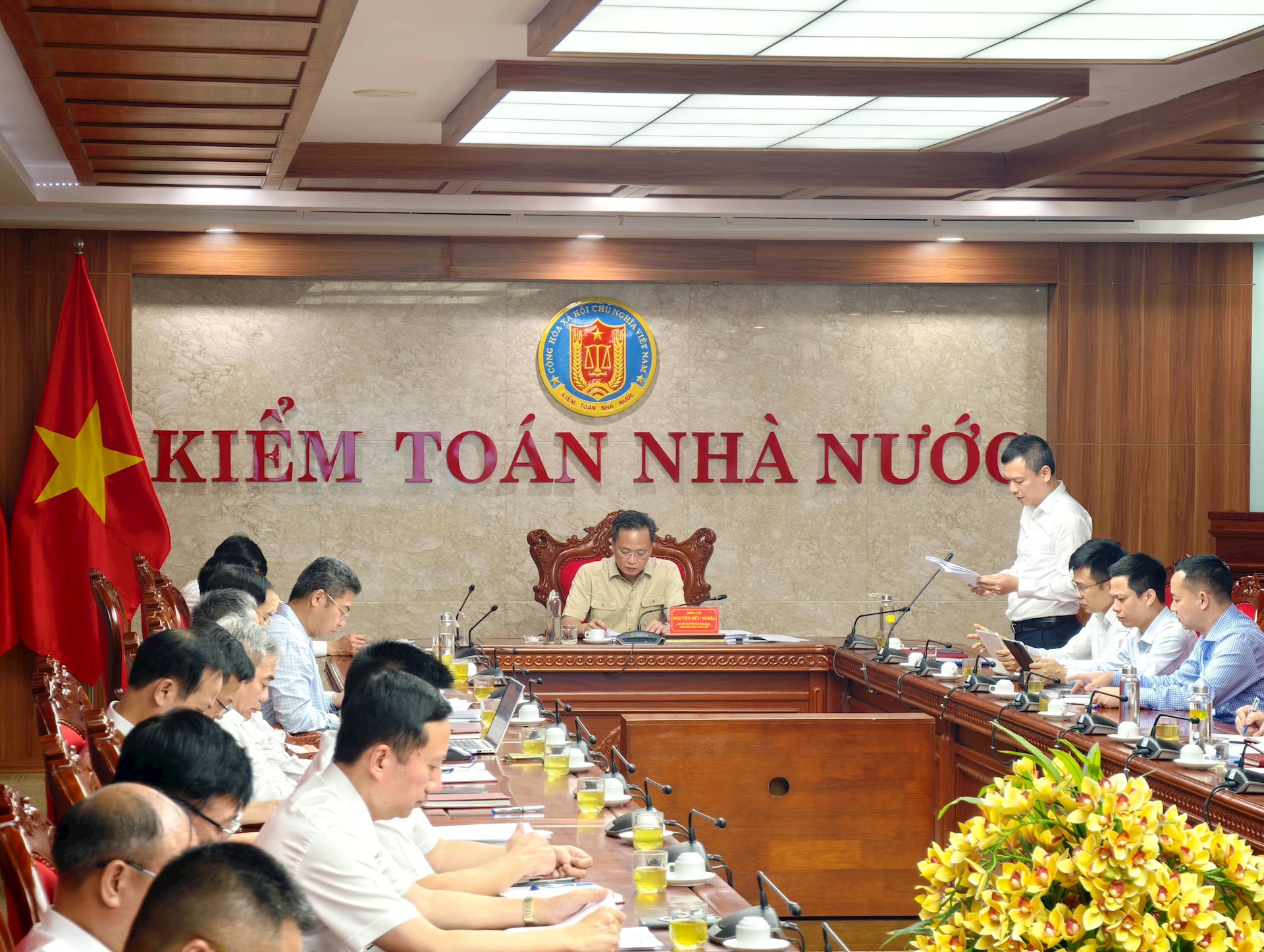
The SAV Steering Committee for the Development of Science, Technology, Innovation and Digital Transformation holds its regular meeting under the chairmanship of State Auditor General Nguyen Huu Nghia.
The Draft also analyzes the current status of 27 software systems currently in operation, identifies technical gaps, and proposes 13 groups of priority tasks, aiming to shift from traditional audit methods toward data-driven auditing based on big data and the application of artificial intelligence (AI).

Director General of the SAV Department of Information Technology Pham Huy Thong presents a report at the meeting.
During the discussion, leaders of the units highly appreciated the efforts of the Department of Information Technology and the consulting unit in updating the new provisions of the Law on Digital Transformation, the Law on Cybersecurity, and the national digital architecture orientations. However, from a professional perspective, many candid opinions pointed out that the Architecture Framework must not stop at generic technical diagrams or abstract technological concepts, but must address the practical interoperability of different systems.
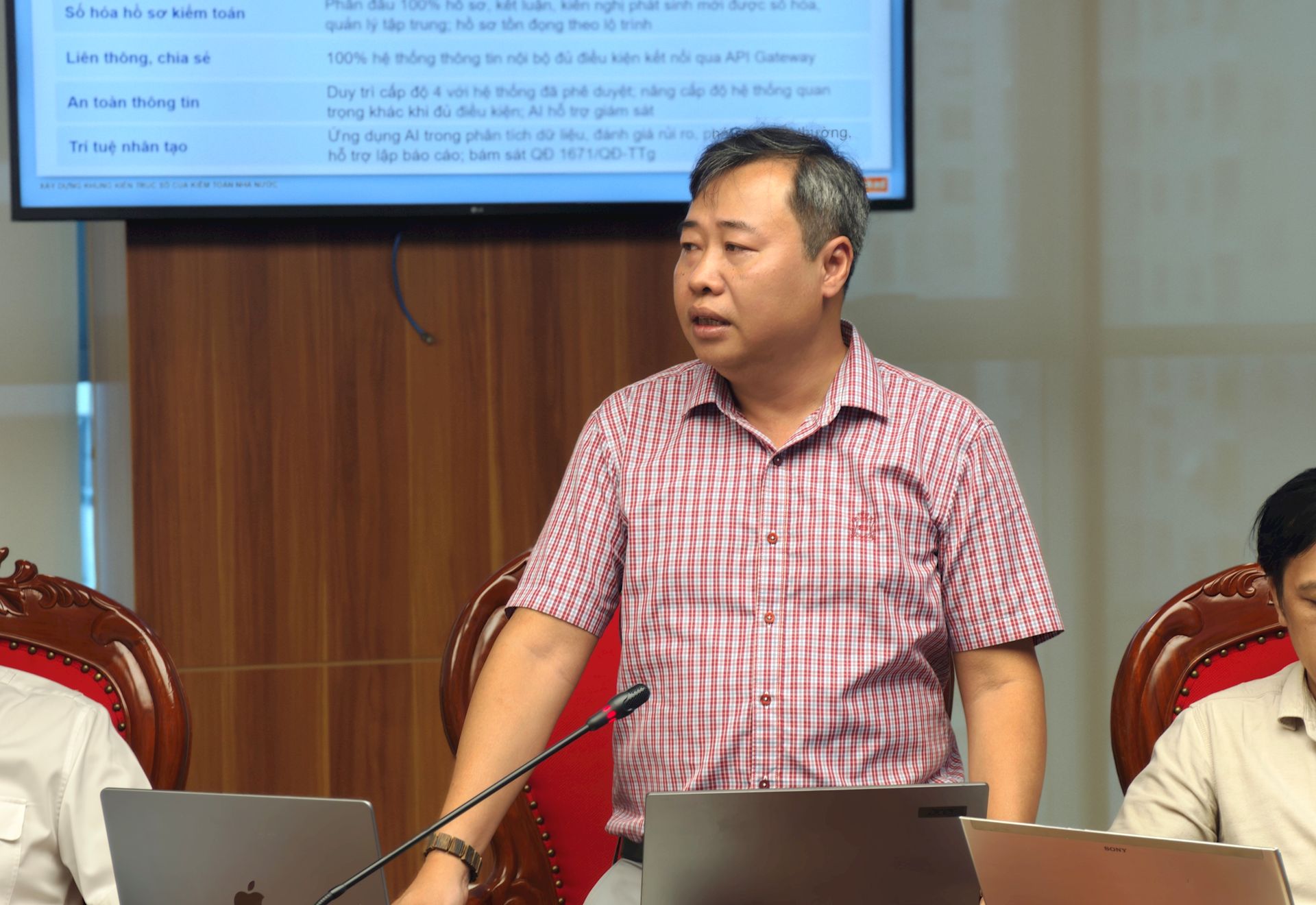
Representative of the consulting unit presents a report at the meeting.
Representatives of the units also emphasized that a prerequisite for successful digital auditing is access to source data at the level of individual transactions from audited entities, rather than relying solely on aggregated financial statements or static data files. At the same time, the application of AI must be directly integrated into each step of the audit process to support auditors in information retrieval, risk detection and report preparation, rather than being implemented on an ad hoc basis as is currently the case.
No pursuit of perfection: 2030 set as the target year for the transition to digital auditing
In his directive remarks and concluding the meeting, State Auditor General Nguyen Huu Nghia, Head of the Steering Committee, commended the Department of Information Technology and the consulting unit for their efforts to complete a substantial workload within a short period. He affirmed that the SAV considers digital transformation a key political task that must be implemented systematically and thoroughly, with investments delivering tangible results for professional activities. In this process, the Digital Architecture Framework serves as a “guiding compass” and is a mandatory step in planning the overall architecture, putting an end to fragmented, piecemeal and overlapping investments.
Providing specific directions for finalizing the Framework, the State Auditor General requested the following:
Adjust the timeline to 2030: The current Draft sets its vision to 2031 and needs to be adjusted to 2030 to align with the State Audit Development Strategy through 2030, pursuant to Resolution No. 999 of the National Assembly Standing Committee, as well as the country's overall direction. The entire three-phase roadmap must also be reviewed and recalculated to ensure consistency with this timeline.
Build on and clarify the distinctive characteristics: Developing the Digital Architecture Framework does not mean “starting from scratch,” but rather building on the previous architecture framework, retaining appropriate elements, removing unreasonable aspects, and incorporating new technologies. In particular, the Framework must clearly reflect the distinctive characteristics of the SAV as an independent audit institution operating under a centralized vertical system from the central level to regional State Audit Offices.
Start from professional requirements: “Consultants can only help solve technical problems, while the professional units themselves must clearly state what they need.” The State Auditor General requested that heads of professional units directly engage in the process and prepare the core business processes for digitization by the technology team, categorically avoiding leaving or outsourcing the entire task to the Department of Information Technology.
Take the initiative in audit data: Data is a resource and the “lifeblood” of modern governance. The SAV has more than 11,000 audited entities across various sectors and industries; therefore, a single data collection formula cannot be applied universally. Professional units cannot simply wait for data to become available from external sources. Instead, they must proactively propose the categories of data that need to be accessed and exploited, while completing the legal framework to require audited entities to provide detailed digital data.
The nature of digital auditing: Remote auditing and data-driven auditing are intended to detect and provide early warnings of signs of violations and risks, thereby shortening the duration of on-site audits from 60 days to approximately 10–12 days. However, digital auditing serves as a supporting tool to improve the quality of audit evidence; it does not completely replace direct auditing or the professional judgment of auditors.
The State Auditor General requested that all units submit written comments to the Department of Information Technology no later than the afternoon of September 28, 2026, and assigned the Department of Information Technology to closely coordinate with the consulting unit to finalize the Draft and issue the Digital Architecture Framework before September 30, 2026, in accordance with the established schedule. The guiding principle is not to pursue excessive perfection; the Framework should be issued promptly as a basis for implementation, with further adjustments to be made during actual operation as necessary.
Determined to complete all fourth-quarter 2026 tasks
Assessing the results of work in the third quarter, the Steering Committee recognized positive changes across the sector. Notable achievements included 100% of civil servants and public employees completing the “Digital Literacy for All” campaign ahead of schedule; the introduction of paperless meeting rooms and fully electronic document processing and digital signing by SAV leaders from August 15; disbursement for the key AI application project reaching more than 71% of the annual capital plan; and the smooth handover and transfer of rights to exploit digital data following the restructuring of the sector's organizational apparatus.
However, the remaining workload for the fourth quarter is substantial, with more than 50 tasks to be completed. To bring about substantive changes, the Head of the Steering Committee requested that units adhere closely to the “6 Clear” principle — clear people, clear tasks, clear timelines, clear responsibilities, clear deliverables, and clear authority — and focus on the following key tasks:
Develop a common Data Dictionary: Immediately after the Digital Architecture Framework is issued, the Department of Information Technology must coordinate with relevant units to begin developing the sector-wide common Data Dictionary, completing it in November 2026 as a basis for interoperable data connection and sharing.
Approve the list of major business problems: Before October 15, 2026, professional units must complete proposals for the sector's major business problems — such as applying AI to analyze corporate financial statements and identify risks in investment projects — with clearly defined business processes for submission to the Steering Committee for approval.
Implement AI applications in a substantive manner: Accelerate the key technology project and ensure that at least two shared AI applications directly supporting professional activities are put into pilot operation before December 31, 2026.
Rectify the digitization of records: The SAV Office must urgently submit the sector-wide document digitization plan. A clear principle must be strictly observed: No indiscriminate or excessive digitization. Each unit must review, organize and classify its records, digitizing only documents that have genuine long-term archival and professional value, thereby avoiding wasteful expenditure. The SAV must urgently shift to sharing audit reports with the National Assembly through electronic data and put an end to the manual printing and photocopying of paper documents.
Assess and rank IT application (DTI): The Department of Information Technology must finalize the assessment criteria in October and conduct an assessment and ranking of the level of digital transformation of each unit in November 2026. The results will be made public to create a substantive emulation movement across the sector.
Digital transformation in Party affairs: Closely coordinate with the Office of the Party Committee and the Party Committee's Organization Commission to bring four Party administrative procedures onto the online environment and update and standardize the Party member database in accordance with the assigned schedule.
Emphasizing that the period from now through the end of 2026 is a pivotal stage, State Auditor General Nguyen Huu Nghia requested that heads of all units uphold their exemplary responsibilities, provide decisive leadership, and proactively coordinate to resolve outstanding issues completely, ensuring that digital transformation products, once launched, effectively support and improve the productivity and quality of each auditor's work.