During the first nine months of 2026, while efforts to streamline and reorganize the organizational structure continued to be implemented decisively, the State Audit Office of Vietnam (SAV) maintained unity, made concerted efforts and proactively carried out its political tasks in a coordinated and effective manner. As the fourth quarter begins—the final stretch marked by a substantial workload—Auditor General Nguyen Huu Nghia has directed all units to urgently complete the 2026 work plan in its entirety, ensuring progress and quality, with a particular focus on the Audit Plan. At the same time, units must proactively prepare for 2027, making digital transformation and technology application a breakthrough in improving audit effectiveness.
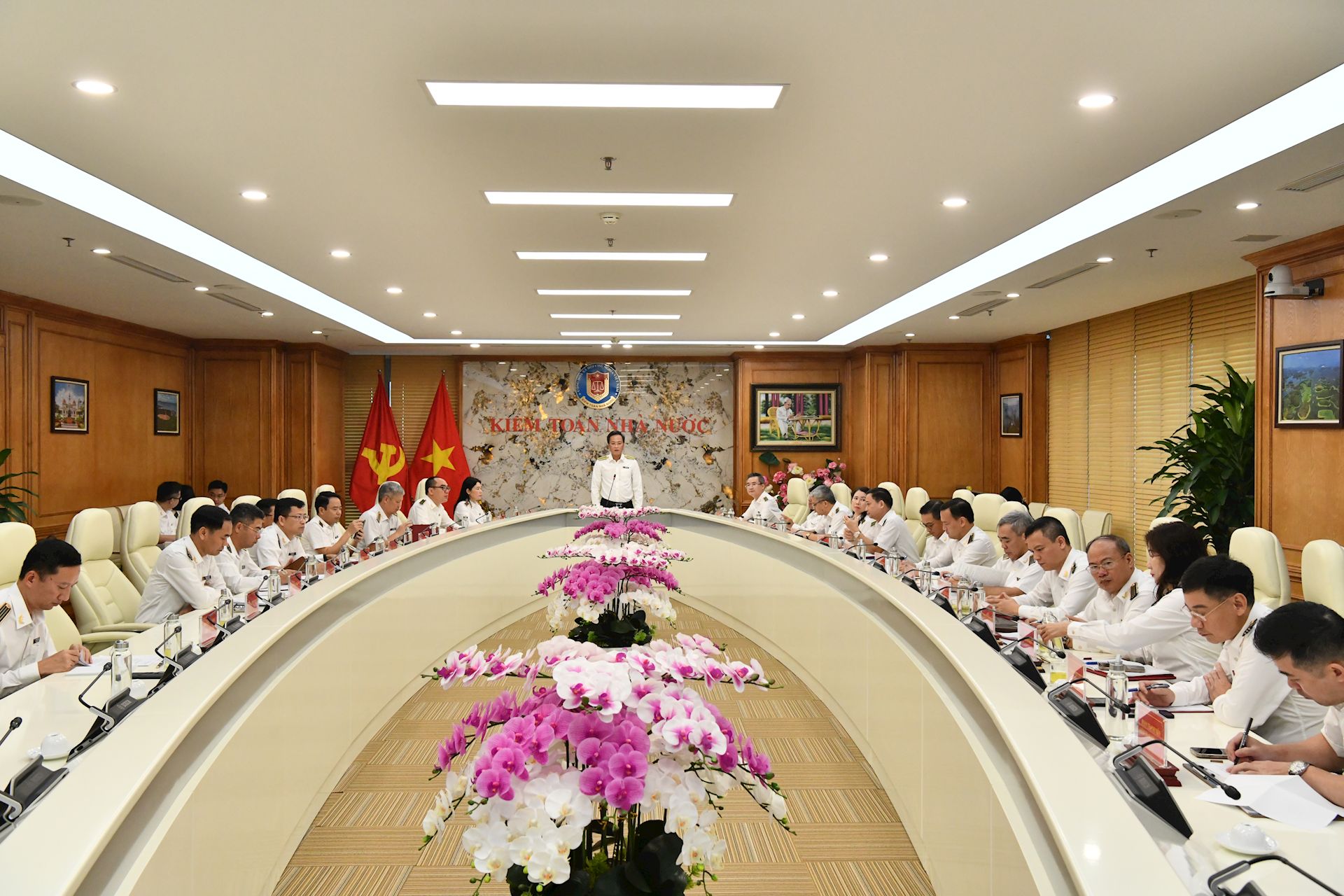
Auditor General Nguyen Huu Nghia calls on the entire sector to focus on completing its 2026 tasks. Photo: N. Loc
Streamlining the Organizational Structure Without Disrupting Operations
One of the SAV’s notable achievements during the first nine months of 2026, particularly in the third quarter, was its continued organizational restructuring and reorganization, completed at an accelerated pace within just 15 days.
Implementing Resolution No. 308a/NQ-UBTVQH dated July 27, 2026, of the National Assembly Standing Committee, the SAV further reduced the number of specialized audit departments by one and eliminated 30 departmental-level units. It also adjusted the functions and responsibilities of its units to ensure a streamlined and professional structure, with clearly defined personnel, tasks, responsibilities and authority, and full accountability for audit results within their respective sectors, fields and assigned jurisdictions.
The restructuring was carried out urgently and decisively, ensuring transparency, systematic implementation and coordination, without room for hesitation or parochial interests. The process fostered consensus and unity among units throughout the sector.
Accordingly, the new organizational model officially commenced operations on August 15, 2026. Audit assignments and routine operations continued uninterrupted and remained stable, with no gaps in leadership, direction or management. The SAV ensured the full implementation of its political tasks, ranging from legal development and personnel management to training, professional development and international cooperation, particularly its core audit responsibilities.
Increasing the Implementation Rate of Audit Recommendations and Referrals to Investigative Authorities
As of September 30, 2026, the SAV had launched 173 audit engagements, completed 123, reviewed 171 draft audit reports and officially issued 145 audit reports.
By September 30, 2026, the SAV had recommended financial adjustments totaling VND 113,952 billion and USD 170,284,999. It also recommended the repeal, amendment or supplementation of inappropriate provisions in 195 documents and called on competent authorities to review and address the responsibilities of collectives and individuals for violations identified through 42 audit reports.
In addition, during the third quarter, the SAV launched 79 reviews of the implementation of its 2025 audit conclusions and recommendations, providing a basis for reporting to the National Assembly. The implementation of audit recommendations for 2025, covering the 2024 budget year, showed positive progress. For recommendations denominated in Vietnamese dong, the implementation rate for financial adjustments and other recommendations reached 79.09%, significantly higher than the 58% recorded in the same period of 2025.
Notably, through its audit activities during the first nine months of 2026, the SAV provided 195 audit reports and related documents to the Central Inspection Commission, investigative authorities and other competent state agencies to support investigations, inspections and oversight. It also provided information and transferred files relating to 16 cases showing signs of criminal offenses to investigative authorities for further investigation and clarification—four times the number recorded in 2025.
Acknowledging and commending these achievements, Auditor General Nguyen Huu Nghia stated that despite the substantial workload and increasingly demanding requirements, the entire sector had demonstrated strong commitment, unity, initiative and decisiveness in implementing its assigned tasks in a coordinated manner in accordance with established programs and work plans. Several audit units had also made considerable efforts to overcome difficulties arising from organizational restructuring, ensuring that professional operations continued smoothly, consistently and effectively.
Enhancing Audit Quality and Making Technology Application a Breakthrough
Emphasizing that the fourth quarter of 2026 would involve a substantial workload to be completed within a short period, the Auditor General instructed audit units to accelerate audit engagements under the 2026 Audit Plan, ensuring that fieldwork is completed before October 31, 2026, and audit reports are issued before December 31, 2026. No tasks are to be carried over into 2027, except for supplementary audits.
In particular, following the restructuring, the functions and responsibilities of various units have changed significantly. Through audit activities and coordination efforts, specialized and regional audit departments must strengthen their role as bridges to Party committees and local authorities, demonstrating their commitment to supporting local development and improving the management of public finances and public assets.
Specialized and regional audit departments must urgently review, take over and clearly assign responsibility for monitoring, urging and inspecting the implementation of audit conclusions and recommendations following the organizational restructuring. For recommendations involving multiple sectors or units, the lead unit and coordinating units must be clearly identified to ensure continuous follow-up and prevent any omissions.
Auditor General Nguyen Huu Nghia
Regarding advisory units, the Auditor General directed the General Department to continue monitoring and urging the implementation of the 2026 Audit Plan to ensure progress and quality. It must also urgently finalize and submit for issuance the audit reports on the 2025 State Budget Final Accounts and the 2025 Public Debt Report for the Ministry of Finance, as well as complete the audit report on the 2025 State Budget Final Accounts and the SAV’s opinions on the 2027 State Budget Estimates and the central budget allocation plan. These documents are to be submitted to the Auditor General for reporting to the National Assembly at the second session of the 16th National Assembly.
Highlighting the important role of inspection and audit quality control in improving audit quality, the Auditor General instructed the SAV Inspectorate to carry out its assigned tasks in accordance with the approved plan. This work is intended to promptly identify, correct and prevent errors in audit activities, ensure that audit teams comply with applicable procedures, standards and regulations, and minimize risks.
Alongside completing the 2026 work plan, the Auditor General instructed all units to proactively prepare the necessary conditions for implementing the 2027 Audit Plan, ensuring there are no delays caused by a lack of guidance or incomplete preparations. “This is an extremely important step in ensuring audit quality and effectiveness,” the Auditor General emphasized.
In particular, the Auditor General directed audit units and the Department of Information Technology to coordinate in strengthening the application of technology in audit activities and promptly address obstacles and shortcomings to maximize the effectiveness of existing software.
The results achieved in carrying out political tasks during the first nine months of the year demonstrate the entire sector’s strong sense of responsibility, unity and determination. Under the Auditor General’s decisive and close guidance, and with the initiative, commitment and urgency demonstrated by individual units, the remaining tasks are being prioritized for completion on schedule and to the required standards of quality and effectiveness. This is not only essential to fulfilling the 2026 work plan but also provides an important foundation for further improving audit performance and affirming the SAV’s role and responsibility in inspecting and overseeing the management and use of public finances and public assets.
Recent audit work at the national statistics agency has demonstrated the practical benefits of using specialized software for data analysis. In the coming period, the SAV will organize training courses on data analytics and specialized software to strengthen units’ technological capabilities and gradually integrate these tools into practical audit activities.
Deputy Auditor General Bui Quoc Dung
To facilitate audit activities, detailed guidance on audit procedures and related matters must be provided at an early stage. In particular, when applying technology to audit activities, special attention must be paid to information confidentiality in accordance with the law. The Department of Information Technology should therefore issue specific guidance on this matter to ensure smooth implementation and minimize risks.
Deputy Auditor General Ha Thi My Dung