The rapid adoption of artificial intelligence (AI) across organizations is outpacing existing governance and control capabilities. The accelerated development of generative AI, AI agents, and the unauthorized use of AI tools (“shadow AI”) poses significant challenges related to transparency, data security, and accountability. In response to these emerging risks, internal audit functions must innovate their methodologies, enhance professional competencies, and strengthen oversight to ensure that AI applications are managed safely and effectively.
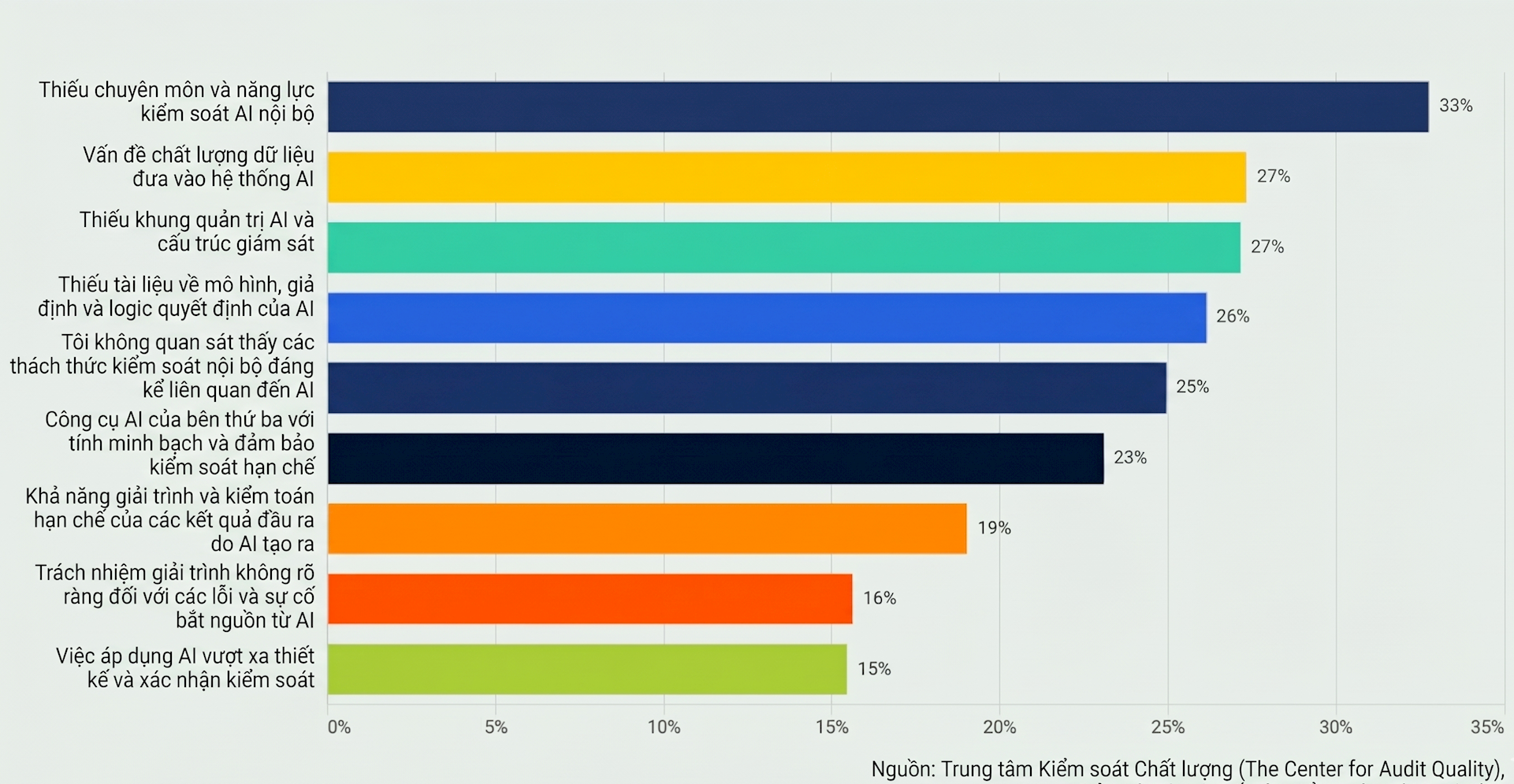
The pace of AI implementation across organizations is exceeding existing governance and control capabilities. Photo: CAQ
Control Gaps Amid the Wave of AI Adoption
AI is driving significant changes in business productivity and operational practices. However, the pace of its adoption is surpassing the ability of governance frameworks and internal control systems to adapt. According to a 2026 study published by the IBM Institute for Business Value, 77% of surveyed organizations reported that AI adoption had outpaced their current governance capabilities. This finding highlights a substantial gap between the speed of technological implementation and the ability to manage associated risks.
The Risk in Focus 2026/2027 report, conducted by the European Confederation of Institutes of Internal Auditing (ECIIA) and The Institute of Internal Auditors (IIA), ranked digital disruption, emerging technologies, and AI as the second most significant category of business risk, with 52% of Chief Audit Executives identifying it as a major risk. Meanwhile, the maturity of AI governance and the scope of AI-related audits remain limited. This is primarily because many organizations have yet to develop the knowledge, skills, and professional capabilities necessary to identify, assess, and manage emerging risks.
Additional challenges for internal audit arise from the operational characteristics of AI models. Their ability to learn from new data and generate different outputs depending on context makes audit documentation, result reproduction, and verification increasingly complex. In particular, the “black-box” nature of certain deep learning models makes it difficult to explain and trace the processes through which input data is transformed into outputs. When errors or losses occur, determining accountability among model developers, system operators, and end users can also be challenging.
Another significant risk is employees' excessive reliance on AI-generated outputs without adequate verification or critical assessment. Such dependence may weaken human oversight and allow errors in data or algorithms to go undetected.
Furthermore, “shadow AI” — the unauthorized use of AI tools by employees without organizational approval — is creating blind spots in internal control systems. Uploading internal data, customer information, or source code to public AI platforms may result in data leakage. Even when third-party software providers automatically integrate or activate AI features within enterprise systems without sufficient assessment, organizations may face risks related to cybersecurity, privacy, and data control.
Integrating Emerging Technologies into Governance Frameworks
In response to these risks, AI should be treated as an integral component of organizational governance and internal control rather than merely as a tool for supporting daily operations. Several international professional organizations have developed guidance to help businesses establish appropriate control frameworks.
The Committee of Sponsoring Organizations of the Treadway Commission (COSO) has published guidance on effective internal control over generative AI, outlining 17 internal control principles applicable to the adoption of this technology. The IIA has also updated its AI Auditing Framework, aligning it with the Three Lines Model and the Global Internal Audit Standards. Accordingly, internal audit functions should evaluate AI strategies, governance mechanisms, algorithmic controls, cybersecurity, and data integrity, thereby supporting boards of directors in overseeing AI-related risks.
One approach highlighted in AI governance research involves shifting from general, static policies toward flexible control mechanisms based on data sensitivity and the risk level of each AI application. Under a tiered governance model, AI applications are classified into four categories:
-
Tier 0 (Prohibited): The use of public AI tools to process confidential information or sensitive personal data is strictly prohibited.
-
Tier 1 (Low Risk): AI may be used to support drafting activities involving publicly available information, subject to simplified approval procedures.
-
Tier 2 (Medium Risk): Applications involving programming or internal data processing require cybersecurity assessments and data storage controls.
-
Tier 3 (High Risk): Applications that automate financial decisions or interact directly with customers require stringent approval procedures, security testing, and emergency shutdown mechanisms.
This classification enables organizations to determine appropriate control requirements for each AI application. For internal audit functions, it also provides a basis for incorporating technical control measures into audit plans, ensuring that AI-related activities can be monitored, evaluated, and supported by properly documented audit evidence.
According to the IIA, digital disruption, emerging technologies, and AI rank second among business risks, with 52% of Chief Audit Executives identifying them as significant risks. As AI adoption continues to accelerate, governance frameworks and control capabilities in many organizations have struggled to keep pace, increasing the risks of data security breaches, limited transparency, and unclear accountability.
Innovating Audit Methodologies and Strengthening Technical Controls
In response to emerging risks, internal audit functions need to move beyond approaches primarily focused on policy reviews toward evidence-based auditing that assesses the operational effectiveness of control mechanisms. KPMG's 2026 report emphasizes that AI trustworthiness must be demonstrated through actual control performance rather than relying solely on organizational commitments or documented policies.
According to KPMG's recommendations, AI audit plans should focus on three key areas.
First, AI governance audits should assess organizational structures, strategies, AI application inventories, the allocation of responsibilities, and third-party risk management.
Second, compliance audits should examine adherence to requirements concerning algorithmic transparency, activity log retention, and human oversight.
Third, AI solution audits should involve quantitative testing of critical AI models, focusing on fairness, reliability, resilience, and vulnerabilities to attacks involving manipulated input data or malicious prompts.
As AI agents become increasingly capable of autonomously executing tasks and interacting across multiple systems, auditors should pay particular attention to access permissions, operational boundaries, execution logs, traceability, and fail-safe mechanisms. Integrating AI governance tools, identity management, and access controls into technological infrastructure can also help organizations enforce control policies during operations, thereby narrowing oversight gaps.
The development of AI presents substantial challenges while also creating opportunities for internal audit functions to redefine their roles and modernize their approaches. Enhancing professional competencies, leveraging technology in audit activities, and strengthening collaboration with risk management and information technology departments will enable internal audit functions to identify emerging threats at an early stage, assess control effectiveness, and contribute to protecting and enhancing organizational value in the digital era.