Supreme Audit Institutions (SAIs) are facing growing demands to shift their focus from financial and compliance auditing toward assessing policy readiness, the quality of public governance, institutional coherence, and accountability in implementing the Sustainable Development Goals (SDGs) and responding to climate change. As Vietnam works toward its commitment to achieve net-zero emissions by 2050, strengthening policy auditing capacity, mastering data, and enhancing inter-agency coordination will contribute to promoting green transformation and sustainable development.
Assessing Governance Capacity and Policy System Coherence
According to the International Organization of Supreme Audit Institutions (INTOSAI) and the INTOSAI Development Initiative (IDI), advancing the SDGs and responding to climate change have become top strategic priorities. Accordingly, IDI has developed the SDG Audit Model (ISAM) to guide SAIs in auditing the preparation for and implementation of the SDGs through a whole-of-government approach.
The most prominent global trend today is a shift in focus. Rather than merely examining how public spending has been used or assessing individual projects, SAIs are increasingly focusing on evaluating government readiness, public governance capacity, policy system coherence, and national accountability for climate commitments.
According to research by MSc. Nguyen Thi Kieu Thu of State Audit Office of Vietnam (SAV) Specialized Audit Department III, practical experience from various countries has recorded a number of innovative audit models. In Canada, an audit report by the Office of the Auditor General of Canada on preparations for implementing the 2030 Agenda showed that the federal government had not established a clear governance structure, lacked a national action plan, and had yet to develop a comprehensive system for measuring, monitoring, and reporting progress.
Based on these findings, the Canadian SAI recommended clearly identifying the lead agency responsible, assigning detailed responsibilities among ministries and sectors, and establishing a national monitoring framework. This is a typical lesson for countries transitioning from policy commitments to measurable implementation.
In India, the Comptroller and Auditor General issued a report assessing the Government’s readiness to implement the SDGs. The report went beyond reviewing commitment documents and examined key governance pillars, including the institutionalization of the 2030 Agenda, financial resource mobilization mechanisms, monitoring systems, and implementation outcomes in priority areas such as Goal 3 (Good Health and Well-being). The experience of the Indian SAI shows that SDG auditing requires an assessment of the linkage between political commitments, resource allocation, and actual implementation capacity.
In Indonesia, the Audit Board of Indonesia (BPK) conducted a performance audit on climate change mitigation and adaptation in the forestry and land-use sectors. A key breakthrough by BPK was the use of emissions data and land-cover data, combined with satellite imagery analysis and remote sensing tools, to verify audit evidence.
This demonstrates that modern climate change auditing cannot rely solely on traditional paper-based records, but must integrate technological techniques and spatial data. In addition, environmental and climate change issues are transboundary in nature, such as water resource management, forest degradation, and greenhouse gas emissions, requiring close cooperation among SAIs.
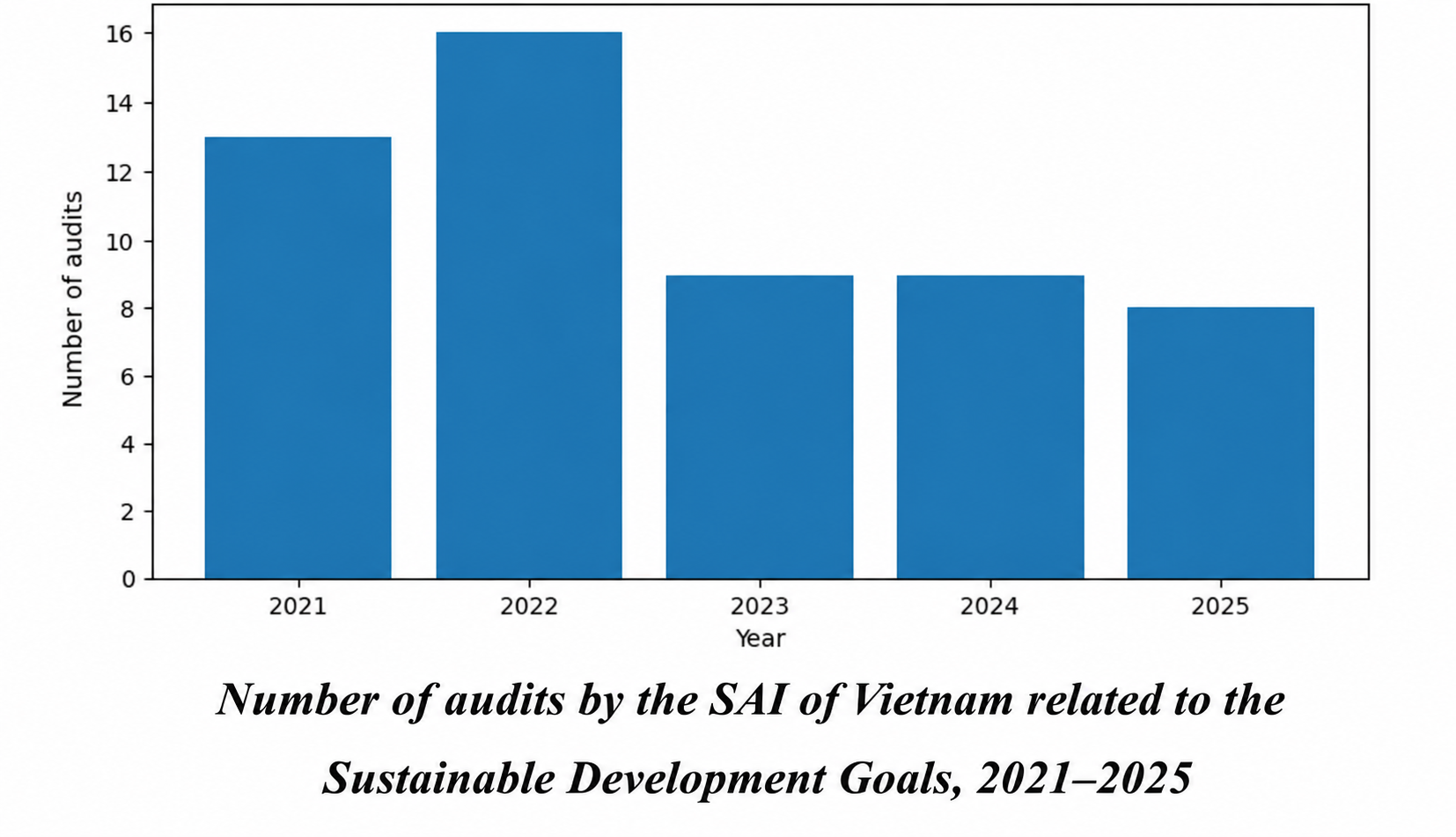
During the 2021–2025 period, the SAI of Vietnam conducted 55 audits containing elements related to climate change and the SDGs. At the same time, audit recommendations have increasingly shifted from addressing individual violations toward correcting processes and improving governance, thereby contributing to stronger financial discipline and accountability, as well as improvements to data systems and coordination mechanisms.
Renewing Audit Thinking and Strengthening Inter-Agency Coordination
In Vietnam, the Party and State have demonstrated strong political determination through the National Action Plan for implementing the 2030 Agenda and the historic commitment made at COP26 to achieve net-zero emissions by 2050. In line with these strategic orientations, the SAI of Vietnam has conducted numerous audits involving sustainable development goals, issued recommendations to address financial violations and rectify management processes, improve policy mechanisms, and enhance accountability.
However, according to MSc. Nguyen Thi Kieu Thu, most audits have so far focused primarily on legal compliance or the effectiveness of individual projects or programs, rather than systematically and comprehensively auditing the implementation of national commitments on climate change and sustainable development under a unified framework. Auditing in this area continues to face challenges related to environmental databases and measurement methodologies.
International experience and practical audit results show that the SAI of Vietnam needs to make a significant shift in audit thinking, moving from compliance checks toward assessing policy outcomes and national governance; and from sector-specific audits based on financial records toward cross-sectoral audits assessing policy readiness, coordination effectiveness, and the quality of public governance. The focus of audits should be closely linked to assessing the preparedness of ministries, sectors, and localities in implementing the National Climate Change Strategy and the energy transition roadmap toward fulfilling the COP26 commitment.
Data must be regarded as core infrastructure for climate change and SDG auditing. Accordingly, institutionalized data-sharing mechanisms should be established with state management agencies such as the Ministry of Finance, the Ministry of Agriculture and Environment (as well as specialized ministries responsible for environmental and natural resource management), the Ministry of Industry and Trade, the Ministry of Construction, and the General Statistics Office. At the same time, the application of Geographic Information Systems (GIS), satellite remote sensing imagery, big data, and digital quantitative analysis tools should be accelerated in the collection and verification of audit evidence.
At the same time, consideration should be given to issuing dedicated professional guidance on SDG and climate change auditing based on the specific application of auditing standards and the ISAM model. The audit criteria framework should clearly distinguish between benchmarks, audit questions, measurement indicators, and sources of evidence.
According to MSc. Dinh Trong Khang, Acting Director of the Specialized Institute of Environment under the Institute of Transport Science and Technology (Ministry of Construction), the SAI of Vietnam needs to develop criteria for coordination mechanisms, assess the cross-sectoral impacts of climate change risks, evaluate the compatibility of adaptation projects and policies with ecological region and river basin planning, and assess the prioritization and effectiveness of ecosystem- and community-based adaptation solutions.
Auditors should not only possess expertise in finance and accounting but also in environmental economics, climate policy, data science, and spatial analysis. Flexible coordination mechanisms should be established with independent experts, research institutes, and universities to support the assessment of complex technical issues in emissions and natural resource audits.
Climate change and sustainable development auditing requires a clear roadmap. During 2026–2027, the focus should be on completing the institutional framework, developing audit criteria and methodologies, and establishing initial data connectivity mechanisms with ministries and sectors. During 2028–2030, the focus should be on strengthening specialized capacity, operating a centralized digital data system, and broadly applying GIS and remote sensing tools in large-scale audits. After 2030, SDG and climate change auditing should be fully integrated into annual audit plans, with processes for assessing policy outcomes standardized.
With a clear roadmap and coordinated solutions, the SAI of Vietnam will not only better meet the requirements for overseeing the allocation and use of public resources but also play a pivotal role in promoting transparency and accountability, making an important contribution to helping Vietnam fulfill its COP26 commitments and advance its green and sustainable development journey toward 2050.