From deeper participation in multilateral mechanisms to expanding cooperation with Supreme Audit Institutions (SAIs), the working trip of the State Audit Office of Vietnam (SAV) delegation, led by Deputy Auditor General Ha Thi My Dung, to Kazakhstan and Slovakia demonstrated that international integration is being pursued within a broader framework. The objective is not only to enhance the standing of the SAV, but, more importantly, to strengthen its contribution to international professional organizations while acquiring knowledge, experience, and new standards to support institutional improvement, methodological innovation, and the modernization of audit activities.
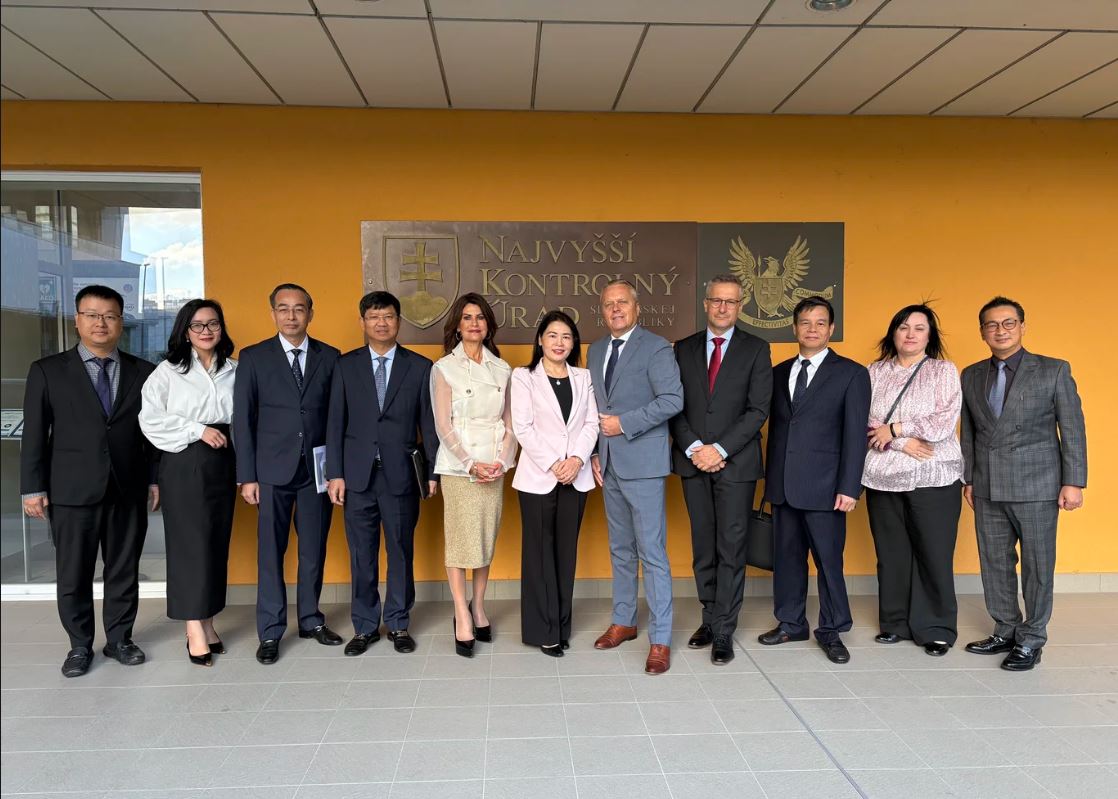
The SAV delegation meets and holds talks with the Supreme Audit Office of Slovakia. Photo: Be Ngoc.
From Membership to a Responsibility to Contribute
In her capacity as a member of the ASOSAI Audit Committee for the 2024–2027 term, Deputy Auditor General Ha Thi My Dung led the SAV delegation at the 63rd ASOSAI Governing Board Meeting in Kazakhstan, at the invitation of the ASOSAI Chair.
With 14 delegations of senior representatives from SAIs in attendance, the meeting discussed various matters concerning ASOSAI's operations, including training and capacity building, research projects, activities of professional working groups, the 2025 financial statements, and the budget estimates for the 2027–2029 period.
The SAV, together with the Supreme Audit Institution of Iran, participated in supervising the voting process for the election of the ASOSAI Secretary General for the 2027–2030 term and the selection of the host SAI for the 18th ASOSAI Congress. The SAV also continued to participate in cooperative audit programs addressing issues of regional and global significance, including the seventh cooperative audit of the Working Group on Environmental Auditing on the topic of mineral resource auditing and the Global Cooperative Audit Program on climate change adaptation actions.
These activities demonstrate that the SAV's role in ASOSAI extends beyond participation in the Organization's mechanisms and increasingly reflects its responsibility to contribute to issues of common concern among the SAI community. The SAV's continued voluntary contributions to ASOSAI's common resources also demonstrate its sense of responsibility and proactive approach to international cooperation.
Deputy Auditor General Ha Thi My Dung affirmed that the SAV is always ready to make active contributions to initiatives and activities of the ASOSAI community, fulfill its responsibilities as a member of the Audit Committee for the 2024–2027 term, and work toward becoming a member of the ASOSAI Governing Board. These efforts are intended to contribute to strengthening professional capacity and the development of ASOSAI and its member SAIs.
Since joining ASOSAI in 1997, the SAV has assumed various roles within the organization, including serving as ASOSAI Chair for the 2018–2021 term and as a member of the Governing Board and Audit Committee. Alongside participating in common activities, the SAV has promoted training, knowledge sharing, and capacity-building initiatives for member SAIs.
International Cooperation Must Translate into Domestic Capacity
While participation in ASOSAI reflects the SAV's responsibility within the international community, bilateral discussions with the State Control Committee of Belarus, the Accounts Chamber of the Russian Federation, the Supreme Audit Institution of Kazakhstan, and the Supreme Audit Office of Slovakia demonstrate another approach: translating international cooperation into specific issues facing the sector.
During talks in Astana, the parties exchanged views on cooperation results achieved in recent years and orientations for future cooperation. The SAV expressed its desire to continue developing practical areas of cooperation that are aligned with the requirements for reforming audit activities.
The issues raised by the SAV with its SAI partners are directly linked to the sector's development process, including the development of the Development Strategy to 2035, with a vision to 2045; amendments to the State Audit Law; enhanced application of information technology; stronger performance auditing and assessment of the effectiveness of public resource management and use; and the application of Big Data, artificial intelligence, and digital technologies in audit activities.
From September 16 to 18, the SAV delegation attended the 63rd ASOSAI Governing Board Meeting, the 30th anniversary of the establishment of the Supreme Audit Institution of Kazakhstan, and the international seminar “The Supreme Audit Institution of the Future: Innovation, Digital Transformation and Sustainable Development” in Astana, Kazakhstan.
From September 21 to 23, the delegation traveled to Bratislava, Slovakia, where it held bilateral meetings with the leadership of the Supreme Audit Office of Slovakia and professional discussions on areas of mutual interest.
At the meetings, Deputy Auditor General Ha Thi My Dung noted that amid a constantly changing global environment, SAIs need not only to ensure the independence and quality of individual audits, but also to strengthen their capacity to anticipate developments, assess policies, and make more timely contributions to national governance.
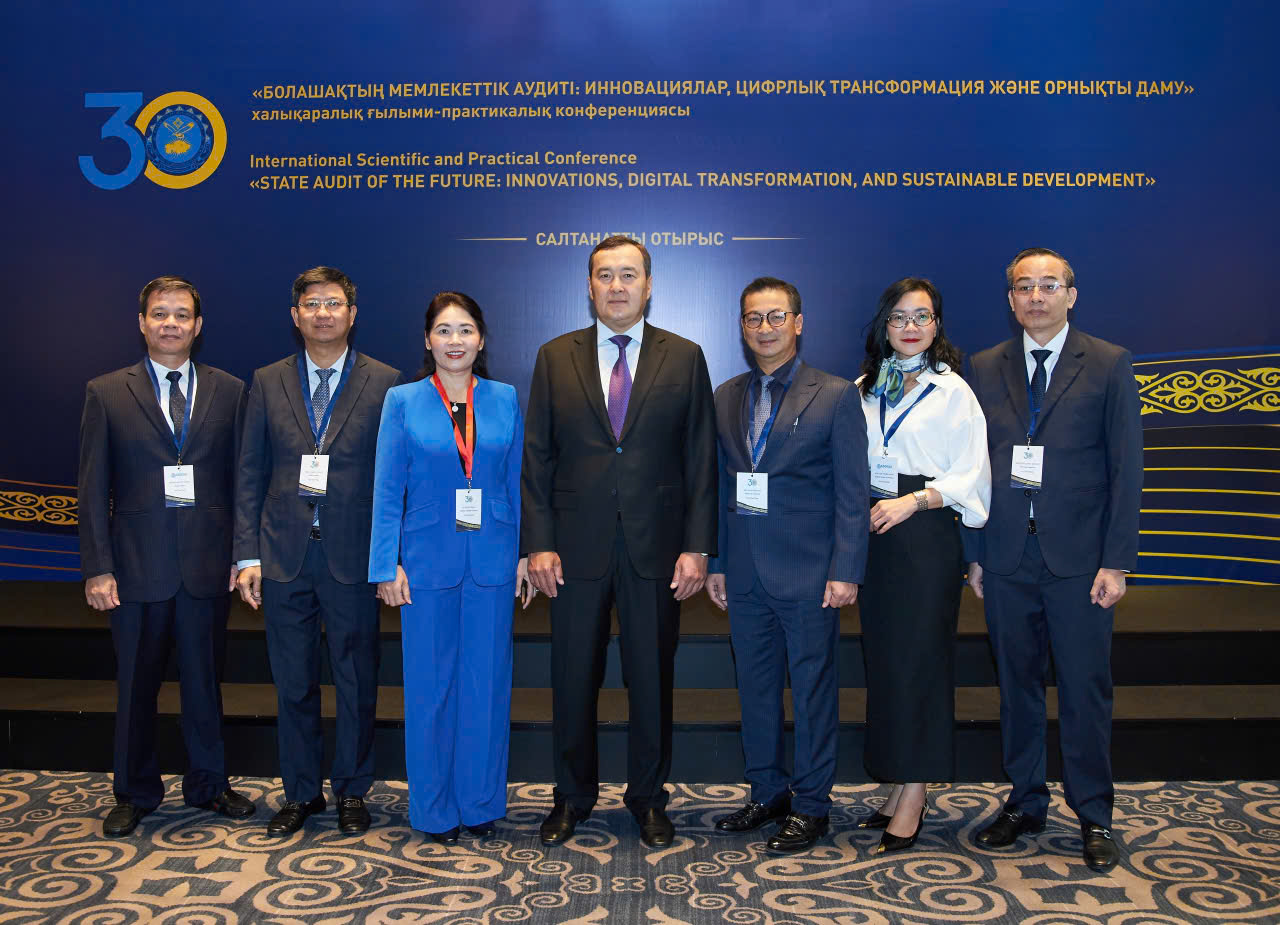
The SAV delegation takes a commemorative photo with Alikhan Smailov, Chairman of the Supreme Audit Institution of Kazakhstan. Photo: Be Ngoc.
At the international seminar organized by the Supreme Audit Institution of Kazakhstan under the theme “The Supreme Audit Institution of the Future: Innovation, Digital Transformation and Sustainable Development,” SAIs shared experiences in technology selection, data integration in auditing, assessment of policy implementation outcomes, the contribution of public resources to the Sustainable Development Goals (SDGs), and strengthening citizen participation.
In Bratislava, professional discussions between the SAV and the Supreme Audit Office of Slovakia focused on improving the legal framework governing SAIs to adapt to emerging trends; developing medium- and long-term development strategies; and applying information technology, artificial intelligence, Big Data, and data analytics in audit activities.
These are all issues of direct relevance to the reform of audit activities. The insights shared by partner SAIs therefore not only supplement professional knowledge but also provide additional reference points for strategy development, legal reform, and the selection of approaches suited to the conditions of the SAV.
From this perspective, international cooperation is not merely about expanding external relations. More importantly, it involves contributing to and helping shape the development of the ASOSAI community while transforming international experience into resources for the SAV's reform process.
Enhancing Standing Must Go Hand in Hand with Strengthening Capacity
Ultimately, international integration should not be measured solely by the number of cooperation relationships or the level of presence in international organizations. Its value also lies in what is acquired, transformed, and created through the cooperation process.
For an SAI, this is particularly significant. Rapid changes in the economy, technology, governance models, and methods of using public resources are creating new requirements for auditing. Auditing must not only identify errors but increasingly be capable of assessing the effectiveness of management and resource use, identifying risks, and providing information to support governance.
In this context, international experience in performance auditing, digital transformation, data analytics, artificial intelligence, institutional development, and policy evaluation represents an important source of reference. However, the value of cooperation does not lie solely in acquiring experience; more importantly, it lies in the ability to transform international knowledge into the SAV's practical capabilities.
The working trip to Kazakhstan and Slovakia therefore not only helped reaffirm the SAV's role and responsibilities within the SAI community, but also opened further opportunities to access knowledge, experience, and new approaches to support the sector's reform process. A stronger standing creates opportunities to expand cooperation, while substantive cooperation provides intellectual resources for strengthening domestic capacity.
From ASOSAI to bilateral relations with other SAIs, the ultimate objective is not simply to establish additional cooperation programs, but to create tangible value for audit activities: improving the institutional framework, enhancing human resources, effectively applying technology, and strengthening the capacity to assess the effectiveness of public resource management and use.
This also provides a foundation for the SAV to continue pursuing more proactive, substantive, and effective international integration. When international experience is transformed into domestic capacity, international cooperation not only contributes to enhancing the standing of the SAV internationally but also becomes a resource for the sector's reform, modernization, and improvement of audit quality.