As part of the State Audit Office of Vietnam (SAV)’s 2026 Training and Professional Development Plan, on September 21 and 22, the School of Audit Training and Professional Development organized a training course on performance auditing of investment projects (Class 5) for nearly 50 auditors from SAV-affiliated units.
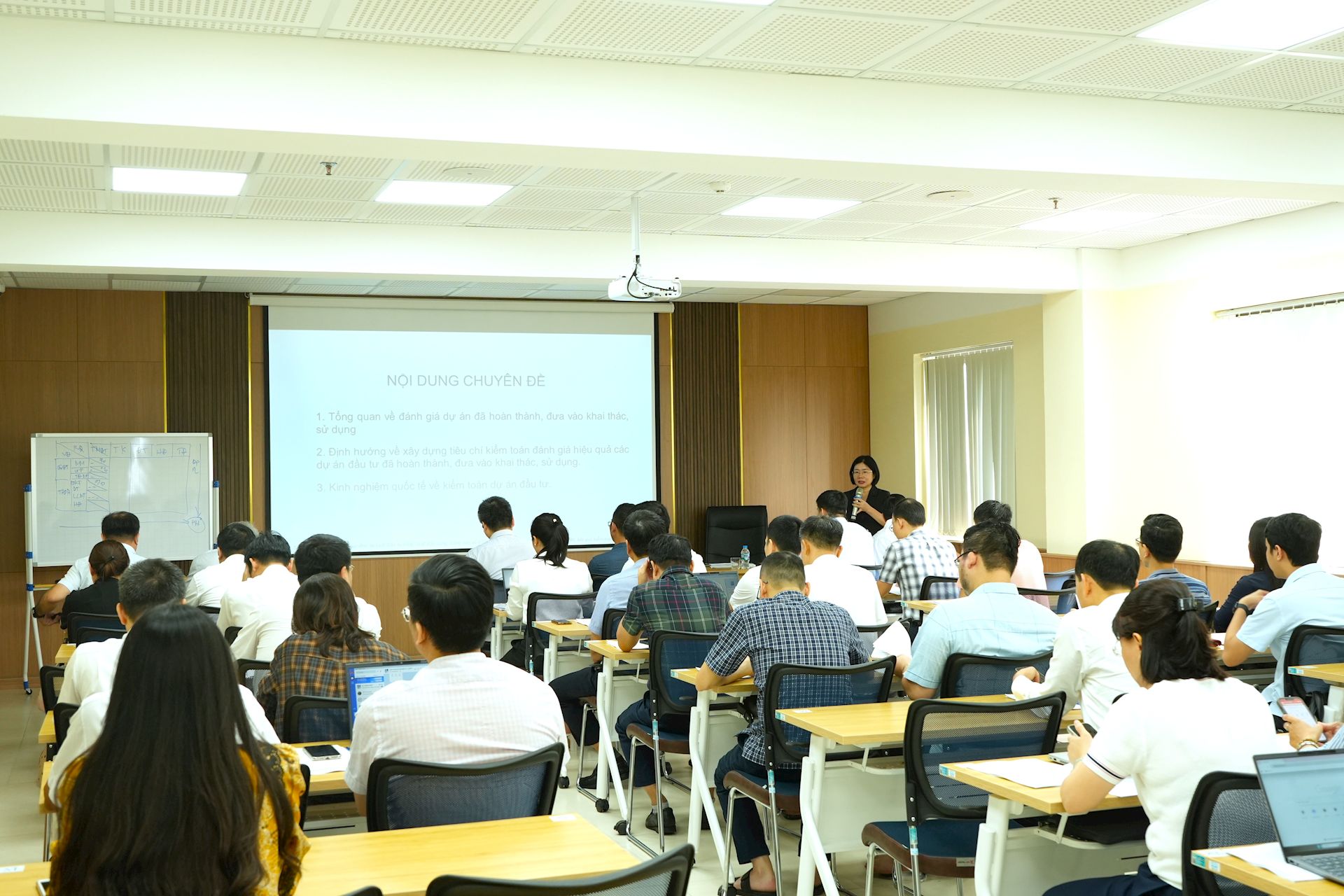
Overview of the training class. Photo: N.LY
Performance auditing of investment projects aims to achieve three key objectives: objectively assessing the actual effectiveness of projects after they are put into operation; promptly detecting violations, corruption, waste and other negative practices in order to determine the responsibilities of organizations and individuals; and recommending improvements to mechanisms, policies, standards and economic-technical norms governing the management and use of public investment resources.
The training program consists of three thematic sessions, focusing on the methodological framework and audit criteria for evaluating the effectiveness of completed investment projects that have been put into operation and use.
The first topic—Guiding Framework for Developing Audit Criteria to Evaluate the Effectiveness of Completed Investment Projects Put into Operation and Use—was delivered by Le Thi Hong Hanh, Deputy Director General of the SAV Department of Policy. The topic enables participants to approach a systematic way of thinking in developing audit criteria in a scientific and objective manner while closely reflecting practical circumstances.
The second topic—Audit Criteria for Evaluating the Effectiveness of Completed Investment Projects in the Transport Sector Put into Operation and Use—was delivered by Lai Xuan Nghi, Deputy Chief Auditor of SAV Specialized Audit Department IV. This topic focuses on the sector currently accounting for the largest proportion of public investment.
The third topic—System of Criteria for Evaluating the Effectiveness of Completed Investment Projects Put into Operation and Use—was delivered by Dao Hai Anh, Head of the Audit Department of SAV Regional Office XII. The session provided in-depth guidance on criteria systems applicable to specific types of works, including transport works, civil works, technical infrastructure works, agricultural and rural development works, and industrial works.

Deputy Director General of the SAV Department of Policy Le Thi Hong Hanh delivers a lecture at the training class. Photo: N.LY
According to Le Thi Hong Hanh, Deputy Director General of the SAV Department of Policy, the course aims to help auditors understand the differences between compliance auditing and auditing the effectiveness of investment projects after their completion and commencement of operation and use, including differences in audit objectives, content and methods. This will enable auditors to establish appropriate criteria and shift from auditing whether public works have been constructed in accordance with their designs to assessing the actual value generated by those works.
In particular, in accordance with the SAV leadership’s requirements, audit teams must conduct assessments based on criteria appropriate to each type of work and quantify the criteria to the greatest extent possible. Therefore, the guiding framework will serve as general guidance, while specialized and regional SAV offices and audit teams will base their assessments on the actual characteristics of each project and select the most appropriate criteria for evaluating the effectiveness of investment projects.
Attending the training course, Nguyen Thi Thu Trang, Head of the Investment Project Audit Department of SAV Specialized Audit Department Ib, expected that the knowledge and experience shared during the course would be effectively applied throughout the audit process, including developing audit outlines, conducting surveys and preparing audit plans, as well as identifying risks and materiality in investment project audits.
“For investment projects, auditing should not stop at assessing compliance and the final settlement value of a project. It must also evaluate the effectiveness generated by the project, including whether the project’s objectives have been achieved, operating and maintenance costs, and the project’s impacts on the economy, society and environment. This will enable auditors to make conclusions and recommendations that closely reflect practical circumstances and have a high degree of persuasiveness,” Nguyen Thi Thu Trang said.
According to the plan, on September 23, the School of Audit Training and Professional Development will organize a class providing an overview of several popular AI tools for auditing activities. The class is designed to equip participants with foundational knowledge of generative AI, prompt engineering techniques, and regulations on information security and audit data confidentiality.
The class will also help auditors apply AI within the permitted scope throughout the audit process, including audit preparation, audit implementation, preparation and submission of audit reports, and monitoring the implementation of audit conclusions and recommendations. At the same time, participants will be thoroughly instructed to strictly comply with the Law on Protection of State Secrets, the Law on Cyberinformation Security, the Law on Cybersecurity, and regulations on personal data protection.