The National Assembly Standing Committee basically agreed with the proposed 2027 State Audit Plan, emphasizing areas involving significant resources, including the state budget, public investment, land, public assets, state capital in enterprises, and banking and finance.

The National Assembly Standing Committee basically agreed with the proposed 2027 State Audit Plan. Photo: Office of the National Assembly
139 Audit Tasks Expected to Be Carried Out in 2027
Reporting at the session of the National Assembly Standing Committee on the afternoon of September 21, State Auditor General Nguyen Huu Nghia said that in 2026, the State Audit Office of Vietnam (SAV) continued to innovate its operations, focusing audits on areas and localities where violations were more likely to arise.
Under the 2026 plan, the SAV is carrying out 132 audit tasks, organized into 180 audit teams. As of August 30, the sector had approved 143 audit plans and deployed 133 audit teams, of which 105 had completed their work and issued 70 audit reports.
Notably, in the first eight months of 2026, the SAV recommended financial measures involving more than VND 80 trillion and USD 47 million, according to the State Auditor General. According to the report, this amount was nearly twice the amount recommended for the entire year of 2025.
Alongside recommendations on financial measures, the SAV has focused on proposing solutions to remove obstacles and inadequacies in mechanisms and policies. During the first eight months of the year, the agency recommended amendments to certain provisions that were no longer consistent with state regulations and practical circumstances in 138 legal and regulatory documents.
The State Auditor General also emphasized that the effectiveness of auditing does not lie solely in the number of audit conclusions and recommendations issued, but, more importantly, in their actual implementation. During the eight-month period, the SAV conducted 79 inspections of the implementation of audit conclusions and recommendations, thereby contributing to the implementation of financial recommendations.
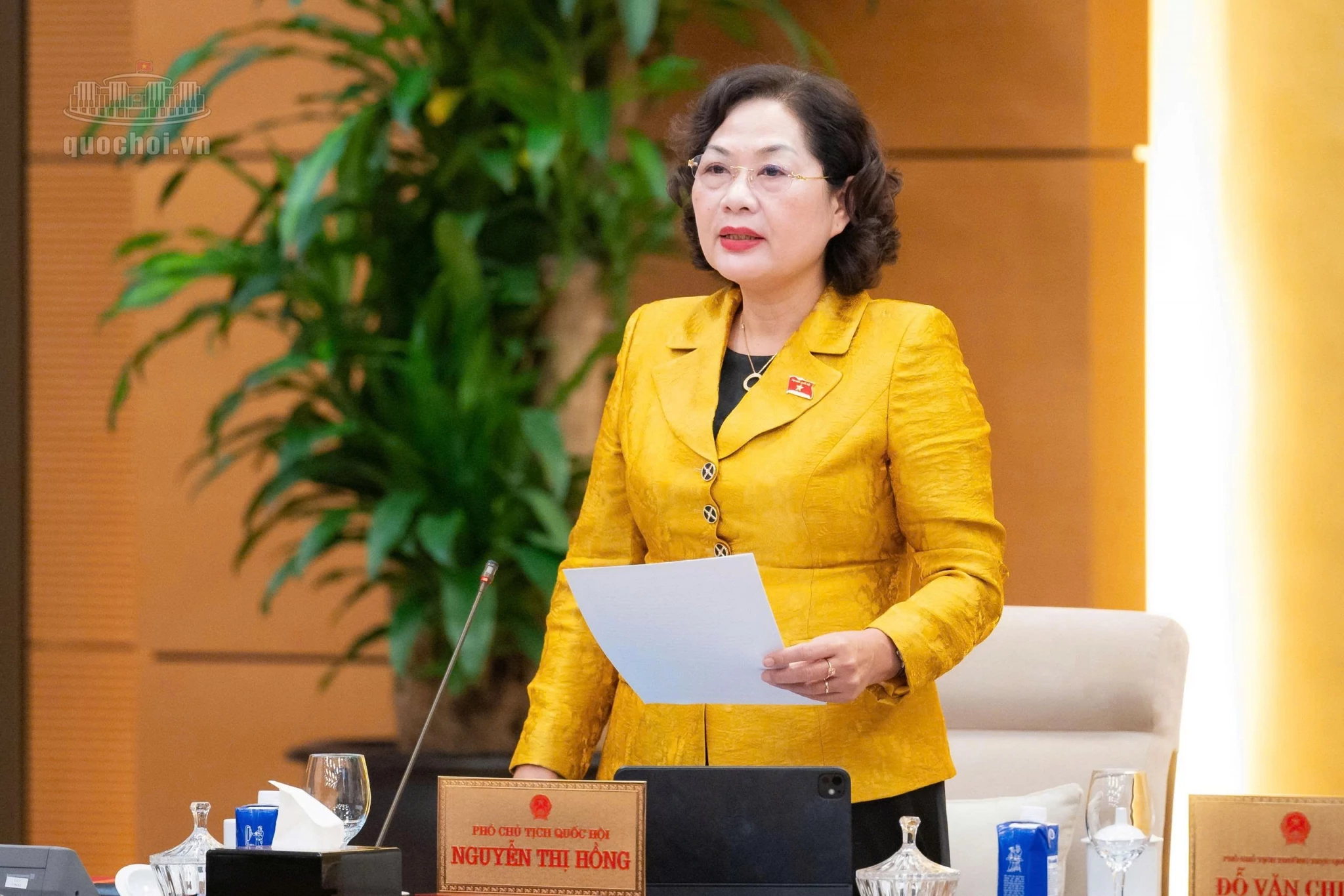
National Assembly Vice Chairwoman Nguyen Thi Hong chairs the session. Photo: Office of the National Assembly
Under the orientation for 2027, the SAV is expected to carry out 139 audit tasks, ensuring audits cover 100% of ministries, central-level agencies and localities, while increasing the proportion of thematic, performance, environmental and information technology audits.
Among the six groups of areas expected to be prioritized for auditing, the first is the management and use of assets, public finance and the state budget. The SAV is expected to audit the management and use of assets, public finance and the state budget at nine ministries, central-level agencies and units; audit final accounts for 34 out of 34 central-level agencies; and audit the final accounts reports of 34 localities.
In addition, the SAV is expected to conduct 24 thematic audits, seven topics covering performance, environmental and information technology audits, and 31 audits of public investment projects. In the enterprise and banking and financial institution sector, the SAV is expected to audit the State Bank of Vietnam, nine groups and corporations, and financial and banking institutions.
Auditing to Improve the Efficiency of Resource Utilization
Reviewing the proposed 2027 State Audit Plan, Chairman of the National Assembly’s Committee on Economic and Financial Affairs Phan Van Mai said that the Standing Committee basically agreed with the proposed plan and recommended that the SAV continue its review toward reducing the number of audit entities while increasing depth and connectivity.
Regarding budget audits, the Standing Committee of the Committee on Economic and Financial Affairs recommended focusing on the implementation of the 2025 Law on the State Budget, particularly the decentralization of revenue sources and expenditure tasks, budget formulation, allocation, execution and settlement, carryovers, budget surpluses, budget reserves, and the management of assets, projects and debts. It also called for an assessment of the quality of resource allocation, the efficiency of resource utilization, output results, and impacts on socio-economic development objectives.
For construction investment, programs and projects, the reviewing body recommended focusing on auditing resource operations, resource mobilization, capital absorption capacity, implementation progress and output results, while assessing the socio-economic effectiveness of projects for which sufficient time and data are available. For enterprises and financial and banking institutions, the proposed focus is on the effectiveness of managing and using capital and assets, asset utilization efficiency, investment effectiveness, and expenditures at risk of loss or waste.
Speaking at the session, National Assembly Chairman Tran Thanh Man highly appreciated the report of the State Auditor General and the review report of the Committee on Economic and Financial Affairs. The National Assembly Chairman noted that auditing should not merely aim to conduct a large number of audits or identify numerous violations; more importantly, it should strengthen early warning and prevention, contribute to building a management system from the central to local levels, and identify issues requiring adjustment.
The National Assembly Chairman requested that the SAV, going forward, focus on strengthening early warning, prevention and policy advisory functions; continue increasing the proportion of performance, thematic, information technology and environmental audits; and ensure that each thematic audit has clear objectives and produces outputs of value to management and oversight activities.
In particular, the National Assembly Chairman emphasized that the audit plan is an important component of the information system serving the Government and the National Assembly, and requested that the SAV provide independent, objective and in-depth information of value to legislative activities, oversight, and decisions on important national issues.

State Auditor General Nguyen Huu Nghia said that in 2027, the State Audit Office of Vietnam is expected to carry out 139 audit tasks. Photo: Office of the National Assembly
Concluding the session, National Assembly Vice Chairwoman Nguyen Thi Hong said that the National Assembly Standing Committee basically agreed with the principles for formulating the 2027 audit plan and the proposed audit tasks, including auditing final accounts reports of ministries, central-level agencies and localities, while increasing the proportion of thematic, performance, environmental and information technology audits.
The National Assembly Standing Committee requested that the plan continue to be reviewed, focusing on areas, programs, policies and projects involving significant resources and high risks, including public investment, nationally important projects, land, public assets, state capital and assets at enterprises, banking and finance, science and technology, and digital transformation.
For the 2026 budget and final accounts audit, attention should be paid to the implementation of the 2025 Law on the State Budget and the operation of the two-tier local government model, including the decentralization of revenue sources and expenditure tasks, and the transfer of assets, projects, debts and funding sources following the restructuring.
The National Assembly Vice Chairwoman also emphasized that increasing the proportion of performance, thematic, environmental and information technology audits must be linked to assessments of economy, effectiveness, efficiency and risk-warning capacity. At the same time, the SAV should promote data-driven auditing, remote auditing, and the controlled application of artificial intelligence, while ensuring information security and confidentiality.
The National Assembly Standing Committee requested that the SAV continue monitoring the implementation of audit conclusions, particularly recommendations concerning amendments to legal documents. It also requested the completion of the 2026 work report and the proposed 2027 State Audit Plan for submission to National Assembly deputies for review and comments, and for reporting to the National Assembly at its 2nd Session as prescribed.