The State Audit Office of Vietnam (SAV) has published the results of its audit of construction activities and the management and use of investment capital for Phase 1 of the My An–Cao Lanh Expressway Construction Project. The audit identified several shortcomings in investment preparation, surveys, technical design, soft ground treatment, the exploitation of construction material mines under special mechanisms, and the management and disbursement of ODA loans.
Phase 1 of the My An–Cao Lanh Expressway Construction Project (the My An–Cao Lanh Project) aims to gradually complete the road transport network in the Mekong Delta, finalize the western North–South Expressway route, promote socio-economic development, and ensure national defense and security in the region. The project is 26.6 km long, with a total investment of VND 6,127.819 billion, funded by ODA loans from the Government of the Republic of Korea through the Economic Development Cooperation Fund (EDCF) and domestic counterpart funding.
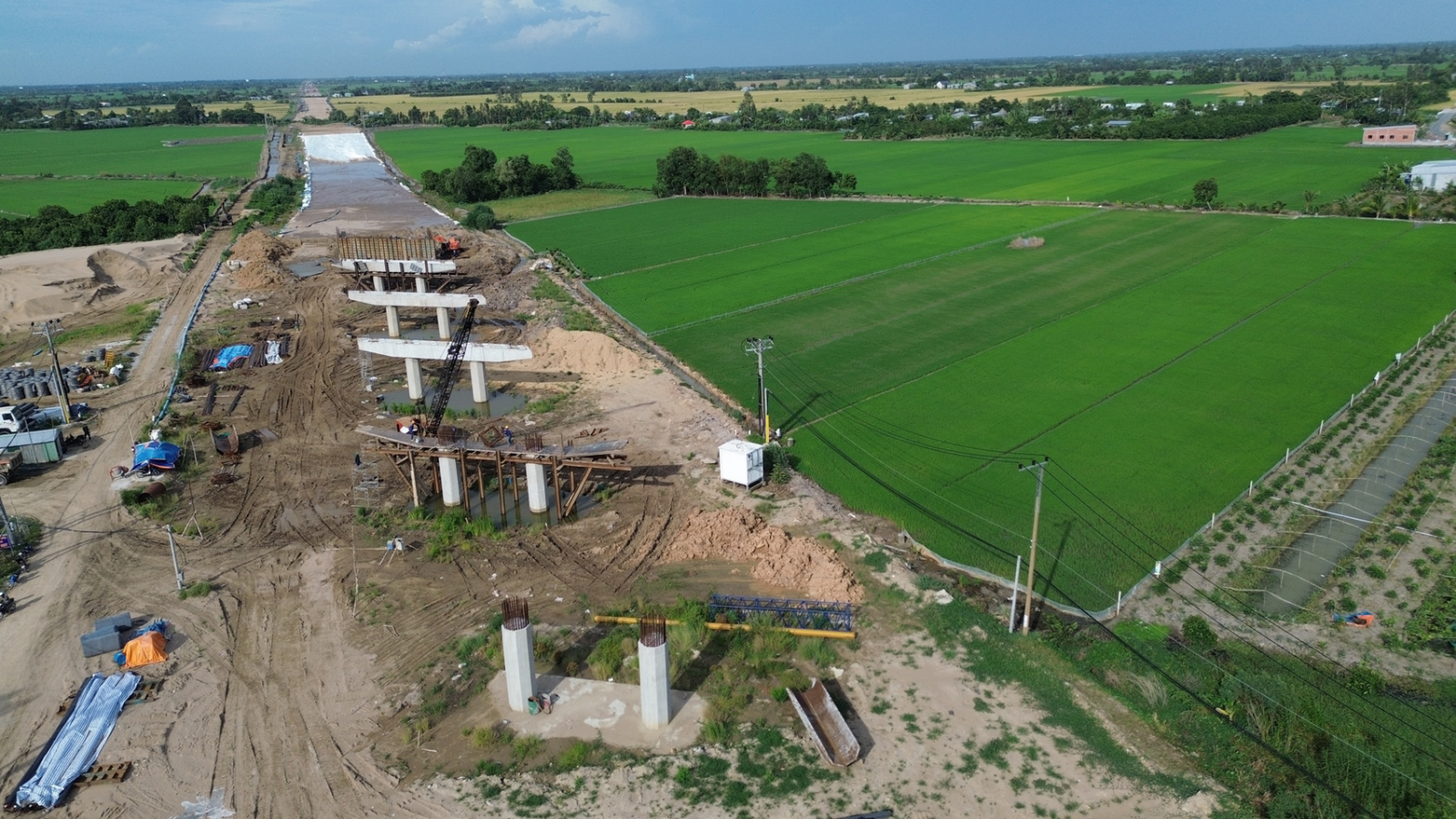
Construction of Tra Bong Bridge on the My An–Cao Lanh Expressway. (Photo: Ministry of Construction)
The audit was conducted by SAV Specialized Audit Department IV from March 4 to April 27, 2026, pursuant to Decision No. 218/QD-KTNN dated February 26, 2026, issued by the State Auditor General. The SAV recommended financial adjustments of VND 182.2 million and other corrective measures valued at VND 2,940.4 million.
Shortcomings in Project Investment Preparation
According to the audit findings, several shortcomings were identified in the preparation, appraisal and approval of the Pre-Feasibility Study Report, the adjusted Pre-Feasibility Study Report and the Feasibility Study Report.
The appraisal of the Pre-Feasibility Study Report and its adjusted version was delayed by approximately 60 days compared with the prescribed timeframe. The Pre-Feasibility Study Report also lacked complete information on preliminary implementation activities.
The Feasibility Study Report did not fully assess options for connecting technical infrastructure inside and outside the project area. Project preparation surveys collected information on the reserves of construction material mines but did not adequately assess their supply capacity or the quality of construction materials.
Certain elements of the basic design lacked sufficient justification for selecting the optimal solution. For example, the vertical clearance of Nguyen Van Tiep A Bridge was not consistent with the technical classification of inland waterways; the design of the overpass at Provincial Road 846 was inconsistent with the planning of National Highway 30B; and no economic and technical analysis or comparison was conducted regarding the use of masonry stone for culvert headwalls and wing walls.
Errors in determining quantities, unit prices and certain cost items during the preparation, appraisal and approval of the total investment resulted in an increase of approximately VND 83.238 billion.
Survey and Design Deficiencies Increase Estimated Costs by More Than VND 61 Billion
Regarding technical surveys, design and cost estimates, the SAV identified numerous shortcomings. The geological survey plan for soft ground did not provide guidance on sampling at boreholes along road cross-sections to establish a basis for determining quantities, preparing cost estimates and conducting surveys. Some survey activities also failed to fully meet design requirements.
The technical design documentation contained several elements that lacked sufficient justification for selecting economically and technically appropriate solutions. Issues were identified in roadbed design and soft ground treatment, including the determination of treatment boundaries, the arrangement of soil-cement columns, and the failure to consider requirements for future road widening during the final development stage. The documentation for soil-cement column ground treatment also omitted certain parameters necessary for construction and quality control.
Construction methods for culverts on soft ground were not adequately explained or evaluated. Hydrological calculations, bridge and culvert designs, and the designs of several other structures along the route also lacked sufficient research and analysis to justify the selected solutions.
Errors in quantities, the application of construction norms and unit prices, and cost calculations during the preparation, verification, appraisal and approval of estimates increased the estimated costs by approximately VND 61.086 billion. In addition, after adjustments, the estimated value of the consulting package for surveys, technical design and cost estimation was approximately VND 119.6 million lower than the signed contract value.
Construction Material Mining Operations Fail to Meet Financial Obligations
The implementation of special mechanisms and policies issued by the National Assembly and the Government for exploiting common minerals used as construction materials for the project revealed shortcomings in determining material demand, completing mine licensing procedures, fulfilling financial obligations and announcing material prices.
For the My An–Cao Lanh Project, contractors had not fully fulfilled their financial obligations for sand mines licensed under the special mechanism. Specifically, water surface rental fees remained unpaid for the Long Khanh A, Long Khanh B and Phu Thuan B mines. The Dinh An mine had neither established the required environmental rehabilitation and restoration deposit nor paid water surface rental fees.
At the time of the audit, the competent authorities had not announced prices for materials extracted under the special mechanism at the licensed mines.
In contractor selection, the division of procurement packages, determination of package prices and scheduling of contractor selection for several packages were inconsistent with the project implementation schedule. Contractor selection and contract signing for some packages were also delayed compared with the approved plan.
Bidding documents and request-for-proposal documents for certain packages contained incomplete or inconsistent contractual provisions. Some requirements concerning advance payments, recovery of advances and payment procedures were not clearly specified. The appraisal of bidding documents also failed to identify and promptly address non-compliant provisions before their issuance.
Contract negotiations, signing and contract management also revealed shortcomings in agreeing on contractual terms. Certain provisions differed between the bidding documents, negotiation minutes and signed contracts. For some packages, the adjusted estimated values were lower than the signed contract values. For packages involving the relocation of public infrastructure, the project owner had not arranged for the handling of recovered materials and equipment after the parties had inspected and confirmed them in accordance with regulations.
ODA Funding Encounters Management and Payment Difficulties
Regarding compliance with financial and accounting regulations, the SAV found that the documentation for Package No. 07 did not fully define the responsibilities of the project owner and contractor in managing and using advance payments for the proper purposes and eligible recipients.
The cumulative amount of allocated capital plans that remained unused and had to be cancelled was substantial, at approximately VND 651.687 billion, including around VND 635.040 billion in ODA loans. The project owner had not prepared and submitted the overall project implementation plan and annual implementation plans for approval by the competent authorities as required by ODA management and utilization regulations. The preparation of documentation for recording disbursed loan amounts as revenue and expenditure was delayed by 6 to 23 days.
Furthermore, the payment mechanism under the contract for Package No. 07, which provides for separate payments in foreign currency (KRW) to the foreign contractor and in domestic currency (VND) to the domestic contractor, has created difficulties in applying foreign exchange management regulations and ODA loan disbursement requirements.
Site Clearance Remains Incomplete
Compensation, support, resettlement and site clearance for the My An–Cao Lanh Project also revealed several shortcomings. The Dong Thap Provincial People's Committee had not issued a decision approving the site clearance subproject. Guidance had not been provided on determining quantities, asset categories and compensation unit prices for certain assets and structures with special characteristics, including concealed or buried assets.
Some compensation, support and resettlement plans approved after July 1, 2025, continued to apply specific land prices previously issued by district-level People's Committees. Documentation for certain households lacked complete information on houses, land and assets. No cost estimates or unit prices had been prepared for underground PVC pipes.
Outstanding advances that had exceeded their recovery deadlines amounted to VND 2.364 billion. There was also no basis for allocating the costs of implementing compensation, support and resettlement activities among individual project owners.
Site clearance was behind schedule. As of March 31, 2026, the relocation of a 220 kV power line had not been completed, and one household had yet to hand over the site at the Provincial Road 846 interchange ramp.
Recommendations to Strengthen Project and ODA Fund Management
In response to the identified shortcomings, the SAV recommended that the audited entities complete the procedures for exploiting construction material mines under the special mechanism; fulfill all financial obligations associated with licensed mines; review and correct errors in surveys, designs, cost estimates and investment cost management; strengthen contractor selection, contract management, acceptance and payment procedures; and urgently complete compensation, support, resettlement and technical infrastructure relocation to ensure full site handover for construction.
The SAV also recommended strengthening the management and use of ODA funds, ensuring compliance with requirements for planning, recording revenue and expenditure, and managing advance payments, as well as fully implementing the recommended financial adjustments of VND 182.2 million and other corrective measures valued at VND 2,940.4 million.
Regarding the improvement of mechanisms and policies, the SAV recommended that the Ministry of Construction review and amend or supplement the system of standards, technical regulations and guidelines governing the survey, design, construction and acceptance of transport infrastructure, ensuring consistent application to projects involving soft ground treatment using soil-cement columns. This includes improving regulations on the inspection, evaluation and acceptance of soil-cement column quality, and reviewing the consistency between TCVN 9906:2014 and BS 8006-1:2010 in determining design parameters, such as the design strength of geotextiles and geogrids, elastic modulus and other indicators used in roadbed structural calculations.
The SAV also recommended that the Ministry of Construction coordinate with the Ministry of Finance to review and amend regulations on general and particular conditions of construction contracts and standard contract forms under Circular No. 02/2023/TT-BXD, as well as regulations governing electronic bidding documents and contractual conditions on the National E-Procurement System. These changes should ensure consistency throughout contractor selection, contract signing and the management of construction contracts funded by public investment capital.
For the Ministry of Finance, the SAV recommended reviewing and improving mechanisms for managing payments under contracts financed by ODA loans, particularly contracts involving joint ventures between domestic and foreign members. The aim is to establish a consistent basis for disbursement, payment and expenditure control in accordance with applicable laws and the financing conditions imposed by donors.