While acknowledging the city’s efforts in budget management, which helped achieve or exceed key economic targets, the State Audit Office of Vietnam (SAV) identified significant shortcomings in revenue and expenditure management, tax arrears, public investment and the implementation of special policy mechanisms in Ho Chi Minh City. With total financial adjustments recommended exceeding VND 9,404 billion, the SAV called on the city to urgently recover budget resources and resolve outstanding issues involving problematic projects.
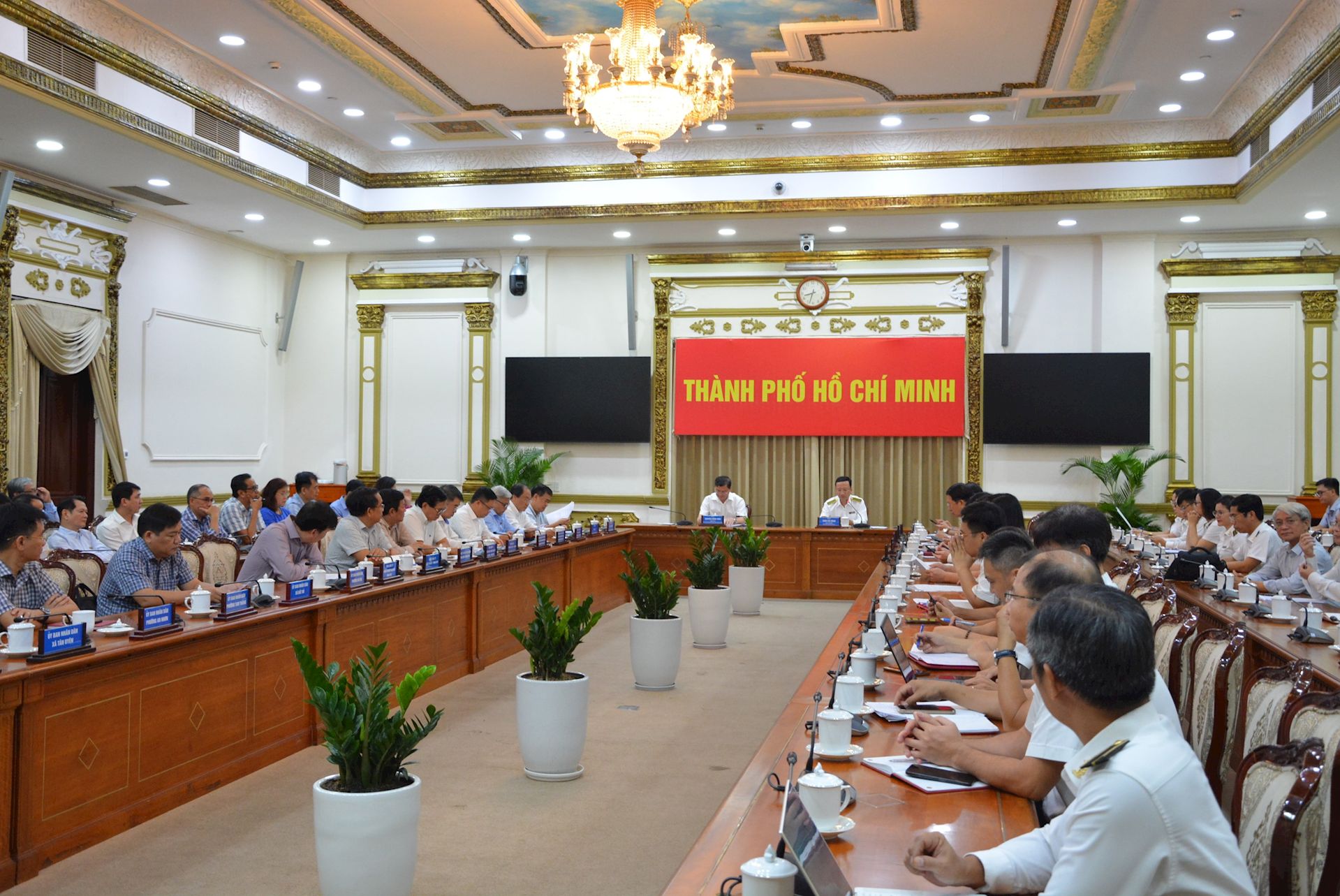
Overview of the conference announcing audit decisions and launching three audit teams in Ho Chi Minh City. Photo: LAM VU
Efforts in Budget Management
The audit results concerning the local budget and the 2025 local budget final accounts of Ho Chi Minh City recognized the efforts of the city’s authorities and departments in achieving and exceeding key economic targets.
Specifically, total state budget revenue collected in the city in 2025 reached VND 800,986 billion, equivalent to 119% of the estimate assigned by the Prime Minister and 115% of the estimate approved by the city People’s Council. Of this amount, import-export revenue reached VND 179,755 billion, representing 106% of the central government’s estimate and a 5% increase year-on-year. Certain domestic revenue items, including land-use fees and land rental payments, recorded sharp increases, partly because major projects made one-off payments.
Total local budget expenditure in 2025, excluding principal debt repayments, amounted to VND 432,551 billion. After excluding transfers between local budget levels totaling VND 59,911 billion, expenditure stood at VND 372,640 billion, equivalent to 191.28% of the estimate assigned by the Prime Minister and 132.61% of the estimate approved by the city People’s Council.
Of the VND 360,648 billion in balanced local budget expenditure, development investment expenditure reached VND 82,130 billion, up 29.98% from the previous year. Recurrent expenditure amounted to VND 106,143 billion, accounting for 29.43% and increasing by 26.75%, while expenditure carried forward to subsequent years reached VND 171,172 billion, accounting for 47.46%. Budget allocations prioritized development investment, social welfare, science and technology, and innovation.
Bottlenecks in Tax Arrears Management and Public Investment Disbursement
Despite these positive results, the SAV identified numerous shortcomings in financial and budget management. The city People’s Committee had not prepared revenue estimates for the excess of owners’ equity over charter capital at wholly state-owned enterprises, amounting to VND 1,577 billion, or for revenue from the leasing and joint operation of public assets, amounting to VND 4,042 billion.
Tax arrears under the tax authorities’ management increased by 49% year-on-year, failing to meet the target of keeping the increase below 5%. The amount of tax arrears collected in 2025 also fell short of the assigned target of collecting at least 80% of collectible tax arrears outstanding as of December 31, 2024.
Payments in lieu of the mandatory 20% land fund for social housing had not been separately estimated in the budget. In addition, tax declaration inspections identified an increase in tax revenue of VND 69.2 billion and a reduction in declared losses of VND 70.5 billion. A company suspected of using illegal invoices was referred to the investigation authorities.
Meanwhile, public investment disbursement reached only 73.24% of the allocated capital plan, falling short of the 100% target. Advances accounted for approximately 50% of total disbursements, or VND 56,187 billion. Of this amount, VND 45,198 billion in advances for compensation and site clearance had largely been transferred to accounts opened by project owners at the State Treasury but had not yet reached the intended beneficiaries. Excluding advances, actual disbursement amounted to only 43.4% of the capital plan.
In particular, the audit found that 192 projects had recorded no disbursement, involving VND 6,269 billion, while 236 projects had disbursement rates below 30%, involving VND 29,541 billion. One example was Component Project No. 6 on compensation, support and resettlement for the Ring Road 3 section passing through Binh Duong Province. Although VND 406.81 billion had been permitted to be carried forward to 2026 for continued implementation, the project owner proposed cancelling the capital allocation, then subsequently registered for and received nearly VND 530.9 billion in central government budget funding for 2026.
Revenue from land-use fees totaling VND 60,955 billion and lottery proceeds totaling VND 11,033 billion had been fully allocated to development investment expenditure. However, the Department of Finance did not maintain detailed records of projects financed by each revenue source or separately track unused balances carried forward for continued allocation to development investment, as required by regulations. At year-end, VND 36,674 billion in development investment budget estimates was cancelled, while the provisional surplus of the provincial-level budget reached VND 44,816 billion as of April 25, 2026. Neither amount was broken down by funding source, including lottery proceeds and land-use fees.
In addition, the city People’s Council reduced development investment expenditure by VND 6,532 billion to increase recurrent expenditure at the commune level by VND 823 billion and contingency reserves by VND 2,180 billion, leaving VND 3,542 billion as a budget surplus. This was inconsistent with the Prime Minister’s directive to strictly economize on recurrent expenditure in order to increase development investment.
Regarding land valuation and social housing, the SAV recalculated the discount rate based on actual conditions at 9.175% for the Thu Thiem Eco Smart City Complex Project, resulting in an additional VND 3,647.733 billion in land-use fees payable to the state budget. The Can Gio Coastal Tourism Urban Area Project also had multiple shortcomings concerning discount rates, interest rates and revenue assumptions. Furthermore, several commercial housing projects had yet to clearly determine the applicable form of social housing provision or fulfill their social housing obligations.
Regarding special policy mechanisms, the city had not implemented the new salary scale under Resolution No. 27-NQ/TW dated May 21, 2018, issued by the 12th Central Committee of the Communist Party of Vietnam on salary policy reform for cadres, civil servants, public employees, armed forces personnel and employees in enterprises. The additional income fund established under National Assembly Resolution No. 98/2023/QH15 on piloting special mechanisms and policies for Ho Chi Minh City’s development had not been capped at 0.8 times the basic payroll fund, resulting in continued excess expenditure. The SAV estimated that such excess expenditure reached VND 2,415 billion in the second half of 2025.
Following the administrative merger, the city People’s Council issued 25 resolutions increasing recurrent expenditure norms and providing special policy support for personnel, applying the highest expenditure levels among the three pre-merger localities. This was inconsistent with the Ministry of Finance’s guidance on financial and budget arrangements during the transition to the two-tier local government model.
Financial Adjustments Exceeding VND 9,404 Billion and Corrective Measures for Numerous Projects
Based on these findings, the SAV recommended financial adjustments totaling more than VND 9,404.15 billion, including an increase in state budget revenue of more than VND 3,726.5 billion and the recovery or reduction of state budget expenditure exceeding VND 5,677.6 billion. Other recommended measures amounted to more than VND 598.642 billion, the remaining contract value was to be reduced by VND 63.662 billion, and corporate losses were to be reduced by nearly VND 70.5 billion.
The SAV recommended that the city suspend additional income payments exceeding 0.8 times the basic payroll fund and report to the Prime Minister on excess expenditure estimated at VND 2,415.4 billion in the second half of 2025. The city was also instructed to direct its Inspectorate to conduct a comprehensive inspection of payments made under Decree No. 178/2024/ND-CP on policies and benefits for cadres, civil servants, public employees, employees and armed forces personnel during the restructuring of the political system.
The city was further urged to reapprove land prices for the Thu Thiem Eco Smart City Project, which would generate an additional VND 3,647.7 billion in revenue, and the Can Gio Project, as well as recover social housing payments from the Phu Thuan Residential Area Project.
The city was also required to review and handle, within its authority, 104 commercial housing projects for which investment policy approval and investor approval had been granted without bidding or auction, considering revocation where violations were identified. In addition, it was instructed to resolve outstanding issues involving 28 encroached public land plots in Phu Dinh Ward and review 16 granite sidewalk projects in Ben Thanh Ward.
The Department of Finance was required to resolve outstanding issues concerning the A-B resettlement area, involving VND 17.3 billion, in coordination with Becamex and the Lai Thieu Ward People’s Committee. It was also instructed to recover amounts payable to the state budget, reimburse recurrent expenditure funds allocated following staff downsizing, and review funding provided to public service units that had transitioned to a different financial autonomy category.
Particular attention was to be paid to clarifying the causes of and responsibilities for registering and allocating capital to the 192 projects with no disbursement and the 236 projects with low disbursement rates. The city was also required to identify and track revenue from land-use fees, lottery proceeds and salary reform funds that had been incorporated into development investment funding, specify the projects financed by these sources, and ensure that the funds continued to be allocated and used for their designated purposes in accordance with regulations.
The SAV’s audit conclusions and recommendations provide an important basis for Ho Chi Minh City to strengthen financial discipline, address existing shortcomings and improve the management and utilization of public budget resources in the coming period.