In the data era, digital transformation is no longer an option but has become an essential requirement for audit activities. For the State Audit Office of Vietnam (SAV), this is not merely a matter of applying technology or digitizing documents, but a fundamental transformation in working methods, audit thinking, and the capacity to oversee public finances. From data analytics to the application of artificial intelligence, the SAV is gradually making digital auditing a core component of its operations.
Digital transformation in audit activities is no longer an option but an essential requirement to fundamentally change audit methodologies, while also representing a long-term strategic step.
Digital transformation in audit activities is no longer an option but an inherent requirement to fundamentally change audit methodologies. Source: Information Technology Department
From Sampling Paper Records to Analyzing 100% of Data
The rapid development of information technology (IT) has brought about fundamental changes in socio-economic management. This also means that the SAV's audit subjects are no longer limited to paper documents and traditional physical records, but are increasingly shifting toward management information systems, electronic payment platforms, e-commerce transactions, and other digital environments. Every day, these systems generate enormous and increasingly complex volumes of data, placing traditional audit methods under new limitations.
While sampling based on paper records and internal spreadsheets was previously regarded as a standard professional practice, in the context of fully digitized processes, this approach carries the risk of overlooking material violations. When sophisticated violations and fraud are concealed and dispersed across a vast “sea of data,” including unstructured data such as emails, electronic contracts, and digitized meeting minutes, manual examination and reconciliation not only consume significant resources but also entail risks and fail to fully meet requirements for transparency in national public finances.
At the same time, expectations from society and state management agencies toward the SAV are increasing. “Post-audit” — auditing after funds have already been spent — is gradually revealing gaps in protecting public assets. Society expects the SAV not only to identify errors after they occur, but also to have the capacity to provide early warnings of risks, prevent the loss of national assets from the outset, and provide timely and insightful policy recommendations for macro-level governance.
According to Deputy Minister of Science and Technology Bui Hoang Phuong, society expects audits not only to identify errors but also to provide early risk warnings, policy orientation, and governance advice. An audit report on public investment should not stop at identifying budget discrepancies, but should also point out underlying causes arising from institutional design or shortcomings in oversight. This challenge requires a combination of multidimensional data analytics and forecasting models based on artificial intelligence (AI) and machine learning (ML).
“To address this complex challenge, the SAV must shift toward a continuous auditing model, monitoring cash flows and transactions in real time to detect anomalies as soon as they arise. This is a critical requirement for fulfilling the mission of protecting a national financial system that is sound, transparent, and efficient,” Deputy Minister Bui Hoang Phuong emphasized.
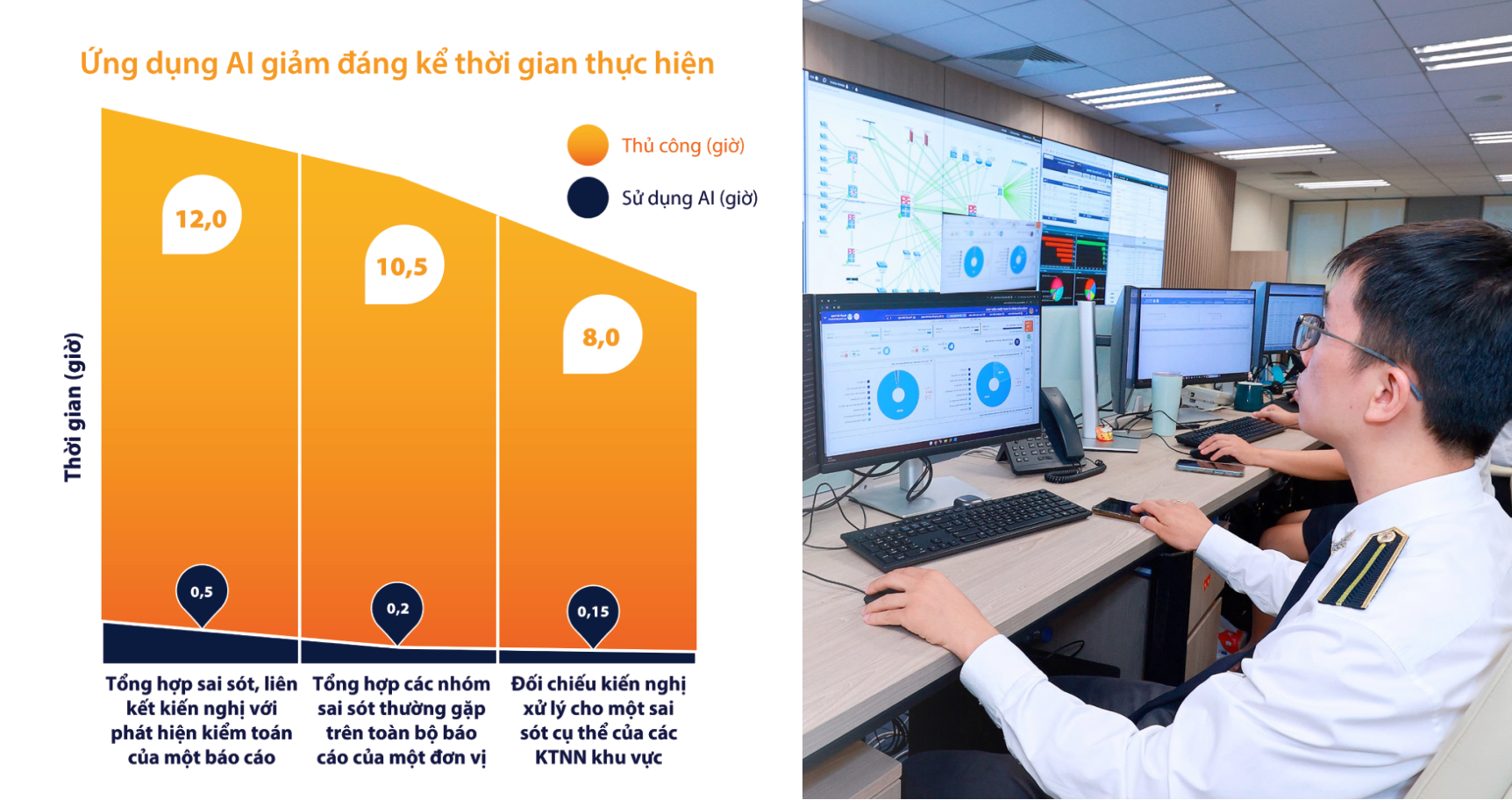
To meet these new expectations, the SAV's audit activities have gradually shifted from sample-based examination of paper records to comprehensive data analysis in the digital environment. Practice has demonstrated the effectiveness of applying new technologies. Notably, during the thematic audit of investment in and application of IT software and the provision of IT services for the Digital Transformation Program for the 2021–2024 period in 13 centrally governed provinces and cities in 2025, the SAV piloted the use of AI and software tools to automatically audit digitization-related procurement packages and collect data from the National E-Procurement System. AI was then used to analyze and cross-check all bidding documents against current legal regulations and data from similar procurement packages nationwide. This approach enabled auditors to rapidly identify bid-rigging, unit-price discrepancies, or cost estimates exceeding prescribed norms, at a speed far beyond that of manual methods.
Digital transformation is not about chasing technology or producing theoretical reports, but must take actual operational effectiveness as the highest benchmark.
Auditor General Nguyen Huu Nghia
Interwoven Challenges and the Driving Force from Resolution No. 57-NQ/TW
Digital transformation at the SAV is a proactive reform journey built on an IT foundation that has been steadily developed over many years. However, despite significant efforts, the SAV continues to face major “bottlenecks” in data and institutional mechanisms.
Based on audit practices, Regional Audit Office I noted that data provided by audited entities is still largely in the form of scanned image files, spreadsheets without standardized structures, data lacking identifiers, and insufficient historical data series. The lack of data standardization makes it difficult to use automated cross-checking tools and AI-based risk analysis. In addition, direct data connectivity and sharing from ministries, sectors, and localities remain incomplete due to institutional and regulatory obstacles.
From another perspective, the sector's digital workforce remains limited, with a relatively low proportion of auditors possessing advanced data analytics skills. In addition, the legal framework and economic-technical norms for digitization and the application of advanced technologies remain inconsistent, creating difficulties and uncertainty in audit practices.
Against this backdrop, Resolution No. 57-NQ/TW dated December 22, 2024, issued by the Politburo, has created a strong and transformative driving force for the SAV. The Resolution identifies science and technology, innovation, and digital transformation as top strategic breakthroughs for bringing the country into a new era of national development. For the SAV, Resolution No. 57-NQ/TW provides additional momentum for the entire sector to make breakthroughs and accelerate comprehensive digital transformation, thereby affirming its position as the highest-level public financial oversight body.
Digital transformation at the SAV is not limited to building technological infrastructure or developing professional software, but is moving toward a broader requirement: transforming the methods of managing, operating, and organizing audit activities on the foundation of data and digital technology.
Auditor General Nguyen Huu Nghia
Under the decisive direction of Auditor General Nguyen Huu Nghia, Head of the SAV Digital Transformation Steering Committee, the entire sector has moved strongly toward concrete and substantive actions. The Information Technology Department is urgently finalizing the Digital Transformation Architecture Framework for the 2026–2030 period for submission for approval in September 2026.
In particular, the entire sector is determined to successfully pilot the application of AI in at least two core audit areas, while affiliated units are also working to integrate technological applications and software more deeply into each audit process. At the same time, the “Digital Literacy for All” movement is being incorporated to develop a four-level digital knowledge and skills framework — basic, intermediate, advanced, and specialized — in order to provide systematic training tailored to each job position and ensure that all civil servants and auditors gradually master new technological tools.
Clearly, digital transformation in audit activities is no longer an option but an essential requirement for fundamentally changing audit methodologies, while also representing a long-term and irreversible strategic step. The ultimate goal is to conduct deeper and more accurate audits, develop early-warning capabilities, create substantive value, and make a meaningful contribution to building integrity and prosperity in national governance. The SAV is making continuous efforts to achieve this goal.
The efforts and achievements of the SAV in making technology and data an integral part of audit activities will be presented to readers in Part 2: “The First Foundations of the Digital Audit Ecosystem.”