Following the public disclosure of the audit results on the 2025 local budget and the thematic audit of tax inspection and examination; tax exemptions, reductions, and extensions of tax payment deadlines; and VAT refunds for the 2023–2025 period in Tay Ninh Province, the State Audit Office of Vietnam (SAV) identified a number of shortcomings and limitations.
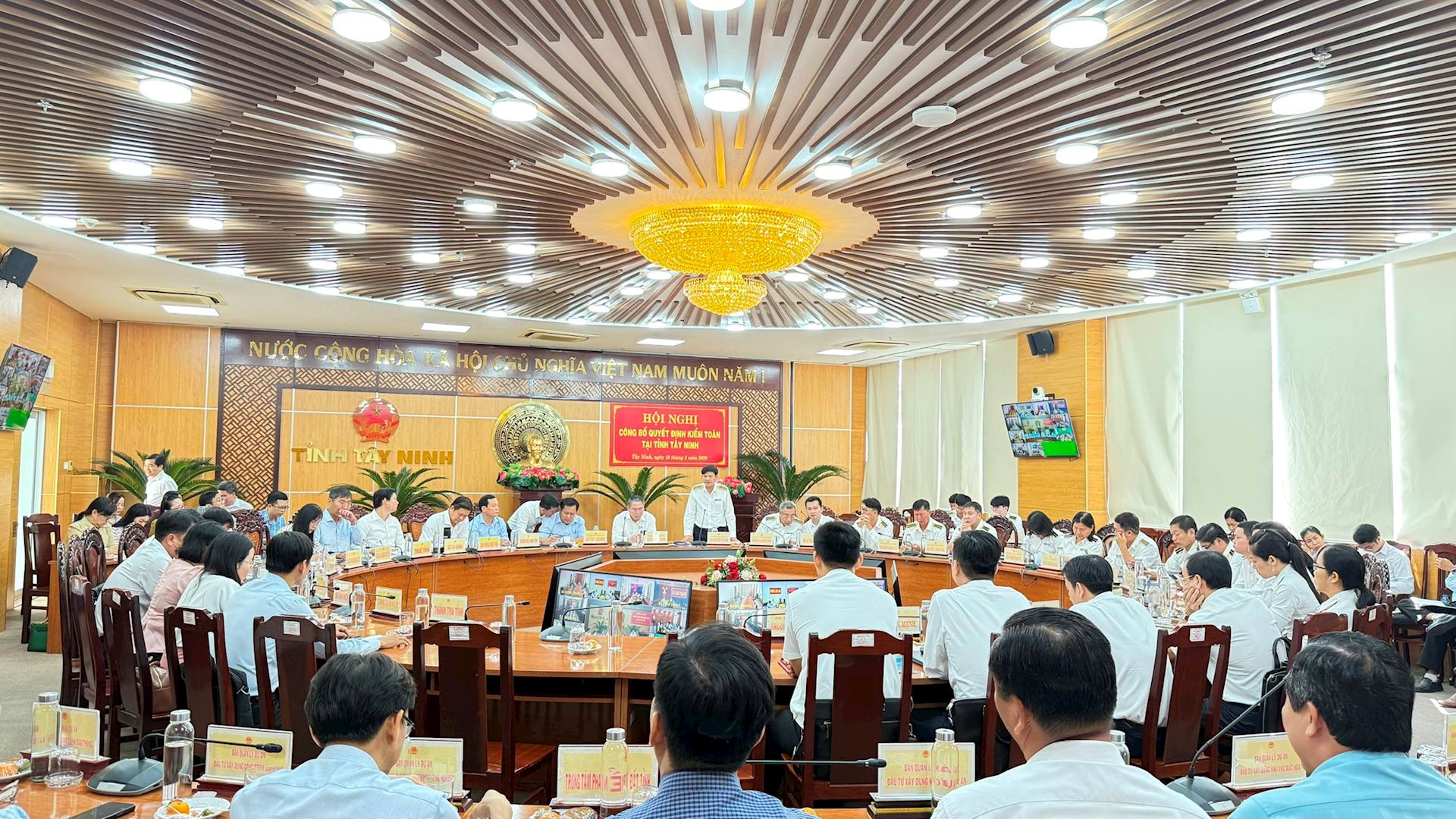
Conference announcing the audit decision in Tay Ninh Province.
According to the audit report, in 2025, under the direction of the two-tier local administration, Tay Ninh achieved positive economic results. The province's GRDP growth rate reached 9.52%, ranking second in the Southeast region and eighth among the 34 provinces and centrally governed cities nationwide.
However, alongside the positive socio-economic development results following the merger with Long An Province, the audit results also identified a number of shortcomings in financial and budget management that need to be addressed. The audit report stated that the total amount recommended for handling exceeded VND 2,845.6 billion, including financial recommendations comprising an increase in state budget revenue of more than VND 128.4 billion and the recovery and reduction of state budget expenditures of more than VND 1,386 billion; a recommendation to reduce losses by more than VND 633.3 billion; and other recommendations totaling more than VND 697.8 billion, including the refunding of funds, supplementation of charter capital, and adjustment of sources for salary reform.
Numerous shortcomings in tax administration and collection
In tax administration, the audit agency identified a number of shortcomings ranging from import-export tax collection to domestic revenue collection. Regarding import-export taxes, Customs Branch Region XVII had not completed the target for recovering overdue specialized tax debts. The management and collection of customs fees and charges also involved delays in remitting revenues to the state budget, with customs fees collected in 2025 amounting to nearly VND 19.2 billion.
Post-clearance inspection also continued to have shortcomings that had not been addressed following the conclusions and recommendations of previous SAV audit teams, such as the failure to proactively develop plans for reviewing and conducting post-clearance inspections of certain specific categories of goods. In addition, errors in determining inappropriate commodity codes resulted in incorrect tax assessments, while a number of goods were omitted because enterprises incorrectly applied commodity codes to benefit from lower tax rates.
Regarding domestic revenue, the incorrect determination of taxable income from real estate transfers resulted in cases where personal income tax was either over-collected or under-collected.
Notably, through the inspection of 11 enterprises with related-party transactions, the audit agency found that these enterprises had incorrectly determined deductible interest expenses in accordance with regulations. This resulted in an under-declaration of nearly VND 14.2 billion in corporate income tax and an adjustment to reduce losses by more than VND 632.7 billion.
The VAT refund process also revealed refunds granted for expenses incurred before construction permits were issued. The amount of VAT that had been refunded and must be recovered exceeded VND 42.1 billion.
Slow disbursement of investment capital and challenges in public asset management
Regarding the management of capital construction investment and recurrent expenditures, implementation and disbursement progress remained slow. According to the report, the disbursement rate of the 2025 public investment capital plan in the province reached 89.6%, below the target of 100% disbursement set in accordance with regulations. Meanwhile, only 53.4% of the capital carried forward to 2025 was disbursed.
In addition, Tay Ninh Province had not returned more than VND 196.9 billion in public investment capital to the central budget after the implementation period had expired. The outstanding balance of overdue contract advances also exceeded VND 1,400.7 billion. The main reasons included contractor bankruptcy, delays in completing procedures for recovering advances, and residents' refusal to accept compensation for site clearance.
Regarding recurrent expenditures, delays in handling remaining district-level budget balances transferred to the commune level resulted in communes and wards transferring the funds to the following year after receiving them and recording them as increased revenue and expenditure savings. In reality, however, these communes and wards had neither increased revenues nor expenditure savings. According to the report of the State Treasury Region XVIII, the total amount transferred and recorded as increased revenue and expenditure savings by 96 communes and wards from this source exceeded VND 777.1 billion.
The management of household waste collection service fees also remained inadequate. The audited communes and wards had not fully compiled lists of households generating domestic waste in order to organize the collection of fees for domestic waste collection, transportation, and treatment. They had also not conducted inspections or supervision of the collection of these service fees by service providers. As a result, the prescribed roadmap for collecting fees for domestic waste collection, transportation, and treatment under the regulations of the provincial People's Committee prior to the merger was not properly implemented, requiring the state budget to continue providing funding to compensate for waste collection activities.
In addition, the implementation of the downsizing policy included cases where allowance levels were incorrectly determined and beneficiaries were not appropriately identified.
The administrative unit merger process also revealed several difficulties in managing public assets and financial resources. Progress in implementing plans for rearranging public buildings and land remained slow. The audit report stated that decisions on the transfer of 276 public buildings and land plots had not yet been issued. In addition, 323 surplus public buildings and land plots had not completed procedures for transfer to organizations responsible for managing and operating housing under the commune-level People's Committees for further utilization planning. As a result, these buildings and land plots were left vacant, without management, and deteriorated due to a lack of care and maintenance.
Regarding the salary reform fund, the audit results determined that the actual figure had increased by more than VND 643.7 billion compared with the figure reported by the Department of Finance to the Ministry of Finance. The province had also not determined the salary reform funding source from 70% of the increase in actual revenue compared with the 2025 estimate to create funding for 2026, amounting to more than VND 5,018.6 billion.
In addition, the audit report clearly stated that the handover of financial resources during the merger of administrative units had not fully covered all required contents. The figures did not fully reconcile with those of the State Treasury; financial inventory minutes had not been prepared; and previous inspection and audit conclusions had not been fully reviewed and resolved.