Through its audit of local budget management, the 2025 local budget final accounts of Vinh Long Province and several related thematic audits, the State Audit Office of Vietnam (SAV) Region IX recommended financial adjustments totaling more than VND 3.41 trillion. Notably, an analysis of electronic invoice data revealed that 21 enterprises showed signs of illegal invoice trading, with the value of goods recorded on invoices but not accompanied by actual goods reaching more than VND 9.01 trillion. The SAV referred information concerning suspected invoice trading and tax evasion to the Investigation Security Agency under the Ministry of Public Security for consideration and handling in accordance with the law.
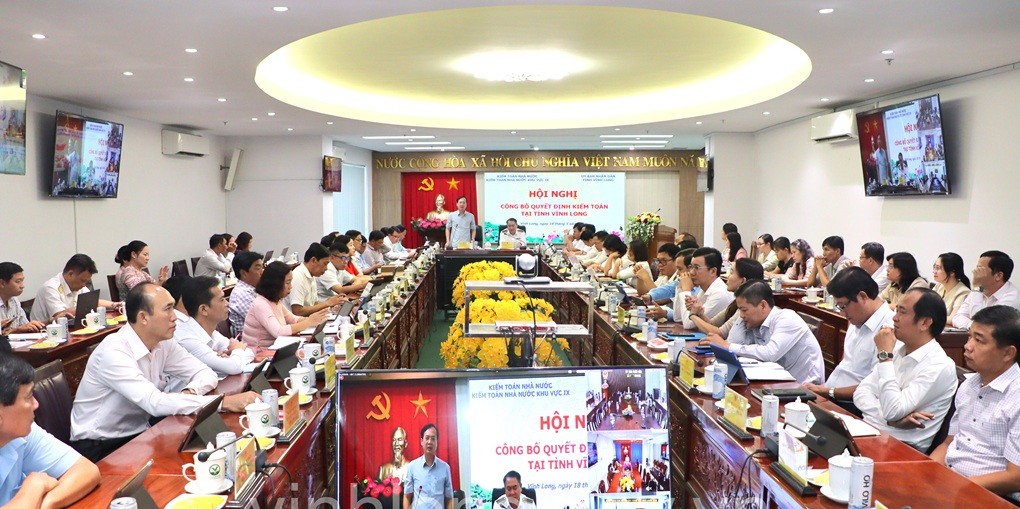
Conference announcing the audit decision and launching the audit plan for the local budget and the 2025 local budget final accounts of Vinh Long Province.
Signs of Illegal Invoice Trading Detected, with Potential Tax Revenue Losses of Trillions of Dong
The results of a thematic audit of tax inspections, examinations, tax exemptions and reductions, extensions of tax payment deadlines, and value-added tax (VAT) refunds for the 2023–2025 period at the Vinh Long Provincial Tax Department revealed several shortcomings in domestic revenue management. Notably, signs of illegal invoice trading and tax evasion were identified through the analysis of electronic invoice data for 2024–2025.
Specifically, the SAV identified 21 enterprises (F0) whose business status was recorded as having abandoned their registered business addresses. These enterprises had issued electronic invoices for goods sold to 248 other enterprises (F1). The F0 enterprises shared several characteristics: they had been established and operated for short periods, their charter capital had been contributed primarily in cash, and their main activities involved commercial trading rather than direct manufacturing. The total value of goods recorded on their sales invoices amounted to VND 9,035.48 billion, while the total difference between sales and purchases reached VND 9,010.54 billion.
Notably, data analysis indicated that most of the goods recorded on the sales invoices were not accompanied by actual goods. This suggests that the F1 enterprises may have used unlawful invoices and supporting documents to record goods and raw materials as input costs, thereby reducing their tax liabilities and increasing the amount of VAT eligible for input tax credits or refunds.
According to the SAV’s estimates, the input VAT corresponding to invoices suspected of being unlawful and therefore ineligible for deduction amounted to VND 901.054 billion. Regarding corporate income tax (CIT), if the F1 enterprises generated taxable income, were not eligible for tax exemptions or reductions, and recorded the entire invoiced value as deductible expenses, the amount of CIT payable to the state budget could have been reduced by approximately VND 1,802.11 billion.
These figures are estimates reflecting the risk of state budget revenue losses; they do not represent officially determined tax losses. Based on the signs of violations identified during the audit, the SAV decided to refer information concerning suspected invoice trading and tax evasion to the Investigation Security Agency under the Ministry of Public Security for consideration and handling in accordance with the law.
In addition to tax-related issues, shortcomings were also identified in the management of land following its recovery and in the determination of land-related financial obligations. At a 13,976.3-square-meter site belonging to Cuu Long Mechanical Joint Stock Company, although the Vinh Long Provincial People’s Committee had issued a land recovery decision, the Tan Hanh Ward People’s Committee had not coordinated with the relevant authorities to take over and manage the site. The enterprise had neither relocated its assets nor handed over the land to the State, but continued to manage and use it. Meanwhile, the tax authority continued issuing notices demanding land rental payments.
At the Phu Khuong Urban Residential Area Improvement Project, invested in by Ben Tre Investment Company Limited, the determination of an amount equivalent to the value of 20% of the total residential land area, in lieu of allocating a land fund for social housing, lacked an adequate legal basis regarding the timing of land price determination. This resulted in the determination of financial obligations that did not fully comply with applicable regulations.
Public Investment Capital Allocated Beyond Approved Total Investment
In the field of basic construction investment, the disbursement rate for Vinh Long Province’s 2025 public investment capital plan reached 74.06%, falling short of the Government’s target of 100%. The allocation of capital to repay advances from previous plans also failed to meet requirements: the locality allocated only VND 125.711 billion out of a total of VND 211.7 billion, equivalent to 59.38%.
Capital was allocated and used for several projects in ways that did not comply with regulations. In particular, the Giao Hoa Riverbank Erosion Prevention Embankment Project used VND 8.1337 billion from the 2023 central budget contingency fund in a manner that was not consistent with applicable regulations.
Notably, the project to build a road connecting National Highway 53, Hoa Phu Industrial Park (Provincial Road 909B), Phu Loc Bau Goc Road and National Highway 1 had an approved total investment of more than VND 1,492.9 billion. However, the total capital allocated as of April 30, 2026, had reached more than VND 1,625.4 billion, exceeding the approved total investment by approximately VND 132.55 billion. This allocation beyond the approved limit did not comply with the principles stipulated in the Law on Public Investment.
In addition, as of December 31, 2025, outstanding basic construction debts for projects and works whose implementation periods had ended amounted to VND 47.755 billion. These debts included projects for which investment capital settlement reports had been approved but whose accounts had not been finalized, as well as completed and accepted works for which final project settlement reports had not yet been prepared or approved.
These shortcomings highlight the need to strengthen discipline in the allocation, management and use of public investment capital, from identifying funding needs and balancing resources to controlling total investment and resolving outstanding construction debts. Capital allocation should be aligned with budgetary capacity, implementation progress and the responsibilities of relevant agencies and units to ensure that public resources are used for the right purposes and in compliance with regulations.
Shortcomings Remain in Budget Management and the Management of Salary Reform Funds
In the management of recurrent expenditure, the SAV identified signs of wasteful use of the state budget at the Vinh Long Provincial Department of Education and Training. The department had prepared and submitted 131 decisions to the Provincial People’s Committee specifying the functions, duties, powers and organizational structures of affiliated schools and centers, at a cost of more than VND 6.744 billion. However, the contents of the decisions for each group of units were largely similar, with the main differences being changes to the names of affiliated units.
Budget administration also involved funding items that had not been handled in accordance with regulations. The provincial- and commune-level budgets had not returned VND 139.977 billion in targeted supplementary funding for which spending purposes had expired to the higher-level budget. The accounting treatment of budget carryovers at the provincial and commune levels was also inconsistent with regulations, requiring adjustments that increased and decreased recorded amounts by a total of VND 829.183 billion.
As of the audit conducted in July 2026, outstanding budget advances accumulated over multiple years and not yet resolved totaled VND 298.696 billion. Of this amount, VND 1.1 billion had been advanced from the central budget and VND 297.596 billion from the provincial budget. Some of these items had already been subject to recommendations in previous audit reports, but the locality continued to track them without fully resolving them.
Regarding salary reform funds, the audit found that Vinh Long Province was required to return VND 921.034 billion to the central budget because it had received excess supplementary funding. In addition, the failure to deduct existing salary reform funds retained by units before allocating further funding had resulted in excess allocations of VND 173.473 billion. The province had also not recovered VND 13.99 billion in budget savings provided to support recurrent operations, arising from workforce streamlining and organizational restructuring, for transfer to the salary reform fund as required by regulations. Some units had used salary reform funds to pay regular salaries inappropriately and were required to replenish these funds.
The findings indicate that shortcomings in budget management extend beyond accounting and final settlement to include the responsibilities of reviewing, recovering, returning and resolving outstanding funding items. Prolonged delays in addressing these issues undermine the transparency of budget figures and affect the ability to control and allocate resources to essential tasks.
Based on its audit findings, the SAV recommended financial adjustments totaling VND 3,410.156 billion. Of this amount, VND 1,582.631 billion related to financial adjustments, including VND 92.391 billion in increased state budget revenue and VND 1,490.240 billion in expenditure reductions and recoveries. Other recommendations amounted to VND 1,827.525 billion.
Full implementation of the audit recommendations is important for strengthening financial and budgetary discipline, correcting shortcomings in tax administration, land management, public investment and budget expenditure. More importantly, audit findings must be translated into concrete actions, with clear accountability assigned to each relevant agency and unit, thereby improving the management and use of public resources in the province.