State budget revenue in 2025 exceeded the estimate, while key financial safety indicators remained under control. However, audit findings revealed shortcomings in revenue composition, budget allocation and expenditure. Land-related revenue accounted for a large share of total revenue, budget carryovers continued to increase, public investment disbursement remained slow, and advances stayed high. These issues underscore the need to tighten fiscal discipline and improve the efficiency of public resource utilization.
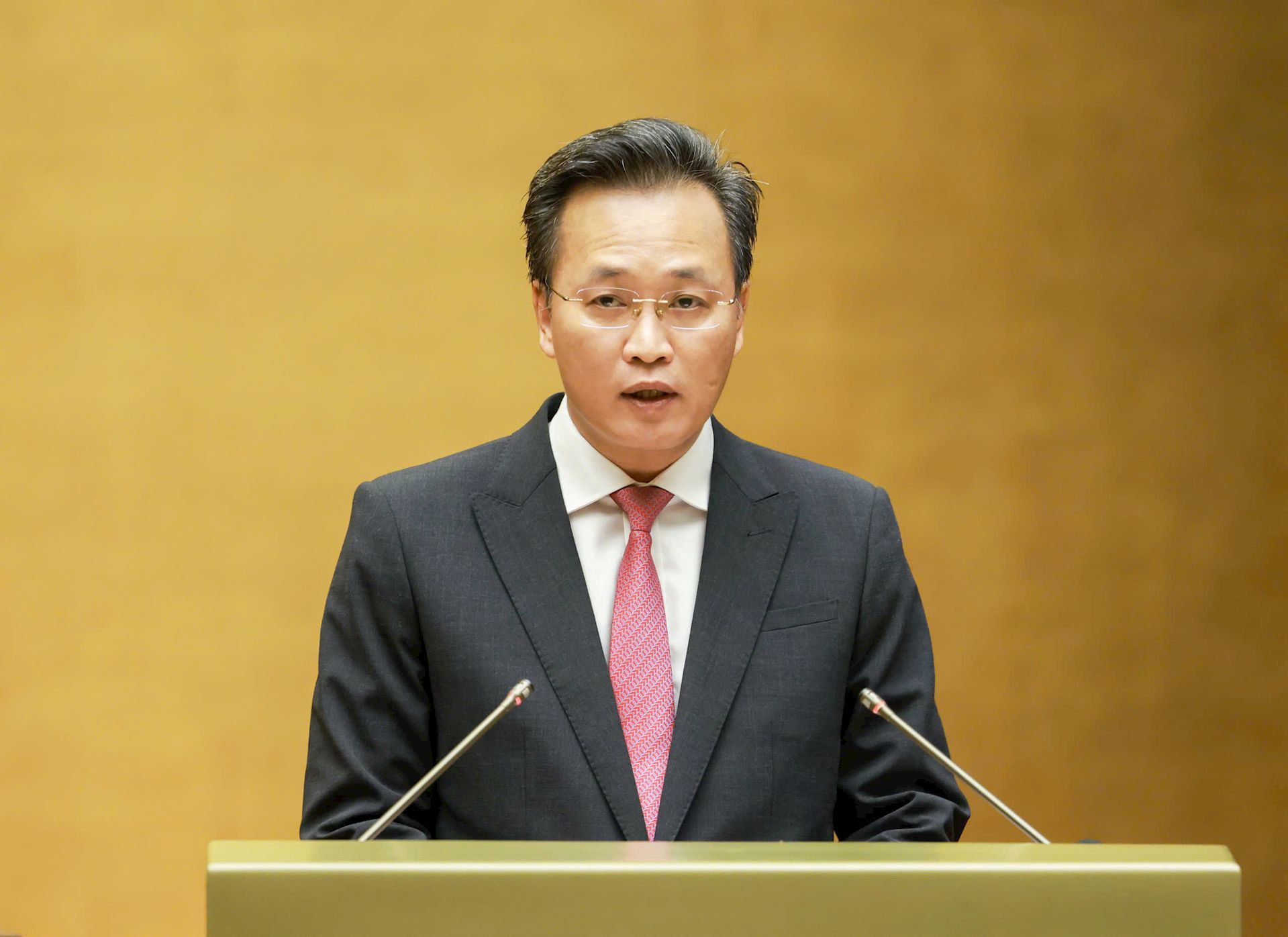
At the Second Session of the 16th National Assembly, State Auditor General Nguyen Huu Nghia presented the audit report on the 2025 State Budget final accounts to the National Assembly. Photo: quochoi.vn
Rising Budget Revenue, but Sustainability Remains a Concern
At the Second Session of the 16th National Assembly, State Auditor General Nguyen Huu Nghia presented the audit report on the 2025 State Budget (SB) final accounts to the National Assembly. This was the first year in which the finalization period was shortened from 18 months to 12 months. Amid the implementation of the two-tier local government model, the State Audit Office of Vietnam (SAV) made significant efforts to fulfill its mandate and ensure that the report was submitted to the National Assembly on schedule.
According to the State Auditor General, from a materiality perspective, the 2025 State Budget final accounts report truthfully and objectively reflected total state budget revenue and expenditure, the budget deficit, local budget surpluses, principal debt repayments, total state budget borrowing and public debt indicators.
In 2025, total state budget revenue reached 21% of GDP, up from 17.9% of GDP in 2024 and exceeding the estimate by 36.8%. This helped secure resources for socio-economic development, foreign affairs, national defense, security and social welfare. Budget revenue exceeded estimates across all three economic sectors: state-owned enterprises by 3%, foreign-invested enterprises by 21.7%, and the non-state sector by 35.7%. Revenue from import and export activities also exceeded the estimate by 35.9%.
State budget expenditure increased by 4.6% compared with the estimate, while the budget deficit stood at 3.1% of GDP and public debt at 33.35% of GDP. However, higher revenue does not necessarily indicate improved sustainability. Audit findings pointed to instability in the composition of domestic revenue: receipts from production, business activities, taxes and fees remained relatively small, while revenue from land, mineral resources and land use accounted for a substantial proportion.
National Assembly deputy Nguyen Thanh Trung, a full-time member of the National Assembly's Committee on Economic and Financial Affairs, stated that revenue from real estate and land reached VND 580 trillion, nearly doubling the estimate. Including one-off land rental payments, registration fees and personal income tax on real estate transfers, land and property-related revenue accounted for 26% of domestic revenue, an increase of 121% compared with 2024.
“This is an unstable source of revenue that does not stem from the economy's internal production and business capacity. This affects local governments' autonomy in budget management, as they remain heavily dependent on this revenue stream. In fact, in 2026, this source of revenue has already been affected in some localities by a slowdown in the real estate market,” deputy Nguyen Thanh Trung explained.
Following its review, the Committee on Economic and Financial Affairs called on the Government to clarify the proportion of additional revenue attributable to land-related receipts, the prospects for sustaining this source of revenue in the coming years, and the extent to which it affects local budget balances.
Revenue management in the areas of land, minerals, taxation, customs and e-commerce also continued to face shortcomings. Tax arrears increased further. Tax arrears managed by tax authorities alone amounted to nearly VND 245.5 trillion, up 20% from 2024 and equivalent to 10.58% of domestic revenue. This situation calls for clarification of the underlying causes, determination of responsibility and action in accordance with the SAV's recommendations.
Speaking at a group discussion session on the 2025 State Budget final accounts, Deputy Prime Minister Nguyen Van Thang said the Government was directing efforts to develop more realistic revenue estimates, separately monitor funding for salary reform, narrow the scope of budget carryovers, and accelerate construction so that advances could be settled against completed construction volumes. Land revenue must be generated in accordance with approved plans and designated purposes, and local authorities must exercise caution when relying on this source to finance projects.
Large Budget Carryovers and Slow Public Investment Undermine Resource Efficiency
While the composition of revenue raises concerns about sustainability, shortcomings in budget allocation and expenditure highlight the need to channel mobilized resources into the economy in a timely manner and deliver tangible results.
According to the State Auditor General, the structure of state budget expenditure in 2025 showed no improvement compared with 2024. The share of investment expenditure continued to decline, while recurrent expenditure increased. Budget management, administration and utilization remained subject to shortcomings, and fiscal discipline was not always strictly enforced. Instances of spending outside approved estimates, procurement and expenditure in violation of standards, spending limits, designated purposes or beneficiary eligibility requirements continued to occur.
Notably, the practice of allocating budgets that were not fully utilized and carrying over large amounts of funding persisted, increasing in both absolute and relative terms. Public investment disbursement remained slow, and allocated capital plans were not fully executed, particularly those funded by loans. Advances accounted for as much as 31% of total public investment disbursements in 2025.
When allocated capital is not deployed promptly, the conversion of public resources into infrastructure, construction projects and productive capacity is delayed. Advances that have not been settled against corresponding completed work also carry the risk of waste and the improper occupation of public funds.
The State Auditor General emphasized: “When the state budget has to increase borrowing to cover its deficit, ineffective budget management, administration and utilization will lead to increased borrowing and state budget expenditure.”
National Assembly deputy Trinh Xuan An, representing Dong Nai City, noted that assessments should not focus solely on disbursement rates. Instead, they should examine how much of the disbursed capital has translated into completed construction work, the status of advances and the progress of projects. These factors provide a basis for evaluating the actual effectiveness of capital utilization rather than relying solely on allocation or disbursement figures.
Speaking at a group discussion on the socio-economic situation, State Auditor General Nguyen Huu Nghia also warned that advance payments do not reflect the physical value of completed construction or its contribution to economic growth. They also carry potential risks of waste and the improper occupation of funds. “Waste and the risks associated with advances must be considered. Public investment disbursement must be substantive and linked to efficiency and savings for the state budget,” he said.
Deputy Nguyen Thanh Trung called for a clearer assessment of the actual effectiveness of public investment disbursement rates and stricter discipline in recovering advances. The objective is not merely to disburse the entire allocated amount, but also to ensure that funds are used for their intended purposes and generate tangible outputs and value.
Maintaining Fiscal Safety and Strengthening Budget Discipline
According to the State Auditor General, national financial security and the state budget remained under control in 2025. However, the need to mobilize resources to support rapid economic growth could increase the budget deficit, public debt and debt-servicing obligations. Meanwhile, losses, waste and inefficient budget utilization persisted. The concentration of Government bond issuance in 10-year maturities could create repayment pressures when the bonds mature, while rising market interest rates could increase the state's borrowing costs.
The efficiency of budget management and utilization is therefore directly linked to the ability to control the budget deficit and public debt. If resources are mobilized but not promptly channeled into the economy, expenditure fails to meet its intended objectives, or investment does not generate commensurate returns, borrowing pressures and debt-servicing obligations will increase.
The audit findings on the 2025 State Budget final accounts underscore the need to further tighten fiscal discipline, improve the quality of budget estimates and strengthen accountability for implementation. Alongside efforts to build more sustainable revenue streams from production and business activities, the authorities must exercise stricter control over budget allocation and utilization, limit carryovers, accelerate public investment implementation, and strengthen the management and recovery of advances.
The objective is not merely to maintain budget balance or keep financial safety indicators under control, but also to improve the efficiency with which public resources are converted into development outcomes. Every revenue stream must be assessed for its sustainability; every expenditure item must be scrutinized for its purpose and effectiveness; and every unit of investment capital must be linked to verifiable results.